
[Paper Review] Differentially Private Representation Learning via Image Captioning
This paper proposes differentially private representation learning via training a vision-language model on internet-scale image-text data using image captioning as a self-supervision signal. By training a DP image captioner (DP-Cap) on a 233M subset of LAION-2B with optimized DP-SGD, the method achieves state-of-the-art linear probe accuracy of 65.8% on ImageNet-1K under ε=8, significantly outperforming prior work and demonstrating that high-quality private representations can be learned from scratch on large-scale data.
Differentially private (DP) machine learning is considered the gold-standard solution for training a model from sensitive data while still preserving privacy. However, a major barrier to achieving this ideal is its sub-optimal privacy-accuracy trade-off, which is particularly visible in DP representation learning. Specifically, it has been shown that under modest privacy budgets, most models learn representations that are not significantly better than hand-crafted features. In this work, we show that effective DP representation learning can be done via image captioning and scaling up to internet-scale multimodal datasets. Through a series of engineering tricks, we successfully train a DP image captioner (DP-Cap) on a 233M subset of LAION-2B from scratch using a reasonable amount of computation, and obtaining unprecedented high-quality image features that can be used in a variety of downstream vision and vision-language tasks. For example, under a privacy budget of $\varepsilon=8$ for the LAION dataset, a linear classifier trained on top of learned DP-Cap features attains $65.8\%$ accuracy on ImageNet-1K, considerably improving the previous SOTA of $56.5\%$.
Motivation & Objective
- To address the poor privacy-accuracy trade-off in differentially private (DP) representation learning, especially under modest privacy budgets.
- To investigate whether training from scratch on internet-scale multimodal datasets can yield high-quality private representations, challenging the belief that such learning is infeasible.
- To improve the efficiency and scalability of DP training pipelines to make large-scale private pre-training computationally viable.
- To evaluate whether DP-trained models can learn generalizable, multimodal representations useful for both vision and vision-language tasks.
Proposed method
- Training a vision-language model via image captioning on a 233M subset of the LAION-2B dataset using DP-SGD for rigorous privacy guarantees.
- Using a contrastive learning objective that aligns image and text features, leveraging the semantic richness of natural language supervision.
- Applying noise injection and gradient clipping in DP-SGD to ensure (ε,δ)-differential privacy with ε=8.
- Optimizing the training pipeline with large batch sizes and adaptive noise scale (σ) to improve signal-to-noise ratio and convergence.
- Employing a vision transformer backbone with masked autoencoding and contrastive pre-training to enhance feature quality.
- Reducing compute cost by nearly 5× through engineering improvements, enabling efficient training on large-scale data.
Experimental results
Research questions
- RQ1Can differentially private representation learning achieve high utility when trained from scratch on internet-scale datasets?
- RQ2Does image captioning as a self-supervision signal provide more efficient information extraction under DP constraints than image-only contrastive learning?
- RQ3What is the optimal trade-off between privacy budget, batch size, noise scale, and compute cost in large-scale DP training?
- RQ4Can DP-trained models learn representations that generalize well to downstream vision and vision-language tasks?
- RQ5How does the quality of DP-generated captions compare to non-private models on zero-shot image understanding?
Key findings
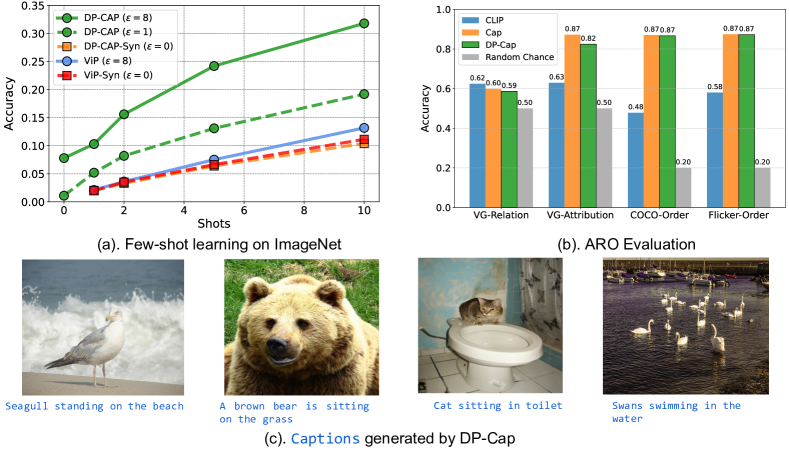
- Under a privacy budget of ε=8, DP-Cap achieves 65.8% linear probe accuracy on ImageNet-1K, a significant improvement over the previous SOTA of 56.5%.
- The model outperforms ViP (Yu et al., 2023), the prior SOTA, by a large margin on the same dataset and privacy budget.
- DP-Cap achieves strong performance on the ARO benchmark for compositional understanding, approaching non-private Cap and outperforming non-private CLIP.
- The model generates grammatically correct and semantically coherent captions on MS-COCO 2017, demonstrating robust zero-shot generalization despite training on noisy LAION captions.
- The training pipeline was optimized to reduce compute cost by nearly 5×, enabling efficient training on large-scale data with high privacy guarantees.
- Increasing the noise scale σ from 0.48 to 0.728 enabled up to 100,000× more gradient steps at fixed ε=8, significantly improving model convergence.
Read this paper
Open the full text in the Nubint reader and ask about any passage as you read.
Read this paper on NubintThis review was generated by AI from the original paper. Please check the paper before citing it.