
[Paper Review] DiffFace: Diffusion-based Face Swapping with Facial Guidance
DiffFace introduces a diffusion-model-based face swapping framework with ID conditioning, facial guidance from pretrained experts, and target-preserving blending to transfer source identity while preserving target attributes without retraining.
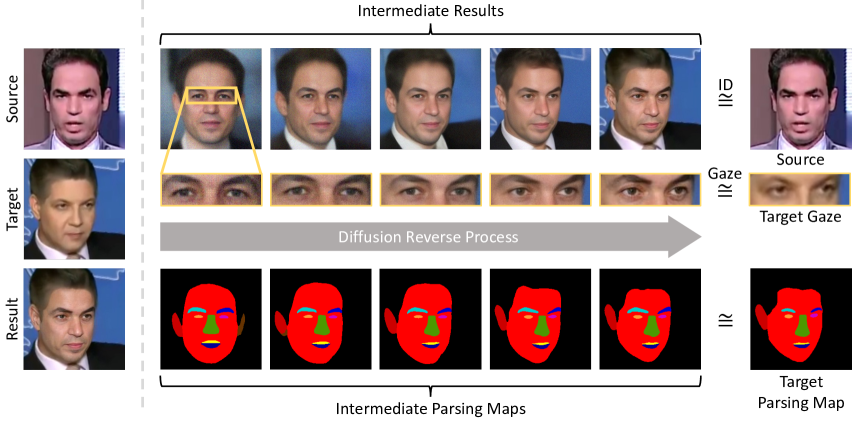
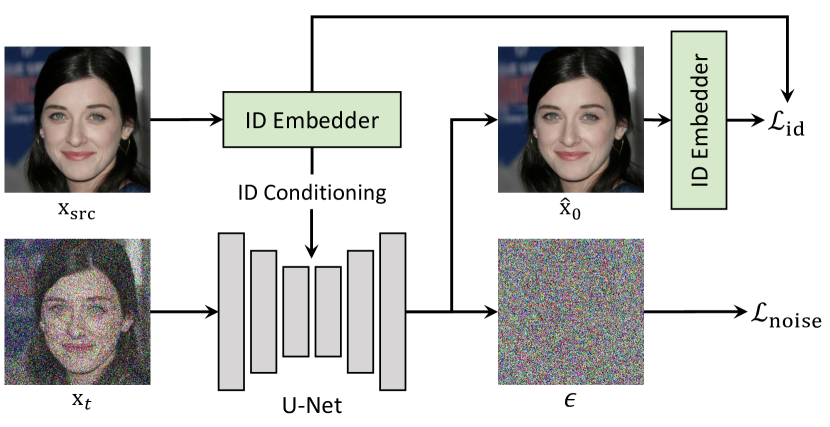
In this paper, we propose a diffusion-based face swapping framework for the first time, called DiffFace, composed of training ID conditional DDPM, sampling with facial guidance, and a target-preserving blending. In specific, in the training process, the ID conditional DDPM is trained to generate face images with the desired identity. In the sampling process, we use the off-the-shelf facial expert models to make the model transfer source identity while preserving target attributes faithfully. During this process, to preserve the background of the target image and obtain the desired face swapping result, we additionally propose a target-preserving blending strategy. It helps our model to keep the attributes of the target face from noise while transferring the source facial identity. In addition, without any re-training, our model can flexibly apply additional facial guidance and adaptively control the ID-attributes trade-off to achieve the desired results. To the best of our knowledge, this is the first approach that applies the diffusion model in face swapping task. Compared with previous GAN-based approaches, by taking advantage of the diffusion model for the face swapping task, DiffFace achieves better benefits such as training stability, high fidelity, diversity of the samples, and controllability. Extensive experiments show that our DiffFace is comparable or superior to the state-of-the-art methods on several standard face swapping benchmarks.
Motivation & Objective
- Motivate robust, high-fidelity face swapping that preserves target attributes while transferring source identity.
- Leverage diffusion models for stable training and controllable identity-guided synthesis.
- Incorporate external facial expert guidance (identity, parsing, gaze) during sampling without retraining.
- Develop a target-preserving blending strategy to maintain target background and structure.
Proposed method
- Train an ID Conditional DDPM to generate images with the source identity.
- Incorporate identity features into the diffusion process via an identity embedding and identity similarity loss.
- Apply facial guidance during sampling using pretrained experts (identity embedder, face parser, gaze estimator) to transfer identity while preserving attributes.
- Use a target-preserving blending strategy with a gradually increasing mask intensity to preserve target background and structure during swapping.
- Provide controllable ID-attributes trade-off at test time without retraining.
- Leverage a target-preserving blending mask M_t that evolves over diffusion steps to blend swapped and target imagery.
Experimental results
Research questions
- RQ1Can diffusion models be conditioned to reliably transfer source identity while preserving target attributes in face swapping?
- RQ2How can external facial expert models guide diffusion sampling to control identity, semantics, and gaze without retraining?
- RQ3Does target-preserving blending maintain target background while transferring identity, and can the trade-off be controlled adaptively?
- RQ4Is DiffFace competitive with or superior to state-of-the-art GAN-based face swapping methods on FF++?
- RQ5What ablations reveal about the contributions of ID Conditional DDPM, facial guidance, and target blending?
Key findings
- DiffFace achieves highest identity similarity scores (Arc↑, Arc-R↑, Cos↑, Cos-R↑) and superior removal of target identity compared with listed baselines.
- The diffusion-based approach provides robust control over identity and attributes, outperforming GAN-based methods on FF++ in key metrics.
- Ablations show that ID Conditional DDPM and identity guidance are essential for strong identity transfer; target-preserving blending enables trade-off control between identity and target structure.
- Gaze and semantic guidance help preserve target gaze and facial structure during swapping.
- Trade-off between identity and shape can be tuned by adjusting the blending timing parameter hat{T} and guidance weights.
Read this paper
Open the full text in the Nubint reader and ask about any passage as you read.
Read this paper on NubintThis review was generated by AI from the original paper. Please check the paper before citing it.