
[Paper Review] DiffiT: Diffusion Vision Transformers for Image Generation
This paper introduces DiffiT, a vision transformer-based diffusion model that replaces traditional U-Net architectures with a hierarchical transformer encoder-decoder. It proposes a time-dependent self-attention (TMSA) mechanism that dynamically adapts attention to different denoising stages, achieving state-of-the-art FID scores of 1.73 on ImageNet-256 and 2.67 on ImageNet-512 in the latent space.
Diffusion models with their powerful expressivity and high sample quality have achieved State-Of-The-Art (SOTA) performance in the generative domain. The pioneering Vision Transformer (ViT) has also demonstrated strong modeling capabilities and scalability, especially for recognition tasks. In this paper, we study the effectiveness of ViTs in diffusion-based generative learning and propose a new model denoted as Diffusion Vision Transformers (DiffiT). Specifically, we propose a methodology for finegrained control of the denoising process and introduce the Time-dependant Multihead Self Attention (TMSA) mechanism. DiffiT is surprisingly effective in generating high-fidelity images with significantly better parameter efficiency. We also propose latent and image space DiffiT models and show SOTA performance on a variety of class-conditional and unconditional synthesis tasks at different resolutions. The Latent DiffiT model achieves a new SOTA FID score of 1.73 on ImageNet256 dataset while having 19.85%, 16.88% less parameters than other Transformer-based diffusion models such as MDT and DiT,respectively. Code: https://github.com/NVlabs/DiffiT
Motivation & Objective
- To investigate the effectiveness of vision transformers in diffusion-based image generation, moving beyond convolutional U-Net architectures.
- To address the lack of fine-grained temporal modeling in existing diffusion models, where attention mechanisms do not adapt to different denoising stages.
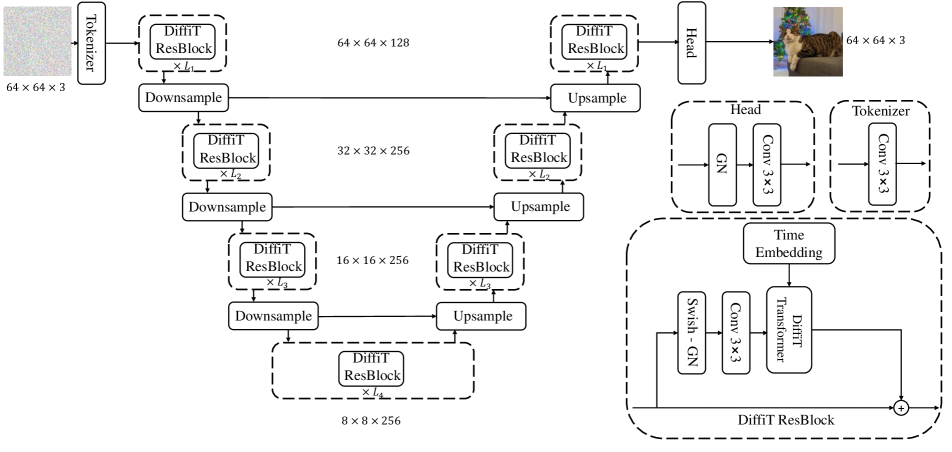
- To unify denoising network design patterns by introducing a hierarchical transformer-based architecture for both image and latent space generation.
- To achieve state-of-the-art performance in image generation quality, measured by FID scores, across multiple benchmarks.
Proposed method
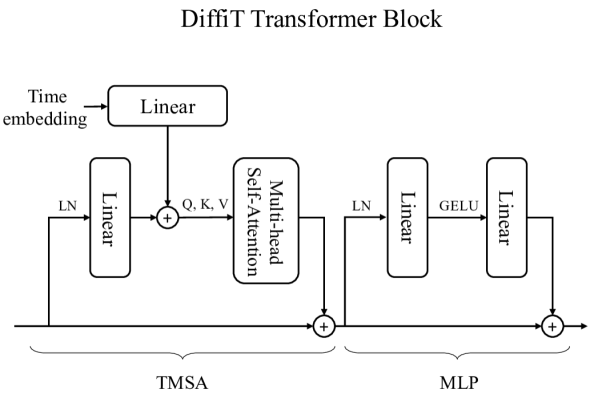
- Proposes a novel time-dependent self-attention (TMSA) module that integrates time-step information directly into query, key, and value projections of self-attention, enabling dynamic adaptation across denoising stages.
- Designs a hierarchical, U-shaped transformer encoder-decoder architecture (DiffiT) that maintains feature hierarchy and enables effective feature refinement across scales.
- Introduces latent DiffiT, a high-resolution image generation model that applies the TMSA module in the latent space, enabling efficient and high-fidelity synthesis.
- Uses time tokens that are injected into the self-attention mechanism via learnable projections, allowing the model to modulate attention behavior based on the current denoising step.
- Employs relative positional bias in combination with time tokens to preserve spatial inductive bias while enabling temporal adaptation.
- Avoids using adaptive layer normalization (AdaLN) for conditioning; instead, time dependency is embedded directly into the attention mechanism.
Experimental results
Research questions
- RQ1Can vision transformers effectively replace U-Net architectures in diffusion-based image generation while maintaining or improving sample quality?
- RQ2How can self-attention mechanisms in diffusion models be made adaptive to different denoising time steps to better capture evolving image structure?
- RQ3What is the impact of integrating time-dependent behavior directly into the attention mechanism, rather than through simple positional embeddings or normalization layers?
- RQ4Does a unified transformer-based architecture with hierarchical design outperform existing U-Net and DiT-style models in both image and latent space generation?
- RQ5To what extent does the proposed time-dependent self-attention improve FID scores across diverse benchmarks like CIFAR10, FFHQ-64, and ImageNet-256/512?
Key findings
- The proposed time-dependent self-attention (TMSA) module reduces FID by 0.28 and 0.25 on CIFAR10 for VE and VP settings, respectively, when replacing standard self-attention.
- Latent DiffiT achieves a new state-of-the-art FID score of 1.73 on the ImageNet-256 dataset, outperforming prior methods including DDPM++ and MDT.
- The ablation study confirms that TMSA is significantly more effective than alternatives: removing time dependency from TMSA increases FID to 3.97, while using time tokens in MLP layers only yields 3.81.
- Qualitative attention map visualization shows that TMSA captures fine-grained object details and adapts dynamically across denoising steps, unlike models without TMSA.
- Classifier-free guidance with a power-cosine schedule improves FID to 1.73 on ImageNet-256, with optimal guidance scale at 4.6, while higher scales degrade performance.
- The full DiffiT architecture with both encoder and decoder blocks achieves a FID of 1.95 on CIFAR10, demonstrating the importance of the complete U-shaped design for high-fidelity generation.
Read this paper
Open the full text in the Nubint reader and ask about any passage as you read.
Read this paper on NubintThis review was generated by AI from the original paper. Please check the paper before citing it.