
[Paper Review] DiffuScene: Denoising Diffusion Models for Generative Indoor Scene Synthesis
DiffuScene introduces a scene-graph denoising diffusion probabilistic model to generate 3D indoor scenes by jointly modeling object semantics, geometry, and placements, enabling unconditional generation, completion, rearrangement, and text-conditioned synthesis.
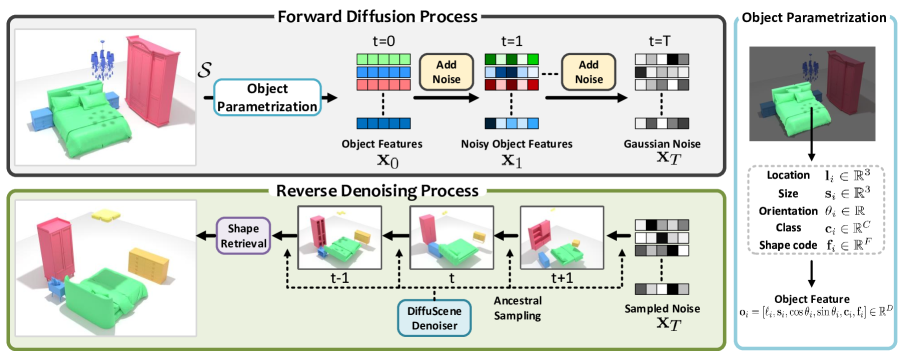
We present DiffuScene for indoor 3D scene synthesis based on a novel scene configuration denoising diffusion model. It generates 3D instance properties stored in an unordered object set and retrieves the most similar geometry for each object configuration, which is characterized as a concatenation of different attributes, including location, size, orientation, semantics, and geometry features. We introduce a diffusion network to synthesize a collection of 3D indoor objects by denoising a set of unordered object attributes. Unordered parametrization simplifies and eases the joint distribution approximation. The shape feature diffusion facilitates natural object placements, including symmetries. Our method enables many downstream applications, including scene completion, scene arrangement, and text-conditioned scene synthesis. Experiments on the 3D-FRONT dataset show that our method can synthesize more physically plausible and diverse indoor scenes than state-of-the-art methods. Extensive ablation studies verify the effectiveness of our design choice in scene diffusion models.
Motivation & Objective
- Motivate 3D indoor scene synthesis that is realistic, semantically meaningful, and diverse.
- Represent scenes as a compact, fully-connected scene graph of object attributes.
- Learn a diffusion prior over holistic scene configurations combining semantics, geometry, and layout.
- Enable downstream tasks: scene completion, scene rearrangement, and text-conditioned scene synthesis.
- Validate improvements over state-of-the-art on 3D-FRONT with ablations.
Proposed method
- Represent each scene as a fixed-size, fully-connected scene graph where each node stores location, size, orientation, class label, and geometry feature.
- Use a denoising diffusion probabilistic model to progressively refine noisy scene graphs into plausible configurations.
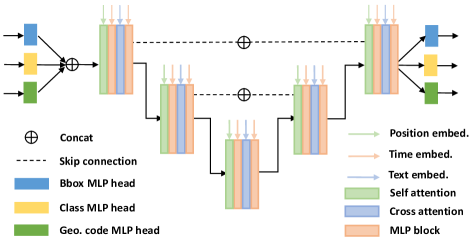
- Predict object properties (location, size, orientation, class, geometry) jointly with attention across objects.
- Perform shape retrieval from CAD models to obtain final geometries after graph denoising.
- Train with a scene-level loss and an IoU-based regularizer to reduce object intersections.
- Optionally condition the denoiser on text via a language encoder and cross-attention for text-conditioned synthesis.
Experimental results
Research questions
- RQ1Can a diffusion-based prior over 3D scene graphs produce diverse and plausible indoor scenes?
- RQ2How does joint diffusion of semantics, geometry, and bounding boxes affect scene quality and diversity?
- RQ3Can the model support scene completion, rearrangement, and text-conditioned scene synthesis beyond unconditional generation?
Key findings
- DiffuScene yields more diverse and plausible indoor scenes than baselines on 3D-FRONT across multiple metrics.
- Adenoising diffusion over a scene graph with attention captures spatial relationships and improves object placement coherence.
- Geometry code diffusion improves scene plausibility and reduces semantic KL divergence.
- The model performs well on scene completion, scene rearrangement, and text-conditioned scene synthesis, with user studies favoring its realism and text-textual alignment.
- Ablations confirm the benefits of multi-head prediction, geometry diffusion, and graph-based representation.
Read this paper
Open the full text in the Nubint reader and ask about any passage as you read.
Read this paper on NubintThis review was generated by AI from the original paper. Please check the paper before citing it.