
[Paper Review] Diffusion-based Reinforcement Learning for Edge-enabled AI-Generated Content Services
The paper proposes AGOD, a diffusion-model based optimizer for discrete decisions, integrated into DRL as D2SAC, to optimize ASP selection in edge-based AIGC services for Metaverse. Experiments show D2SAC surpasses several DRL baselines.
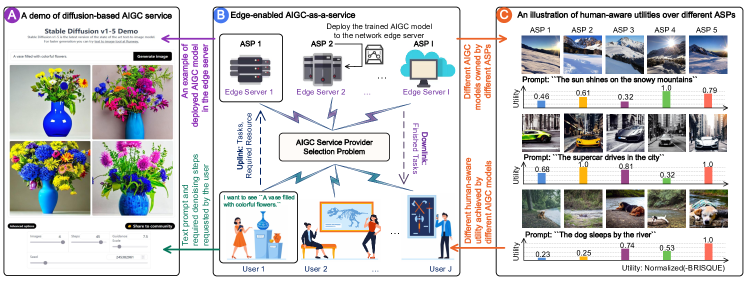
As Metaverse emerges as the next-generation Internet paradigm, the ability to efficiently generate content is paramount. AIGenerated Content (AIGC) emerges as a key solution, yet the resource intensive nature of large Generative AI (GAI) models presents challenges. To address this issue, we introduce an AIGC-as-a-Service (AaaS) architecture, which deploys AIGC models in wireless edge networks to ensure broad AIGC services accessibility for Metaverse users. Nonetheless, an important aspect of providing personalized user experiences requires carefully selecting AIGC Service Providers (ASPs) capable of effectively executing user tasks, which is complicated by environmental uncertainty and variability. Addressing this gap in current research, we introduce the AI-Generated Optimal Decision (AGOD) algorithm, a diffusion model-based approach for generating the optimal ASP selection decisions. Integrating AGOD with Deep Reinforcement Learning (DRL), we develop the Deep Diffusion Soft Actor-Critic (D2SAC) algorithm, enhancing the efficiency and effectiveness of ASP selection. Our comprehensive experiments demonstrate that D2SAC outperforms seven leading DRL algorithms. Furthermore, the proposed AGOD algorithm has the potential for extension to various optimization problems in wireless networks, positioning it as a promising approach for future research on AIGC-driven services. The implementation of our proposed method is available at: https://github.com/Lizonghang/AGOD.
Motivation & Objective
- Introduce an AIGC-as-a-Service (AaaS) architecture deploying AIGC models at wireless edge servers to enable ubiquitous AIGC services.
- Develop AGOD, a diffusion model-based optimizer to generate optimal discrete decisions under environmental uncertainty.
- Integrate AGOD with DRL to create the Deep Diffusion Soft Actor-Critic (D2SAC) algorithm for ASP (AIGC Service Provider) selection.
- Demonstrate that D2SAC outperforms multiple DRL baselines and discuss extension potential of AGOD to other wireless-network optimization problems.
Proposed method
- Formulate ASP selection as a resource-constrained, online, discrete optimization problem with human-aware utility.
- Develop the AGOD algorithm that uses a diffusion process to generate discrete decision distributions conditioned on environment states.
- Describe the forward probability noising process and the reverse denoising process to obtain optimal decision distributions.
- Embed AGOD into the DRL SAC framework to produce the D2SAC algorithm.
- Use a human-aware utility function based on a content quality assessment (e.g., BRISQUE) and diffusion model-assisted decision making.
- Provide implementation and evaluation comparing D2SAC to seven DRL baselines across ASP selection and control tasks.
Experimental results
Research questions
- RQ1How can diffusion models be used to generate optimal discrete decisions for ASP selection under resource constraints and uncertainty?
- RQ2Can a diffusion-based augmentation of DRL (D2SAC) outperform standard DRL algorithms for edge-based AIGC service provisioning?
- RQ3What is the impact of human-aware content quality metrics on ASP selection and user utilities?
- RQ4How well does the proposed approach generalize to other optimization problems in wireless networks?
Key findings
- D2SAC outperforms seven representative DRL algorithms on ASP selection and standard control tasks.
- AGOD generates discrete decision distributions by reversing a diffusion process conditioned on environment states.
- The AaaS architecture enables edge deployment of AIGC models to provide ubiquitous services with human-centric optimization.
- The human-aware utility function links AIGC model output quality to resource-aware decision making.
- The approach is extensible to broader wireless-network optimization problems beyond ASP selection.
Read this paper
Open the full text in the Nubint reader and ask about any passage as you read.
Read this paper on NubintThis review was generated by AI from the original paper. Please check the paper before citing it.