
[Paper Review] Diffusion Cross-domain Recommendation
DiffCDR introduces a diffusion probabilistic modeling-based cross-domain recommender to transfer user embeddings from a rich auxiliary domain to a sparse target domain, using a Diffusion Module and an Alignment Module, achieving strong cold-start and warm-start performance.
It is always a challenge for recommender systems to give high-quality outcomes to cold-start users. One potential solution to alleviate the data sparsity problem for cold-start users in the target domain is to add data from the auxiliary domain. Finding a proper way to extract knowledge from an auxiliary domain and transfer it into a target domain is one of the main objectives for cross-domain recommendation (CDR) research. Among the existing methods, mapping approach is a popular one to implement cross-domain recommendation models (CDRs). For models of this type, a mapping module plays the role of transforming data from one domain to another. It primarily determines the performance of mapping approach CDRs. Recently, diffusion probability models (DPMs) have achieved impressive success for image synthesis related tasks. They involve recovering images from noise-added samples, which can be viewed as a data transformation process with outstanding performance. To further enhance the performance of CDRs, we first reveal the potential connection between DPMs and mapping modules of CDRs, and then propose a novel CDR model named Diffusion Cross-domain Recommendation (DiffCDR). More specifically, we first adopt the theory of DPM and design a Diffusion Module (DIM), which generates user's embedding in target domain. To reduce the negative impact of randomness introduced in DIM and improve the stability, we employ an Alignment Module to produce the aligned user embeddings. In addition, we consider the label data of the target domain and form the task-oriented loss function, which enables our DiffCDR to adapt to specific tasks. By conducting extensive experiments on datasets collected from reality, we demonstrate the effectiveness and adaptability of DiffCDR to outperform baseline models on various CDR tasks in both cold-start and warm-start scenarios.
Motivation & Objective
- Address cold-start in cross-domain recommender systems by leveraging auxiliary-domain data.
- Propose a diffusion-based mapping module to transfer user embeddings across domains.
- Stabilize cross-domain transfer with an Alignment Module.
- Incorporate target-domain label data to align diffusion outputs with task objectives.
- Demonstrate effectiveness in real-world Amazon-domain CDR tasks under cold- and warm-start settings.
Proposed method
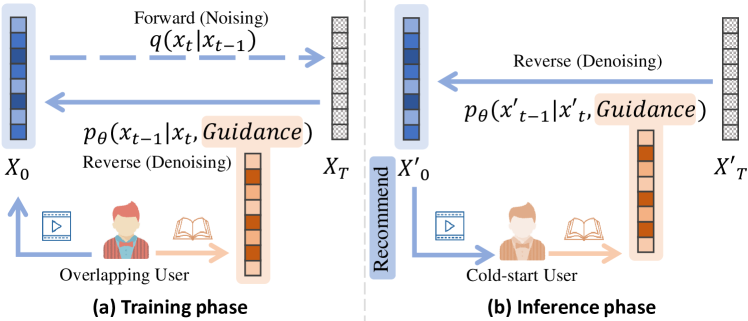
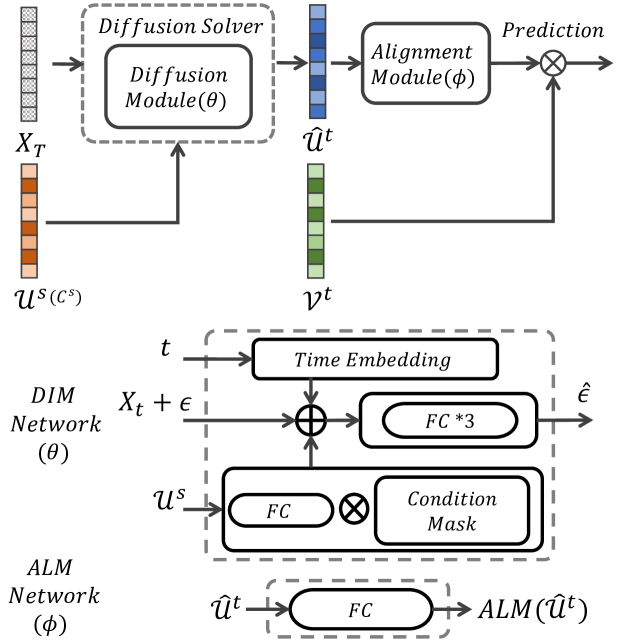
- Introduce Diffusion Module (DIM) to generate target-domain user embeddings by reversing diffusion conditioned on source-domain embeddings.
- Add an Alignment Module (ALM) to reduce randomness and align transferred embeddings with ground-truth target embeddings.
- Use a fast diffusion-solver for efficient DIM inference.
- Train with a DIM loss that matches predicted noise to true noise and an ALM+task loss that ties transferred embeddings to target-domain ratings.
- Employ a task-oriented loss by combining ALM output with target-domain ratings to adapt to specific tasks.
- Conduct ablation studies to isolate contributions of DIM, ALM, and task-oriented learning.
Experimental results
Research questions
- RQ1How does DiffCDR perform against state-of-the-art cross-domain recommender baselines in cold-start and warm-start settings?
- RQ2How do the DIM and ALM components contribute to performance, and what is the impact of including target-label task loss?
- RQ3Why does diffusion-based transfer yield improvements in cross-domain knowledge transfer?
- RQ4What is the inference throughput of DiffCDR compared to traditional methods?
Key findings
- DiffCDR outperforms several baselines (CMF, EMCDR, SSCDR, LACDR, PTUPCDR) in cold-start and warm-start CDR tasks on Amazon datasets.
- Ablation shows DIM, ALM, and task-oriented learning each contribute to performance gains.
- DiffCDR with full DAT configuration achieves the best results across multiple tasks and cold-start levels, with notable improvements in MAE, RMSE, N@20, and H@20 over strongest baselines.
- Using a fast DIM solver significantly speeds up inference without sacrificing much accuracy.
- Visualization indicates DiffCDR transfers user factors more coherently into the target domain than other methods.
Read this paper
Open the full text in the Nubint reader and ask about any passage as you read.
Read this paper on NubintThis review was generated by AI from the original paper. Please check the paper before citing it.