
[Paper Review] Diffusion Model-Augmented Behavioral Cloning
This paper proposes Diffusion Model-Augmented Behavioral Cloning (DBC), a novel imitation learning framework that combines behavioral cloning (BC) with a diffusion model to jointly learn the conditional $p(a|s)$ and joint $p(s,a)$ distributions of expert demonstrations. By optimizing both BC and a diffusion model loss that encourages actions to align with expert data, DBC achieves state-of-the-art performance in continuous control tasks, outperforming baselines including Diffusion Policy and BC across navigation, manipulation, and locomotion environments, especially with limited expert data.
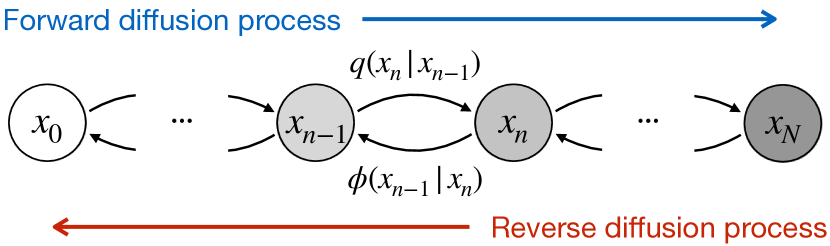
Imitation learning addresses the challenge of learning by observing an expert's demonstrations without access to reward signals from environments. Most existing imitation learning methods that do not require interacting with environments either model the expert distribution as the conditional probability p(a|s) (e.g., behavioral cloning, BC) or the joint probability p(s, a). Despite the simplicity of modeling the conditional probability with BC, it usually struggles with generalization. While modeling the joint probability can improve generalization performance, the inference procedure is often time-consuming, and the model can suffer from manifold overfitting. This work proposes an imitation learning framework that benefits from modeling both the conditional and joint probability of the expert distribution. Our proposed Diffusion Model-Augmented Behavioral Cloning (DBC) employs a diffusion model trained to model expert behaviors and learns a policy to optimize both the BC loss (conditional) and our proposed diffusion model loss (joint). DBC outperforms baselines in various continuous control tasks in navigation, robot arm manipulation, dexterous manipulation, and locomotion. We design additional experiments to verify the limitations of modeling either the conditional probability or the joint probability of the expert distribution, as well as compare different generative models. Ablation studies justify the effectiveness of our design choices.
Motivation & Objective
- To address the generalization limitations of behavioral cloning (BC), which struggles with out-of-distribution states despite its training stability.
- To overcome the inefficiency and manifold overfitting issues of joint probability modeling in imitation learning.
- To combine the efficiency of conditional modeling ($p(a|s)$) with the generalization benefits of joint modeling ($p(s,a)$) in a single framework.
- To develop a method that leverages diffusion models to improve policy learning without environment interaction.
- To empirically validate the effectiveness of joint modeling via diffusion models in boosting imitation learning performance.
Proposed method
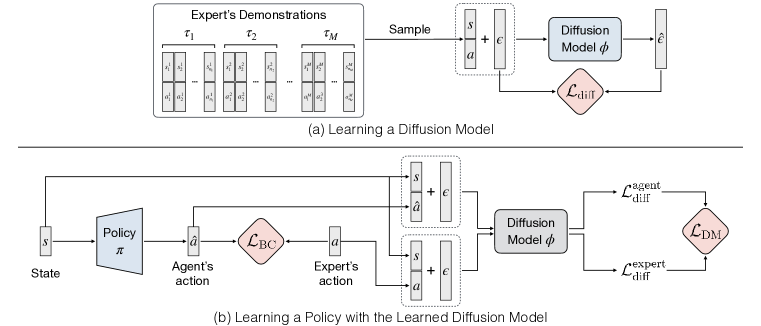
- The framework trains a policy to minimize both the standard BC loss and a novel diffusion model loss that encourages predicted actions to match the expert distribution.
- A diffusion model is trained to estimate the likelihood of state-action pairs, modeling the joint distribution $p(s,a)$ of expert demonstrations.
- The diffusion loss $\mathcal{L}_{\text{diff}}$ is computed for both expert data $(s,a)$ and predicted actions $(s,\hat{a})$, with a contrastive objective: $\mathcal{L}_{\text{DM}} = \mathbb{E}_{(s,a)\sim D,\hat{a}\sim\pi(s)}[\max(\mathcal{L}_{\text{diff}}^{\text{agent}} - \mathcal{L}_{\text{diff}}^{\text{expert}}, 0)]$.
- The final objective combines BC and diffusion losses with a hyperparameter $\lambda$ to balance their contributions.
- The method is evaluated on continuous control tasks including navigation, robot arm manipulation, and locomotion, using both full and reduced expert dataset sizes.
- Ablation studies compare different generative models and analyze the impact of hyperparameters and data sparsity.
Experimental results
Research questions
- RQ1Can jointly modeling the conditional and joint distributions of expert demonstrations improve generalization in imitation learning without environment interaction?
- RQ2How does the proposed diffusion model-augmented BC framework compare to standard BC and diffusion policy baselines in low-data regimes?
- RQ3What is the impact of using a diffusion model to model $p(s,a)$ on policy generalization and robustness to dataset size?
- RQ4How do different components of the framework, such as the diffusion loss and hyperparameter $\lambda$, affect performance?
- RQ5Does the method mitigate manifold overfitting and compounding error issues common in BC and joint modeling approaches?
Key findings
- DBC outperforms BC, Implicit BC, and Diffusion Policy across all evaluated tasks in navigation, robot arm manipulation, and locomotion, achieving the highest success rates.
- On the Maze environment, DBC achieves 95.4% ± 1.7% success rate with 100% of the dataset, outperforming Diffusion Policy (95.5% ± 1.9%) and significantly surpassing BC (92.1% ± 3.6%).
- With only 25% of the dataset, DBC achieves 71.2% ± 3.9% success rate, outperforming Diffusion Policy (72.7% ± 9.2%) and showing greater robustness to data scarcity.
- Ablation studies confirm that the diffusion loss is critical for performance, and the method remains robust to hyperparameter $\lambda$ across different settings.
- The framework demonstrates superior generalization, especially in low-data regimes, where BC and Implicit BC show significant performance drops.
- The results validate that combining conditional and joint modeling via diffusion improves both sample efficiency and policy performance.
Read this paper
Open the full text in the Nubint reader and ask about any passage as you read.
Read this paper on NubintThis review was generated by AI from the original paper. Please check the paper before citing it.