
[Paper Review] Diffusion Model is an Effective Planner and Data Synthesizer for Multi-Task Reinforcement Learning
MTDiff uses a GPT-backed diffusion model with prompt learning to enable both planning and data synthesis for multi-task offline RL, improving planning performance and augmenting data across seen and unseen tasks.
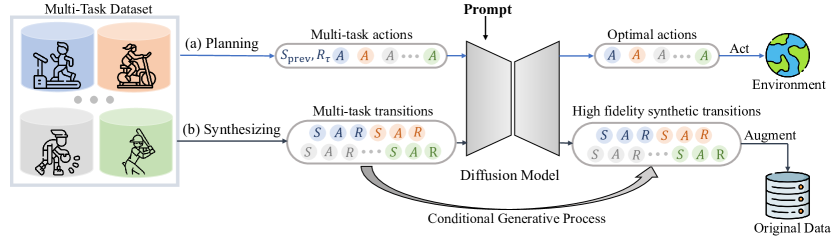
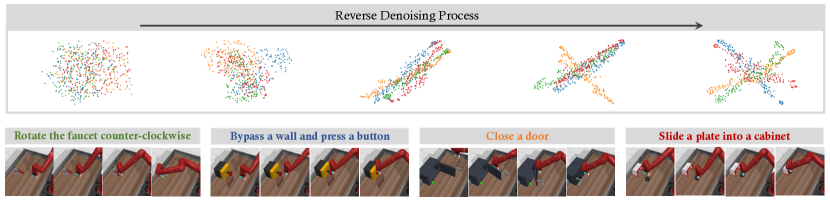
Diffusion models have demonstrated highly-expressive generative capabilities in vision and NLP. Recent studies in reinforcement learning (RL) have shown that diffusion models are also powerful in modeling complex policies or trajectories in offline datasets. However, these works have been limited to single-task settings where a generalist agent capable of addressing multi-task predicaments is absent. In this paper, we aim to investigate the effectiveness of a single diffusion model in modeling large-scale multi-task offline data, which can be challenging due to diverse and multimodal data distribution. Specifically, we propose Multi-Task Diffusion Model ( extsc{MTDiff}), a diffusion-based method that incorporates Transformer backbones and prompt learning for generative planning and data synthesis in multi-task offline settings. extsc{MTDiff} leverages vast amounts of knowledge available in multi-task data and performs implicit knowledge sharing among tasks. For generative planning, we find extsc{MTDiff} outperforms state-of-the-art algorithms across 50 tasks on Meta-World and 8 maps on Maze2D. For data synthesis, extsc{MTDiff} generates high-quality data for testing tasks given a single demonstration as a prompt, which enhances the low-quality datasets for even unseen tasks.
Motivation & Objective
- Motivate learning a single model that can handle diverse multi-task offline RL data.
- Investigate how diffusion models can model multimodal, multi-task trajectories.
- Develop prompt-conditioned, transformer-based diffusion methods for planning (MTDiff-p) and data synthesis (MTDiff-s).
- Show that MTDiff can generalize to unseen tasks and improve data efficiency.
Proposed method
- Formulate multi-task trajectory modeling as a conditional denoising problem using diffusion models.
- Use a GPT2-based transformer backbone to model sequential trajectories with task prompts.
- In planning mode (MTDiff-p), condition on prompts and returns to generate optimal action sequences via classifier-free guidance.
- In data-synthesis mode (MTDiff-s), synthesize transitions (state, action, reward) conditioned on task prompts for data augmentation.
- Incorporate a flexible prompting scheme where demonstrations serve as task-conditioning prompts rather than one-hot IDs.
- Train with diffusion reverse process to minimize denoising loss and optionally apply low-temperature sampling for high-likelihood sequences.
Experimental results
Research questions
- RQ1Can a single diffusion model learn and generalize across multiple offline RL tasks?
- RQ2Do prompt-conditioned diffusion models improve planning quality in multi-task RL compared with baselines?
- RQ3Can diffusion-based data synthesis augment offline datasets effectively for seen and unseen tasks?
- RQ4How does multi-task diffusion benefit data efficiency and generalization compared with single-task augmentation methods?
Key findings
- MTDiff-p outperforms state-of-the-art baselines in multi-task planning on Meta-World MT50-rand and Maze2D, achieving higher average success rates.
- MTDiff-s synthesizes high-fidelity multi-task data, boosting offline RL performance across multiple tasks, including unseen ones.
- MTDiff-p with prompts enables few-shot generalization to unseen tasks, outperforming one-hot baselines in adaptation tests.
- Data synthesized by MTDiff-s yields substantial policy improvements, outperforming single-task augmentation methods (S4RL, RAD) in offline RL.
- Increasing the number of tasks during multi-task training yields progressively better data synthesis performance, indicating effective multi-task knowledge sharing.
Read this paper
Open the full text in the Nubint reader and ask about any passage as you read.
Read this paper on NubintThis review was generated by AI from the original paper. Please check the paper before citing it.