
[Paper Review] Diffusion Models for High-Resolution Solar Forecasts
This paper uses score-based diffusion models to super-resolve coarse numerical weather forecasts into high-resolution probabilistic solar-irradiance forecasts, demonstrated for day-ahead cloud cover on Oahu.
Forecasting future weather and climate is inherently difficult. Machine learning offers new approaches to increase the accuracy and computational efficiency of forecasts, but current methods are unable to accurately model uncertainty in high-dimensional predictions. Score-based diffusion models offer a new approach to modeling probability distributions over many dependent variables, and in this work, we demonstrate how they provide probabilistic forecasts of weather and climate variables at unprecedented resolution, speed, and accuracy. We apply the technique to day-ahead solar irradiance forecasts by generating many samples from a diffusion model trained to super-resolve coarse-resolution numerical weather predictions to high-resolution weather satellite observations.
Motivation & Objective
- Motivate probabilistic forecasting of high-dimensional weather variables with diffusion models.
- Demonstrate super-resolution of coarse numerical weather predictions to high-resolution satellite-derived cloud cover.
- Quantify uncertainty and accuracy of day-ahead solar forecasts on Oahu.
- Show that diffusion-based samples provide realistic, diverse, and useful forecast distributions.
Proposed method
- Two cascaded diffusion models (64x64 then 128x128) conditioned on ERA5/GFS atmospheric variables.
- U-Net architectures with atmospheric conditioning injected as a flat vector.
- Denoising score matching objective to train the diffusion models.
- Sampling from the reverse-time ODE to generate probabilistic forecasts.
- Evaluation against ERA5-based and GFS-based baselines using RMSE on satellite-derived cloud cover.
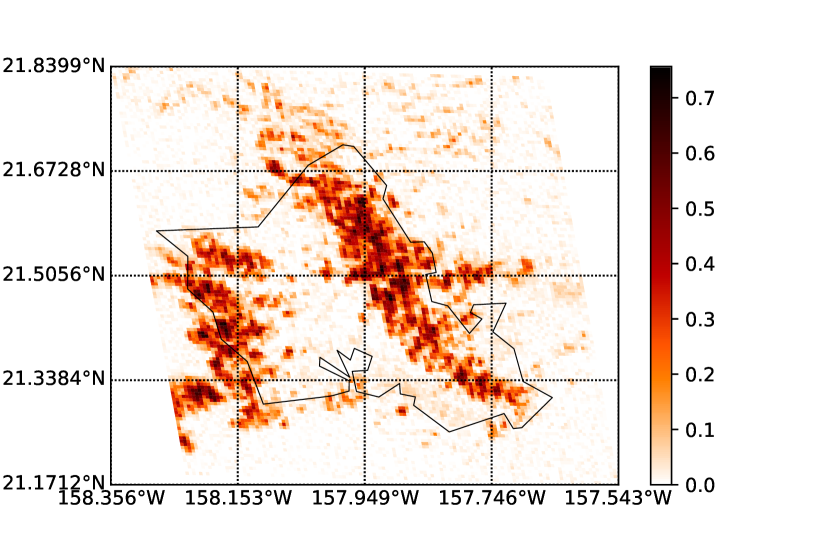
Experimental results
Research questions
- RQ1Can score-based diffusion models provide fully probabilistic, high-resolution forecasts for solar-related variables?
- RQ2Does super-resolution of coarse atmospheric outputs improve predictive accuracy over baseline downscaling?
- RQ3How well do diffusion-model samples capture uncertainty and spatial patterns (e.g., orography-driven clouds) for Oahu?
Key findings
- The diffusion model achieves lower RMSE than the coarse ERA5 baseline in historical prediction (0.207 ± 0.075 vs. 0.362 ± 0.190, p < 5×10^-4).
- For future 11 am forecasts conditioned on GFS, diffusion modeling yields lower RMSE (0.198 ± 0.075) than the coarse GFS baseline (0.358 ± 0.229, p = 0.008).
- Sampling more diffusion iterations improves predictive accuracy; 45+ samples used for historical results.
- Samples are realistic, diverse, and the mean of samples provides a better point estimate than the input coarse forecast.
- The approach enables rapid probabilistic forecasting suitable for risk assessment of rare events and grid management.

Better researchstarts right now
From reading papers to final review, dramatically reduce your research time.
No credit card · Free plan available
This review was created by AI and reviewed by human editors.