
[Paper Review] Diffusion Models for Open-Vocabulary Segmentation
OVDiff uses text-to-image diffusion models to generate a support set of images for any category, builds multiple visual prototypes (foreground and background), and segments images via nearest-prototype matching without training. It achieves strong zero-shot open-vocabulary segmentation performance and offers explainability by mapping decisions back to support-set regions.
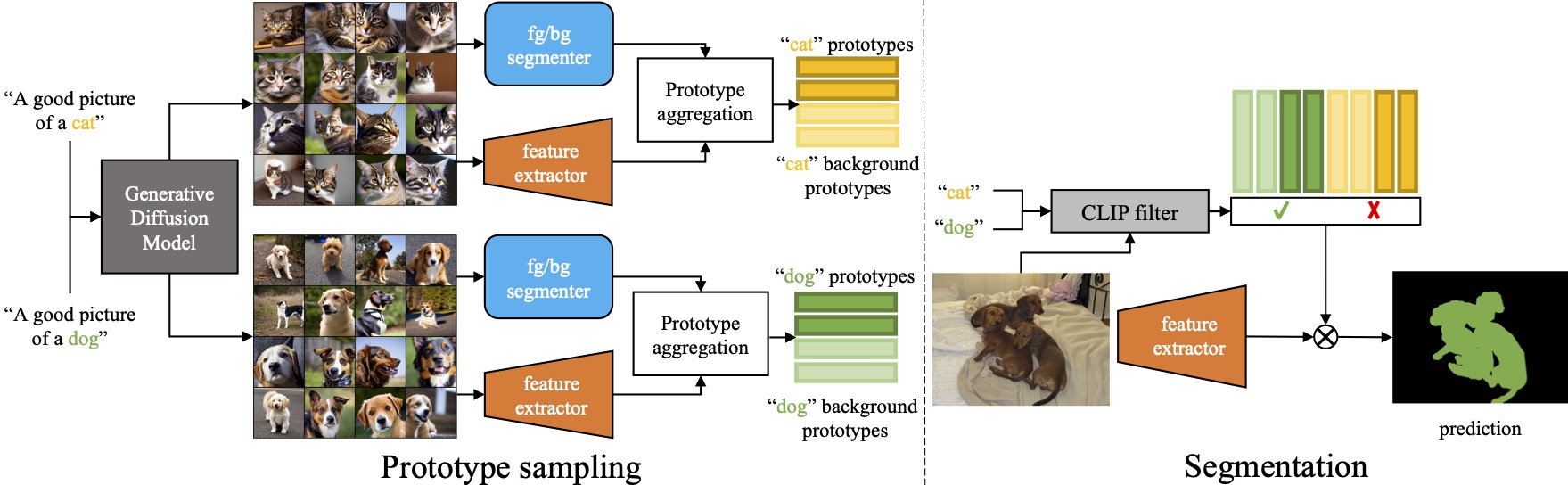
Open-vocabulary segmentation is the task of segmenting anything that can be named in an image. Recently, large-scale vision-language modelling has led to significant advances in open-vocabulary segmentation, but at the cost of gargantuan and increasing training and annotation efforts. Hence, we ask if it is possible to use existing foundation models to synthesise on-demand efficient segmentation algorithms for specific class sets, making them applicable in an open-vocabulary setting without the need to collect further data, annotations or perform training. To that end, we present OVDiff, a novel method that leverages generative text-to-image diffusion models for unsupervised open-vocabulary segmentation. OVDiff synthesises support image sets for arbitrary textual categories, creating for each a set of prototypes representative of both the category and its surrounding context (background). It relies solely on pre-trained components and outputs the synthesised segmenter directly, without training. Our approach shows strong performance on a range of benchmarks, obtaining a lead of more than 5% over prior work on PASCAL VOC.
Motivation & Objective
- Address open-vocabulary semantic segmentation without labeled training data.
- Leverage diffusion models to sample diverse appearances and contexts for each category.
- Ground a pretrained visual backbone with language-free prototypes for robust segmentation.
- Incorporate foreground and background prototypes to improve object-background separation and explainability.
Proposed method
- Generate a support set of images per query using a text prompt with Stable Diffusion.
- Extract class and instance prototypes from support images via a pretrained visual encoder and unsupervised segmentation.
- Augment prototypes with part-level centroids obtained by K-means clustering of masked features.
- Use foreground and background prototypes for open-vocabulary grounding and a single cosine-similarity based classifier per pixel.
- Apply CLIP-based category pre-filtering and stuff/thing filtering to reduce spurious categories and handle background regions.
- Segment a target image by nearest-prototype matching against the prototype sets for each candidate category (plus a background class).
Experimental results
Research questions
- RQ1Can diffusion-generated support sets ground open-vocabulary segmentation without fine-tuning?
- RQ2How does using multiple prototypes (instance, class, part) and background prototypes affect segmentation quality?
- RQ3What role do pre-filtering and filtering of stuff/thing categories play in open-vocabulary segmentation performance?
- RQ4How does OVDiff perform across standard open-vocabulary benchmarks (VOC, Context, Object) and with different feature extractors?
Key findings
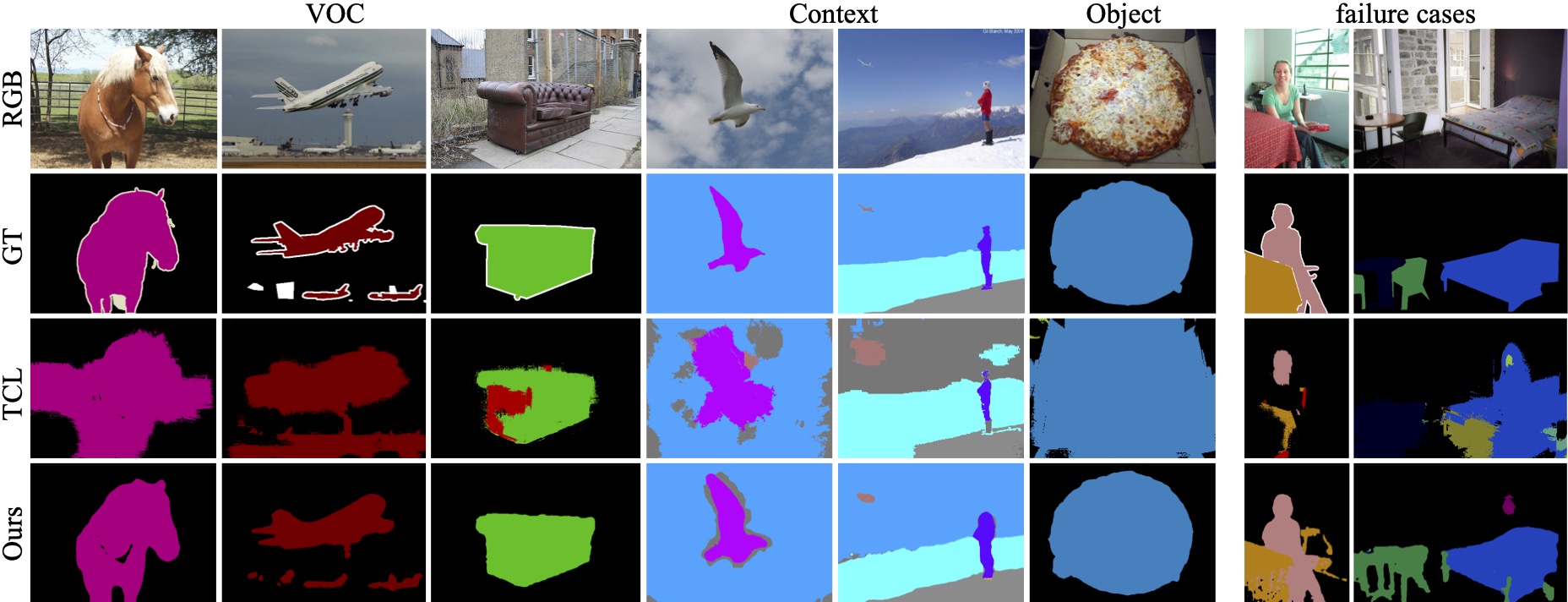
- OVDiff achieves strong zero-shot open-vocabulary segmentation, surpassing prior methods on VOC, Context, and Object benchmarks.
- Using background prototypes and category pre-filtering significantly improves performance and reduces spurious correlations.
- In experiments, OVDiff with a combination of SD, DINO, and CLIP feature extractors yields the best results (e.g., VOC 63.6 with single setup, up to 67.0 with ensemble).
- Prototypes across foreground, background, and part levels enable finer segmentation and explainability by linking decisions to support-set regions.
- The method remains training-free, relying only on pretrained components and a diffusion-based support set generation process.
- Performance scales with support set size and stabilizes around 128 samples per class.
Read this paper
Open the full text in the Nubint reader and ask about any passage as you read.
Read this paper on NubintThis review was generated by AI from the original paper. Please check the paper before citing it.