
[Paper Review] DiffusionDet: Diffusion Model for Object Detection
DiffusionDet treats object detection as a denoising diffusion process that refines random boxes into object boxes, enabling dynamic numbers of proposals and iterative evaluation with competitive performance.
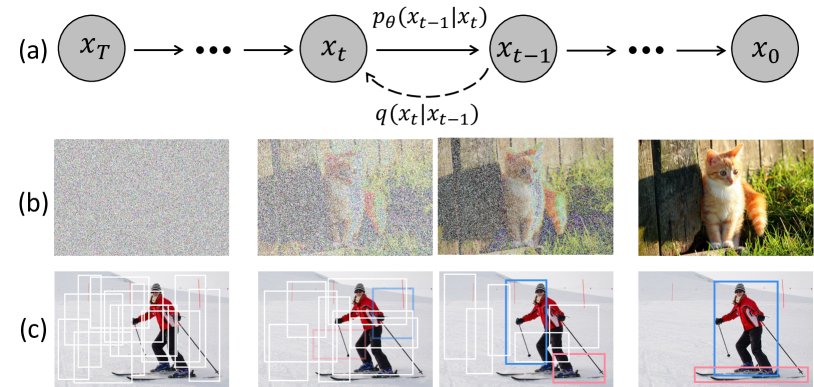
We propose DiffusionDet, a new framework that formulates object detection as a denoising diffusion process from noisy boxes to object boxes. During the training stage, object boxes diffuse from ground-truth boxes to random distribution, and the model learns to reverse this noising process. In inference, the model refines a set of randomly generated boxes to the output results in a progressive way. Our work possesses an appealing property of flexibility, which enables the dynamic number of boxes and iterative evaluation. The extensive experiments on the standard benchmarks show that DiffusionDet achieves favorable performance compared to previous well-established detectors. For example, DiffusionDet achieves 5.3 AP and 4.8 AP gains when evaluated with more boxes and iteration steps, under a zero-shot transfer setting from COCO to CrowdHuman. Our code is available at https://github.com/ShoufaChen/DiffusionDet.
Motivation & Objective
- Motivate a simpler, learnable-query-free object detector by applying diffusion to the space of bounding boxes.
- Decouple training and inference to allow a dynamic number of proposals and iterative refinement.
- Demonstrate competitive performance across COCO, CrowdHuman, and LVIS benchmarks, including zero-shot transfer scenarios.
Proposed method
- Formulate detection as a diffusion process from ground-truth boxes to noisy boxes during training.
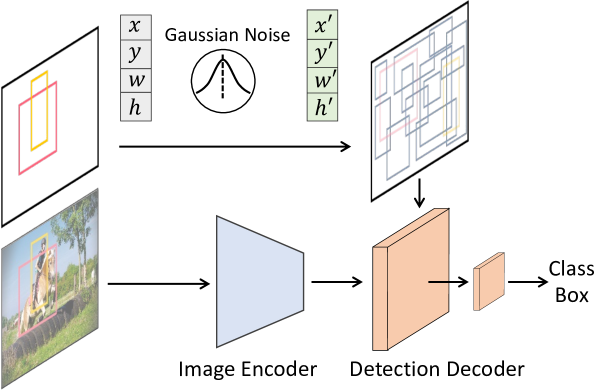
- Use an image encoder plus a 6-stage detection head to predict boxes conditioned on noisy inputs.
- Pad ground-truth boxes and apply Gaussian noise with a cosine schedule to create training targets.
- During inference, start from random boxes and iteratively denoise via the learned detector head with timestep conditioning.
- Enable iterative evaluation by reusing the detection head across steps and applying box renewal and DDIM-based updates.
- Allow flexibility to evaluate with arbitrary numbers of boxes and steps without retraining.
Experimental results
Research questions
- RQ1Can object detection be effectively cast as a denoising diffusion process over bounding boxes?
- RQ2Does a diffusion-based detector support dynamic numbers of proposals and iterative refinement without retraining?
- RQ3How does DiffusionDet perform on standard and zero-shot transfer benchmarks (COCO, CrowdHuman, LVIS) compared with established detectors?
Key findings
- DiffusionDet achieves competitive COCO results, e.g., 45.8 AP with 1×300 setting and improvements with more boxes or steps (e.g., 46.8 AP with 4×500 on COCO).
- On zero-shot transfer from COCO to CrowdHuman, increasing evaluation boxes from 300 to 2000 and iterations from 1 to 4 yields AP gains of 5.3 and 4.8, respectively.
- DiffusionDet with Swin-Base backbone reaches 52.5 AP on COCO val with 1@300, outperforming several baselines and improving further with more steps/backbones.
- LVIS results show DiffusionDet gains with more evaluation steps, e.g., 4@300 or 4@500 backbones yield higher AP than 1@300, especially with larger backbones.
- The model supports dynamic numbers of boxes and iterative evaluation without retraining, distinguishing it from fixed-query detectors.
Read this paper
Open the full text in the Nubint reader and ask about any passage as you read.
Read this paper on NubintThis review was generated by AI from the original paper. Please check the paper before citing it.