
[Paper Review] DiffusionInst: Diffusion Model for Instance Segmentation
DiffusionInst treats instance segmentation as a noise-to-filter denoising process, representing masks with instance-aware filters and a dynamic mask head, achieving competitive results on COCO and LVIS with various backbones.
Diffusion frameworks have achieved comparable performance with previous state-of-the-art image generation models. Researchers are curious about its variants in discriminative tasks because of its powerful noise-to-image denoising pipeline. This paper proposes DiffusionInst, a novel framework that represents instances as instance-aware filters and formulates instance segmentation as a noise-to-filter denoising process. The model is trained to reverse the noisy groundtruth without any inductive bias from RPN. During inference, it takes a randomly generated filter as input and outputs mask in one-step or multi-step denoising. Extensive experimental results on COCO and LVIS show that DiffusionInst achieves competitive performance compared to existing instance segmentation models with various backbones, such as ResNet and Swin Transformers. We hope our work could serve as a strong baseline, which could inspire designing more efficient diffusion frameworks for challenging discriminative tasks. Our code is available in https://github.com/chenhaoxing/DiffusionInst.
Motivation & Objective
- Motivate and explore a diffusion-model-based framework for instance segmentation.
- Represent instance masks via instance-aware filters and a global mask feature to enable noise-to-filter denoising.
- Train with a noise-to-noise diffusion process over groundtruth boxes and filters without RPN inductive bias.
- Demonstrate competitive performance on COCO and LVIS across backbones like ResNet and Swin Transformers.
Proposed method
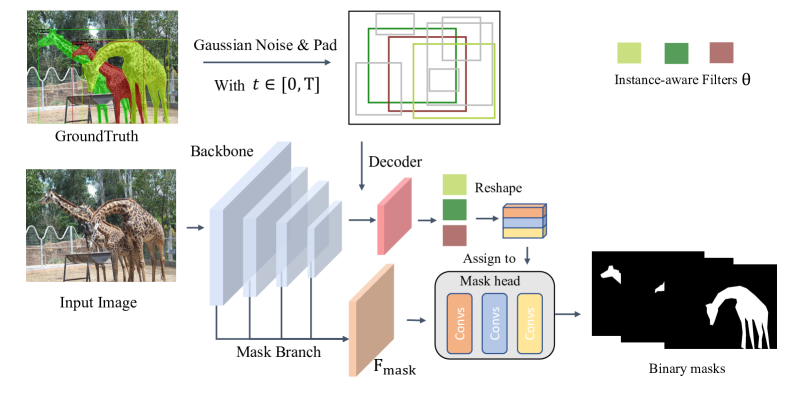
- Represent each instance mask as a dynamic mask head conditioned on an instance-aware filter , combined with a multi-scale mask feature from FPN.
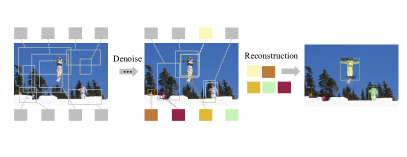
- Formulate instance segmentation as a denoising diffusion process that denoises noisy groundtruth boxes and noisy filters to produce masks.
- Use a mask branch to preserve multi-scale information and enable global mask reconstruction via a dynamic mask head with convolution weights given by the denoised filters.
- Train with a dice loss on masks plus a detection loss, using multiple supervision stages similar to DiffusionDet.
- During inference, perform one-step or multi-step denoising by sampling initial noisy inputs (boxes and filters) from Gaussian distributions and refining them through DDIM-based iterations.
Experimental results
Research questions
- RQ1Can a diffusion model be effectively applied to discriminative tasks like instance segmentation, avoiding RPN biases?
- RQ2How can instance masks be represented to exploit diffusion denoising while maintaining global context?
- RQ3What is the impact of multi-step denoising and backbone choice on COCO/LVIS performance for diffusion-based instance segmentation?
- RQ4What are the trade-offs in speed and accuracy for DiffusionInst compared to traditional and query-based methods?
Key findings
- DiffusionInst achieves 37.3 AP with ResNet-50 and one-step denoising on COCO validation, outperforming Mask R-CNN, SOLO, and CondInst under the same backbone.
- With a larger backbone (Swin-L) and 5x schedule, DiffusionInst reaches 47.8 AP on COCO with Swin-L, exceeding several baselines.
- On COCO test-dev, DiffusionInst with Swin-L 5x achieves 47.8 AP (one-step) and 51.9 AP for AP L with 4-step variant, illustrating backbone-driven gains.
- DiffusionInst shows competitive performance on LVIS with Swin-Base/Swim-L, notably surpassing some Mask RCNN baselines and improving especially in long-tail categories.
- A 1-step diffusion setup provides strong results; multi-step denoising yields smaller incremental gains (~0.3% AP typically) and slower inference.
- Training DiffusionInst requires substantial compute (e.g., 26 hours on 8 A100 GPUs for ResNet-50 configuration) and lacks RPN-based inductive bias, placing it as a competitive baseline for diffusion-based discriminative tasks.
Read this paper
Open the full text in the Nubint reader and ask about any passage as you read.
Read this paper on NubintThis review was generated by AI from the original paper. Please check the paper before citing it.