
[Paper Review] DiffusionShield: A Watermark for Copyright Protection against Generative Diffusion Models
DiffusionShield embeds a uniform, blockwise watermark into data to enable reliable detection of copyright infringement in images generated by generative diffusion models, even under multiple users and large datasets. It jointly optimizes watermark patches and a detector to maximize detectability with low perceptual distortion.
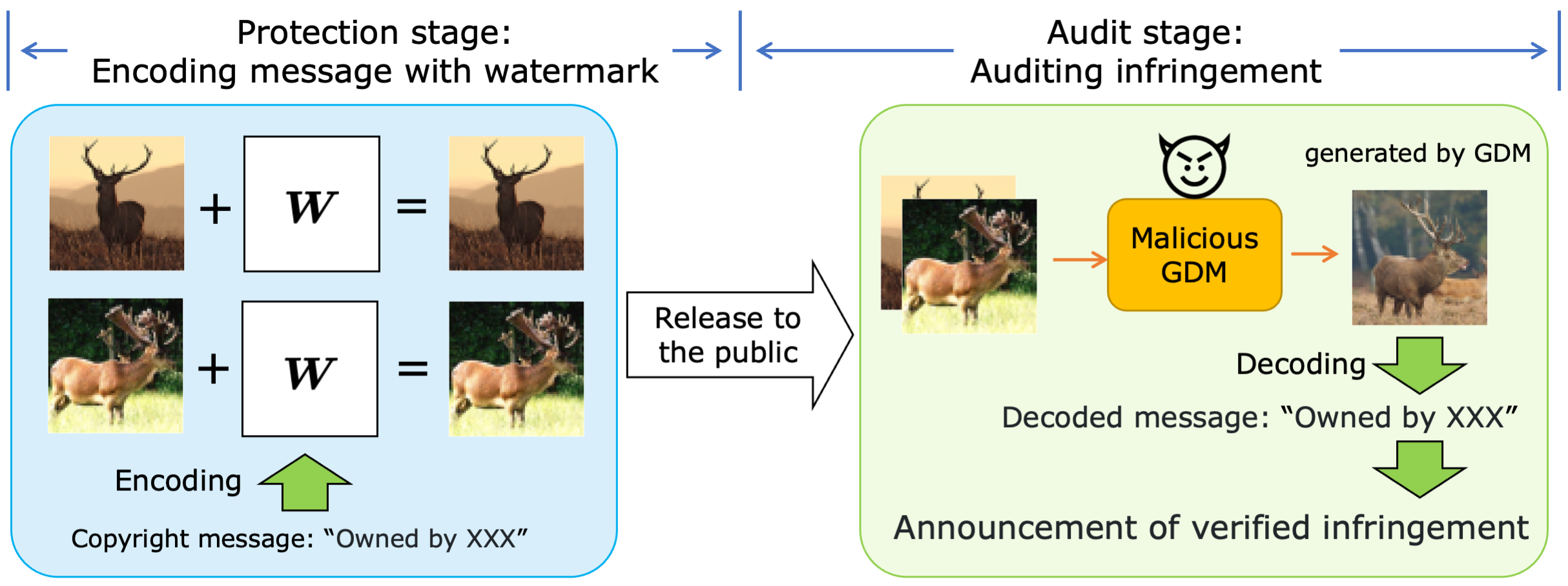
Recently, Generative Diffusion Models (GDMs) have showcased their remarkable capabilities in learning and generating images. A large community of GDMs has naturally emerged, further promoting the diversified applications of GDMs in various fields. However, this unrestricted proliferation has raised serious concerns about copyright protection. For example, artists including painters and photographers are becoming increasingly concerned that GDMs could effortlessly replicate their unique creative works without authorization. In response to these challenges, we introduce a novel watermarking scheme, DiffusionShield, tailored for GDMs. DiffusionShield protects images from copyright infringement by GDMs through encoding the ownership information into an imperceptible watermark and injecting it into the images. Its watermark can be easily learned by GDMs and will be reproduced in their generated images. By detecting the watermark from generated images, copyright infringement can be exposed with evidence. Benefiting from the uniformity of the watermarks and the joint optimization method, DiffusionShield ensures low distortion of the original image, high watermark detection performance, and the ability to embed lengthy messages. We conduct rigorous and comprehensive experiments to show the effectiveness of DiffusionShield in defending against infringement by GDMs and its superiority over traditional watermarking methods. The code for DiffusionShield is accessible in https://github.com/Yingqiancui/DiffusionShield.
Motivation & Objective
- Motivate copyright protection for data shared to train/trigger generative diffusion models (GDMs).
- Develop a watermarking scheme that is easily learnable by GDMs and reproducible in generated images.
- Ensure low visual distortion while enabling long messages and multi-user support.
- Provide theoretical and empirical evidence that uniform watermark patterns are learned earlier by GDMs, enabling effective detection.
Proposed method
- Introduce pattern uniformity as a key factor for watermark learnability in GDMs.
- Propose a blockwise watermarking scheme where a single watermark W is divided into a sequence of basic patches encoding a message.
- Develop a joint optimization objective to optimize both the basic patches and the watermark detector.
- Use randomly cropped image blocks during training to promote flexibility and adaptability across images.
- Provide theoretical analysis showing watermarks with pattern uniformity are learned before other features in linear/MLP settings.
- Experimentally compare DiffusionShield against baselines on multiple datasets and GDM settings, measuring invisibility, decoding accuracy, and message capacity.
Experimental results
Research questions
- RQ1Can a watermark with high pattern uniformity be reliably learned by GDMs and reproduced in generated images?
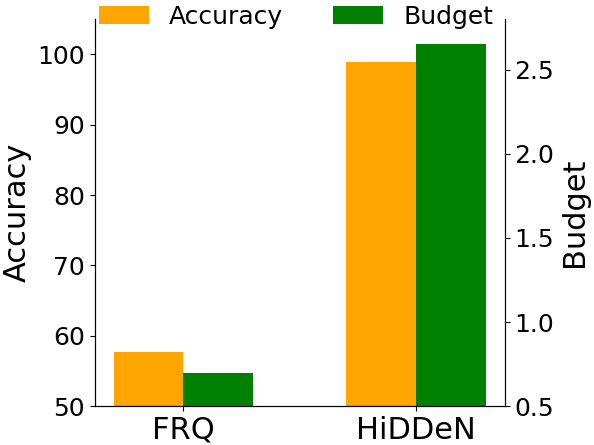
- RQ2Does joint optimization of watermark patches and a decoder improve detection performance at low distortion budgets?
- RQ3How does DiffusionShield scale to multiple data owners and to fine-tuned or class-conditional GDMs?
- RQ4What is the theoretical justification that watermarks are learned prior to other data features in GDM training?
- RQ5What is the practical capacity (bit-length) of embeddable messages across datasets?],
- RQ6key_findings:[
- RQ7DiffusionShield achieves high bit accuracy in generated images while maintaining low perceptual distortion across CIFAR-10, CIFAR-100, and STL-10 datasets.
- RQ8Pattern uniformity correlates with higher watermark detection rates in GDM-generated images, outperforming existing watermarking methods lacking uniformity.
- RQ9The blockwise watermark design yields uniform watermark patterns across all images from a single owner, enabling easier detection and multi-owner support.
- RQ10Joint optimization of watermark patches and the decoder improves decoding accuracy at smaller budgets compared to non-joint approaches.
- RQ11Across multiple owners, the method maintains high protection with re-use of basic patches and decoders, enabling scalable multi-user watermarking.
- RQ12Theoretical analyses demonstrate watermarks with pattern uniformity are learned prior to other features in linear and neural network settings, supporting practical protection against GDMs.
Key findings
- Uniform watermark patterns improve reproducibility in GDM outputs.
- Jointly optimized patches and detector outperform non-joint baselines in decoding accuracy at fixed budgets.
- Blockwise watermarking enables scalable, multi-user protection with reusable components.
- Watermarks are learnable prior to data distributions in toy linear and MLP models, supporting practical copyright protection.
Read this paper
Open the full text in the Nubint reader and ask about any passage as you read.
Read this paper on NubintThis review was generated by AI from the original paper. Please check the paper before citing it.