
[論文レビュー] Digital Twin-Assisted Cooperative Driving at Non-Signalized Intersections
本稿では、拡張されたFIFOスロット予約、コンSENSUS運動制御、モデルベースの運動推定を用いて、信号のない交差点におけるコネクテッドビークルが停止せずに交差できる、デジタルツインを活用した協調走行システムを提案する。Unityを用いたシミュレーションで、実世界のサンフランシスコのデータを用いると、信号付き交差点と比較して平均走行時間が20%短縮され、エネルギー消費量は23.7%削減された。
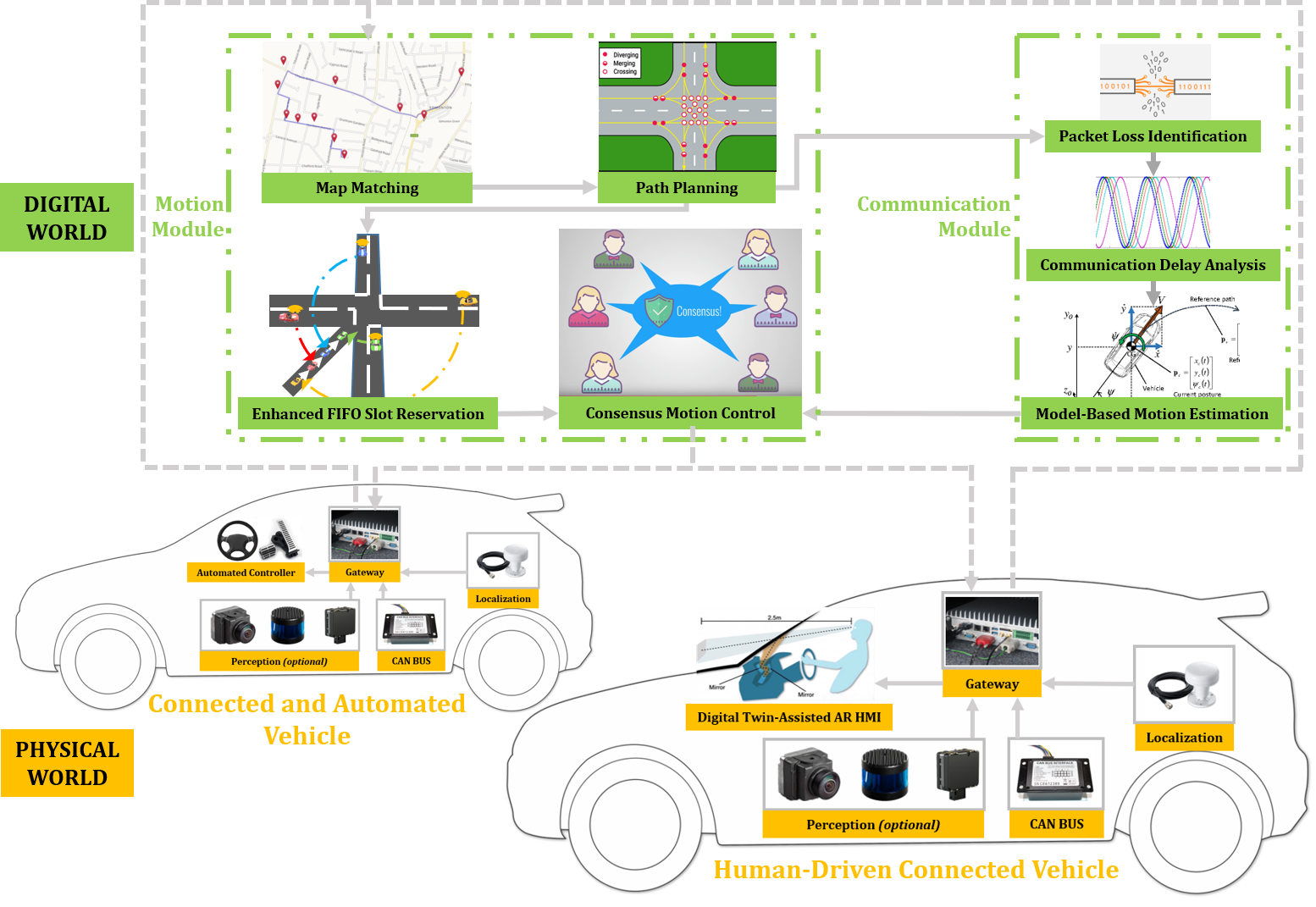
Digital Twin, as an emerging technology related to Cyber-Physical Systems (CPS) and Internet of Things (IoT), has attracted increasing attentions during the past decade. Conceptually, a Digital Twin is a digital replica of a physical entity in the real world, and this technology is leveraged in this study to design a cooperative driving system at non-signalized intersections, allowing connected vehicles to cooperate with each other to cross intersections without any full stops. Within the proposed Digital Twin framework, we developed an enhanced first-in-first-out (FIFO) slot reservation algorithm to schedule the sequence of crossing vehicles, a consensus motion control algorithm to calculate vehicles' referenced longitudinal motion, and a model-based motion estimation algorithm to tackle communication delay and packet loss. Additionally, an augmented reality (AR) human-machine-interface (HMI) is designed to provide the guidance to drivers to cooperate with other connected vehicles. Agent-based modeling and simulation of the proposed system is conducted in Unity game engine based on a real-world map in San Francisco, and the human-in-the-loop (HITL) simulation results prove the benefits of the proposed algorithms with 20% reduction in travel time and 23.7% reduction in energy consumption, respectively, when compared with traditional signalized intersections.
研究の動機と目的
- 信号のない交差点における完全停止を回避するデジタルツイン技術を活用した協調走行システムの設計。
- V2Xを用いた車両連携における通信遅延およびパケット損失を補償する、耐障害性の高い運動推定技術の開発。
- 従来の交通信号の代わりに知能的で車両連携型の交差メカニズムを導入することで、交通効率と安全性の向上。
- 増強現実(AR)を活用した人間機械インターフェース(HMI)を統合し、協調走行行動をドライバにガイド。
- 実世界の交通データを用いたリアルな人間を含むループ(HITL)シミュレーション環境で、システムの性能を評価。
提案手法
- デジタルツイン環境における車両交差順序のスケジューリングを目的とした、強化された先着順(FIFO)スロット予約アルゴリズムの開発。
- 協調する車両の同期された縦方向参照軌道を生成するためのコンセンサス運動制御アルゴリズムの実装。
- 予測状態推定を用いてV2X通信の遅延およびパケット損失を補償する、モデルベースの運動推定アルゴリズムの提案。
- ドライバがいつ・どのように交差するかを視覚的にガイドするARベースのHMIの設計により、協調走行行動への準拠度を向上。
- サンフランシスコの実際の地図を用いた、ミックスド・トラフィックおよび交差点ダイナミクスをモデル化するため、Unityゲームエンジン上でのエージェントベースシミュレーションの実施。
- 人間を含むループ(HITL)シミュレーションを統合し、現実の走行条件下での実用性と性能を評価。
実験結果
リサーチクエスチョン
- RQ1デジタルツインを活用したシステムは、信号のない交差点において完全停止を伴わずにコネクテッドビークルを効果的に連携可能か?
- RQ2モデルベースの運動推定アルゴリズムは、通信遅延およびパケット損失が車両連携に与える影響をどのように軽減するか?
- RQ3予測周波数が変化する状況下で、運動推定アルゴリズムにおける予測精度と計算負荷のトレードオフはどのようなものか?
- RQ4従来の信号付き交差点と比較して、提案されたシステムは走行時間およびエネルギー消費量をどの程度削減するか?
- RQ5人間を含むループシナリオにおいて、AR HMIはドライバの協調行動支援およびシステム性能向上にどの程度有効か?
主な発見
- HITLシミュレーションにおいて、提案システムは従来の信号付き交差点と比較して平均走行時間を20%短縮した。
- 同じ比較条件下でエネルギー消費量は23.7%削減され、顕著な効率向上が確認された。
- 0.01秒の予測ステップ(100 Hz周波数)を用いた場合、位置推定誤差は0.2 m未満に達した。
- 1秒の予測ステップ(1 Hz)では、重大なパケット損失発生時、推定誤差が5.8 mに増加し、更新周波数への感受性が顕著に現れた。
- 0.01秒の予測ステップではシミュレーションのフレームレートが6 FPSに低下し、高い計算負荷が生じた一方、1秒のステップでは19 FPS以上を維持した。
- 本研究では、運動推定の精度と計算コストの間には重要なトレードオフが存在することが判明し、今後の研究でさらなる最適化が求められる。

より良い研究を、今すぐ始めましょう
論文の読解から最終レビューまで、研究時間を劇的に削減しましょう。
クレジットカード登録不要
このレビューはAIが作成し、人間の編集者が確認しました。