
[Paper Review] Digital Twin for Non-Terrestrial Networks: Vision, Challenges, and Enabling Technologies
This paper proposes a digital twin (DT) framework for non-terrestrial networks (NTNs) to enable real-time monitoring, dynamic resource allocation, and AI-driven optimization using a data-driven deep neural network (DNN) model. The approach achieves 60% higher spectral efficiency than static orthogonal allocation under high URLLC traffic, while maintaining URLLC outage probability below 7%.
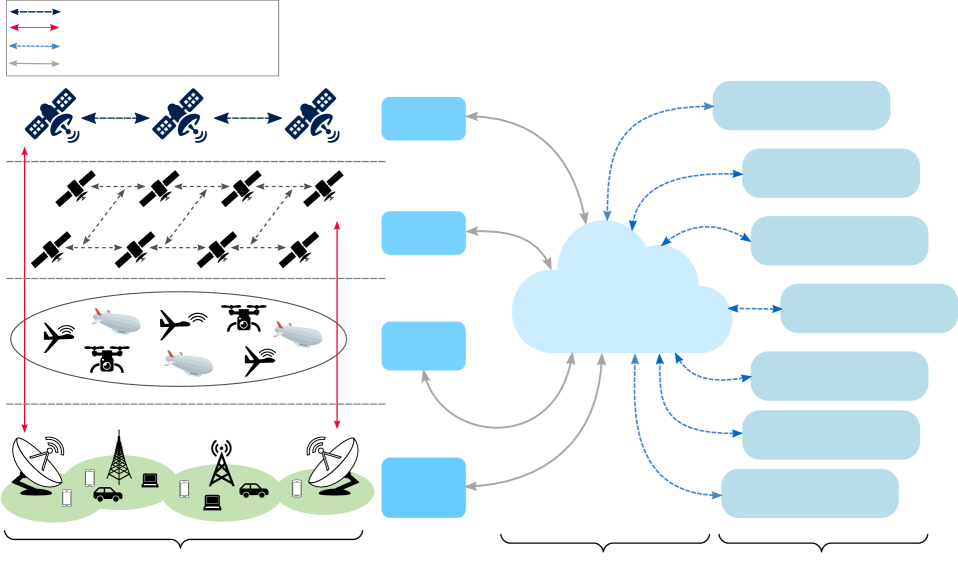
This paper investigates the transformative potential of digital twin (DT) technology for non-terrestrial networks (NTNs). NTNs, comprising airborne and space-borne elements, face unique challenges in network control, management, and optimization. DT technology provides a novel framework for designing and managing complex cyber-physical systems with enhanced automation, intelligence, and resilience. By offering a dynamic virtual representation of the NTN ecosystem, DTs enable real-time monitoring, simulation, and data-driven decision-making. This paper explores the integration of DTs into NTNs, identifying technical challenges and highlighting some key enabling technologies. Emphasis is placed on technologies such as the Internet of Things (IoT), machine learning, generative AI, space-based clouds, quantum computing, and others, highlighting their potential to empower DT development for NTNs. To illustrate these concepts, we present a case study demonstrating the implementation of a data-driven DT model for enabling dynamic, service-oriented network slicing within an open radio access network (O-RAN) architecture tailored for NTNs. This work aims to advance the understanding and application of DT technology, contributing to the evolution of network control and management in the dynamic and rapidly changing landscape of non-terrestrial communication systems.
Motivation & Objective
- Address the growing complexity of managing non-terrestrial networks (NTNs) with massive, dynamic, and heterogeneous entities.
- Enable real-time control, simulation, and optimization of NTN systems through a high-fidelity digital twin (DT) virtualization layer.
- Integrate artificial intelligence (AI) and machine learning into DTs to support dynamic, service-aware network slicing and resource allocation.
- Overcome challenges in data fidelity, computational load, and secure interconnectivity for scalable NTN-DT deployment.
- Demonstrate the feasibility and performance gains of AI-enhanced DTs in an open RAN (O-RAN) NTN architecture
Proposed method
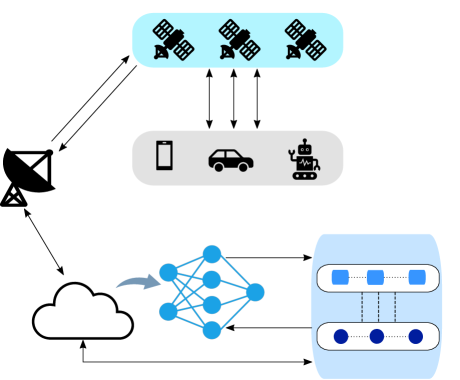
- Develop a data-driven digital twin model for NTNs using real-time sensor data from physical network entities.
- Implement a deep neural network (DNN) with three hidden layers (600, 300, 250 neurons) and ReLU activation for hidden layers, and Softmax for output layer.
- Train the DNN using network state inputs (channel state, traffic load, QoS requirements) to predict optimal resource allocation matrices.
- Use a dynamic scheduling algorithm that prioritizes URLLC traffic by reallocating resources from eMBB users based on stochastic network dynamics.
- Integrate the DT with an open RAN (O-RAN) architecture to support service-oriented, on-demand network slicing.
- Enable two-way data flow between the physical network and DT for continuous model refinement and real-time control
Experimental results
Research questions
- RQ1How can digital twin technology enhance real-time monitoring, control, and optimization in complex, dynamic non-terrestrial networks (NTNs)?
- RQ2What are the key technical challenges in deploying digital twins for NTNs, including data accuracy, computational demands, and secure interconnectivity?
- RQ3To what extent can AI-driven dynamic resource allocation in a DT framework improve spectral efficiency and QoS compliance compared to static orthogonal methods?
- RQ4How does the integration of a digital twin with O-RAN enable adaptive, service-aware network slicing in NTN environments?
- RQ5Can the digital twin model maintain URLLC reliability under varying traffic loads while optimizing overall system performance?
Key findings
- The AI-based dynamic resource allocation approach achieved approximately 60% higher downlink spectral efficiency than the static orthogonal method when URLLC traffic rate was 100 packets/time slot.
- At high URLLC traffic (λ = 200 packets/time slot), the spectral efficiency of the dynamic approach dropped to 2.1 bits/sec/Hz, while the orthogonal method reached 2.2 bits/sec/Hz due to full resource utilization.
- The cumulative outage probability for URLLC services remained below the 7% threshold (ε_max = 0.07), with only 2% of time slots exceeding the outage limit.
- The DNN-based DT model successfully prioritized critical URLLC traffic by dynamically reallocating resources from eMBB users, ensuring low-latency and high-reliability performance.
- The integration of the digital twin with O-RAN enabled real-time, data-driven network slicing that adapts to changing QoS requirements and network conditions.
- The system demonstrated robustness in handling stochastic network dynamics through continuous feedback and model retraining, improving long-term accuracy and responsiveness.
Read this paper
Open the full text in the Nubint reader and ask about any passage as you read.
Read this paper on NubintThis review was generated by AI from the original paper. Please check the paper before citing it.