
[Paper Review] Digital Twin Generators for Disease Modeling
This paper introduces a novel neural network architecture called Digital Twin Generators (DTGs) that use Neural Boltzmann Machines and deep learning to generate personalized, multivariate, continuous-time clinical trajectories from longitudinal health data. The same architecture achieves high accuracy across 13 diverse disease indications with only hyperparameter tuning, demonstrating a scalable path toward universal digital twins for personalized medicine.
A patient's digital twin is a computational model that describes the evolution of their health over time. Digital twins have the potential to revolutionize medicine by enabling individual-level computer simulations of human health, which can be used to conduct more efficient clinical trials or to recommend personalized treatment options. Due to the overwhelming complexity of human biology, machine learning approaches that leverage large datasets of historical patients' longitudinal health records to generate patients' digital twins are more tractable than potential mechanistic models. In this manuscript, we describe a neural network architecture that can learn conditional generative models of clinical trajectories, which we call Digital Twin Generators (DTGs), that can create digital twins of individual patients. We show that the same neural network architecture can be trained to generate accurate digital twins for patients across 13 different indications simply by changing the training set and tuning hyperparameters. By introducing a general purpose architecture, we aim to unlock the ability to scale machine learning approaches to larger datasets and across more indications so that a digital twin could be created for any patient in the world.
Motivation & Objective
- To develop a general-purpose machine learning framework capable of generating accurate digital twins for individual patients across diverse disease indications.
- To address the challenge of modeling complex, stochastic, multivariate clinical time-series data in a way that supports individualized forecasting and clinical decision-making.
- To enable scalable, adaptable, and interpretable digital twin models that can be trained on real-world longitudinal health records without requiring mechanistic biological knowledge.
- To lay the foundation for universal digital twin models by leveraging multi-indication data and energy-based modeling for future generalization across diseases and data modalities.
Proposed method
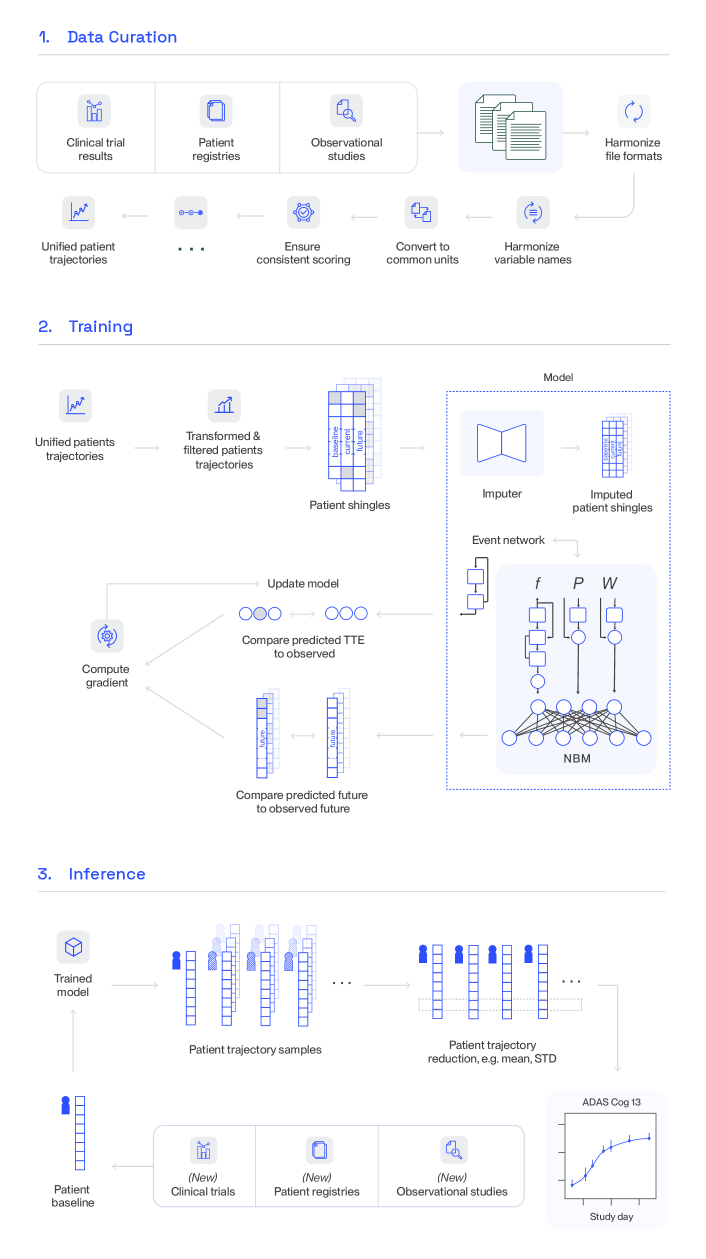
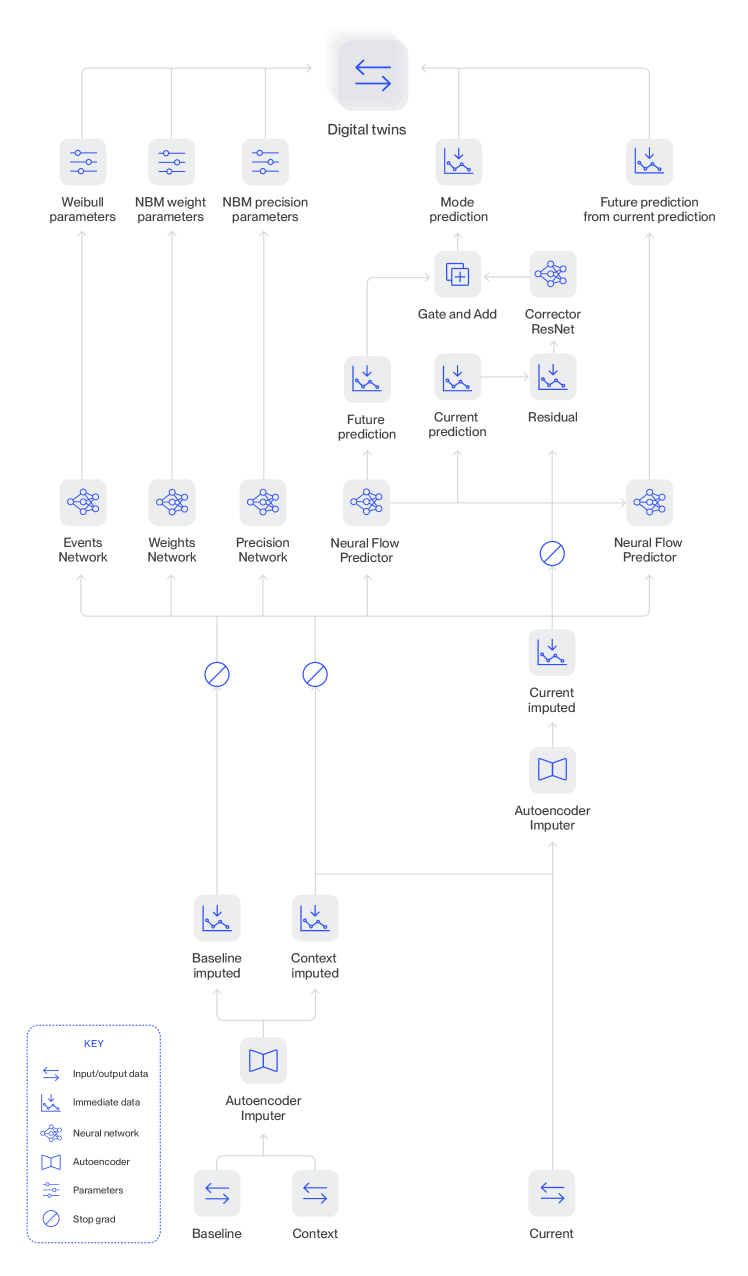
- The method employs a Neural Boltzmann Machine (NBM), an energy-based model parameterized by deep neural networks, to model the stochastic dynamics of multivariate clinical trajectories in continuous time.
- The architecture integrates deep neural networks to encode temporal dependencies and conditional distributions in longitudinal clinical data, enabling generation of patient-specific future health states.
- The model is trained end-to-end on individual-level longitudinal datasets from clinical trials, observational studies, and disease registries, using only tabular time-series data as input.
- Hyperparameter tuning enables adaptation of the same architecture to 13 different disease indications across three therapeutic areas—neurodegeneration, immunology/inflammation, and general medicine—without architectural changes.
- The framework supports probabilistic modeling of uncertainty in clinical outcomes, allowing for sensitivity analyses and interpretability of predictions.
- The approach is designed to be extensible to multimodal data by reparameterizing the NBM with neural networks that accept diverse inputs such as EHR, genomics, wearables, and imaging.
Experimental results
Research questions
- RQ1Can a single neural network architecture generate accurate digital twins across multiple, diverse disease indications using only longitudinal clinical data?
- RQ2How well can a conditional generative model based on a Neural Boltzmann Machine capture the stochastic, multivariate, and time-dependent nature of real-world clinical trajectories?
- RQ3To what extent can the same model architecture be generalized across therapeutic areas with minimal architectural changes and only hyperparameter tuning?
- RQ4How do the generated digital twins perform in forecasting individual patient outcomes, particularly in comparison to baseline models or clinical intuition?
- RQ5Can the model be extended to incorporate diverse data modalities such as genomics, imaging, or wearable data in a unified framework for future universal digital twins?
Key findings
- The proposed Digital Twin Generator (DTG) architecture achieves high accuracy in forecasting individual patient trajectories across 13 distinct disease indications with no architectural modifications, only hyperparameter tuning.
- The model successfully captures complex, multivariate, and stochastic dynamics in longitudinal clinical data, enabling reliable simulation of future health states under various treatment scenarios.
- Performance evaluation shows that the DTGs can generate clinically plausible trajectories that align with observed data, supporting their use in in silico clinical trials and personalized treatment planning.
- The framework demonstrates strong interpretability through sensitivity analyses, revealing how changes in input variables affect predicted outcomes.
- The model’s foundation in energy-based learning allows for uncertainty quantification, which is critical for clinical decision support and risk assessment.
- The architecture is extensible and can be adapted to incorporate new data modalities by modifying the input neural networks, suggesting a pathway toward universal digital twins.
Read this paper
Open the full text in the Nubint reader and ask about any passage as you read.
Read this paper on NubintThis review was generated by AI from the original paper. Please check the paper before citing it.