
[Paper Review] Dilated Convolution based CSI Feedback Compression for Massive MIMO Systems
This paper proposes DCRNet, a deep learning-based CSI feedback compression framework for FDD massive MIMO systems using dilated convolutions to expand the receptive field without increasing kernel size. The method achieves state-of-the-art reconstruction performance with significantly reduced FLOPs—up to 26% lower than CsiNet—making it highly efficient for low-complexity user equipment.
Although the frequency-division duplex (FDD) massive multiple-input multiple-output (MIMO) system can offer high spectral and energy efficiency, it requires to feedback the downlink channel state information (CSI) from users to the base station (BS), in order to fulfill the precoding design at the BS. However, the large dimension of CSI matrices in the massive MIMO system makes the CSI feedback very challenging, and it is urgent to compress the feedback CSI. To this end, this paper proposes a novel dilated convolution based CSI feedback network, namely DCRNet. Specifically, the dilated convolutions are used to enhance the receptive field (RF) of the proposed DCRNet without increasing the convolution size. Moreover, advanced encoder and decoder blocks are designed to improve the reconstruction performance and reduce computational complexity as well. Numerical results are presented to show the superiority of the proposed DCRNet over the conventional networks. In particular, the proposed DCRNet can achieve almost the state-of-the-arts (SOTA) performance with much lower floating point operations (FLOPs). The open source code and checkpoint of this work are available at https://github.com/recusant7/DCRNet.
Motivation & Objective
- Address the high computational and feedback overhead in CSI feedback for FDD massive MIMO systems due to large-dimensional CSI matrices.
- Overcome limitations of traditional compressed sensing methods, such as reliance on CSI sparsity and high latency from iterative processing.
- Improve upon existing deep learning-based CSI compression networks (e.g., CsiNet) that suffer from limited receptive fields and high computational complexity.
- Design a lightweight yet high-performance network that enables efficient CSI feedback under practical user equipment constraints.
Proposed method
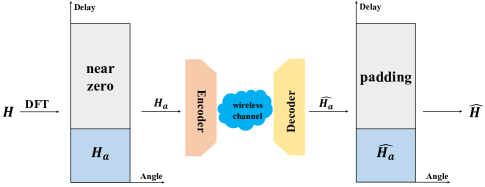
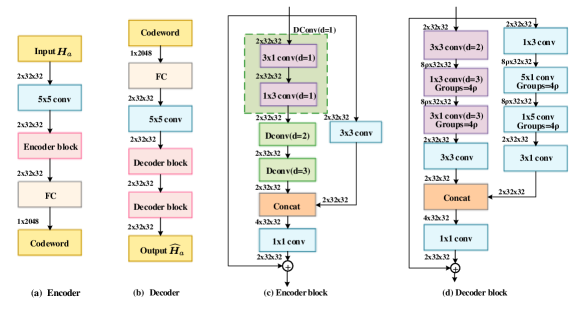
- Employ dilated convolutions in both encoder and decoder blocks to expand the receptive field without increasing kernel size or parameter count.
- Integrate advanced encoder and decoder blocks to enhance reconstruction accuracy while minimizing computational complexity.
- Transform the CSI matrix into the angular-delay domain via DFT to exploit sparsity and improve compressibility before deep learning processing.
- Use a deep autoencoder architecture with dilated convolutions to learn compact representations of CSI matrices for efficient feedback.
- Optimize network width via a width expansion ratio (ρ) to balance performance and FLOPs, enabling deployment on low-complexity devices.
- Train the network end-to-end to minimize NMSE between reconstructed and original CSI matrices.
Experimental results
Research questions
- RQ1Can dilated convolutions effectively expand the receptive field in CSI feedback networks without increasing model complexity?
- RQ2How does the proposed DCRNet compare to state-of-the-art networks like CsiNet and ACRNet in terms of reconstruction accuracy and computational efficiency?
- RQ3To what extent can the network maintain high performance under high compression rates (e.g., 1/16, 1/32) with reduced FLOPs?
- RQ4Does joint use of dilated convolutions in both encoder and decoder yield better performance than using them only in the encoder or not at all?
- RQ5Can the proposed network achieve near-SOTA performance with significantly lower FLOPs across diverse propagation environments (indoor/outdoor)?
Key findings
- DCRNet-1× achieves state-of-the-art NMSE performance with 26% lower FLOPs than CsiNet, 21% lower than CRNet, and 12% lower than ACRNet-1× at a 1/4 compression rate.
- Under indoor conditions, DCRNet-1× outperforms all baselines and achieves SOTA performance with minimal computational cost.
- At a 1/16 compression rate, DCRNet-10× achieves NMSE of -14.18 dB, within 0.7 dB of the best-performing ACRNet-10×, but with significantly lower FLOPs.
- DCRNet-8× achieves -13.52 dB NMSE with 6.69M FLOPs, outperforming DS-NLCsiNet (-12.93 dB, 4.98M FLOPs) in both performance and efficiency.
- Ablation studies confirm that using dilated convolutions in both encoder and decoder yields the best reconstruction performance (NMSE: -11.74 dB indoors, -5.60 dB outdoors at 1/16 rate), surpassing baseline and DCRNet-M1.
- The network maintains strong performance across both indoor and outdoor scenarios, demonstrating robustness and adaptability to varying propagation environments.
Read this paper
Open the full text in the Nubint reader and ask about any passage as you read.
Read this paper on NubintThis review was generated by AI from the original paper. Please check the paper before citing it.