
[Paper Review] DinoSR: Self-Distillation and Online Clustering for Self-supervised Speech Representation Learning
DinoSR proposes a self-supervised speech representation learning framework that combines self-distillation and online clustering to learn meaningful discrete acoustic units from raw audio. By using a teacher network to generate contextualized embeddings, applying online clustering to discover a phone-like codebook, and distilling these units into a student network, DinoSR achieves state-of-the-art performance on LibriSpeech and unsupervised acoustic unit discovery, with high-quality, interpretable discrete units closely aligned to human phonetic categories.
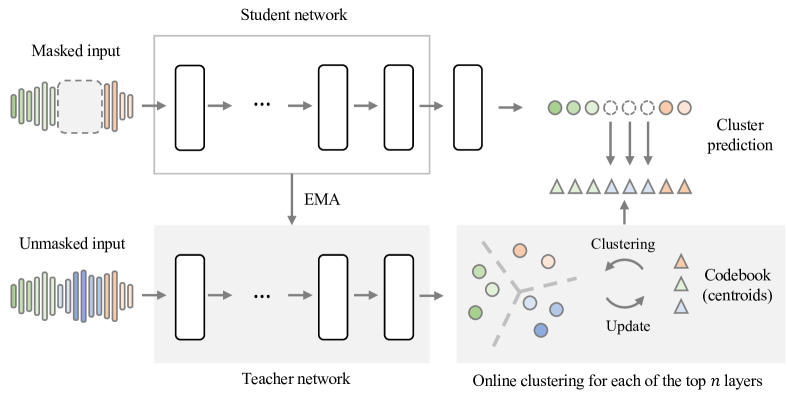
In this paper, we introduce self-distillation and online clustering for self-supervised speech representation learning (DinoSR) which combines masked language modeling, self-distillation, and online clustering. We show that these concepts complement each other and result in a strong representation learning model for speech. DinoSR first extracts contextualized embeddings from the input audio with a teacher network, then runs an online clustering system on the embeddings to yield a machine-discovered phone inventory, and finally uses the discretized tokens to guide a student network. We show that DinoSR surpasses previous state-of-the-art performance in several downstream tasks, and provide a detailed analysis of the model and the learned discrete units.
Motivation & Objective
- To develop a self-supervised speech representation learning method that leverages discrete units for improved performance and interpretability.
- To address the limitations of iterative, heuristic-based acoustic unit discovery in prior methods like HuBERT by enabling end-to-end training with online clustering.
- To improve codebook usage and cluster quality through a gradient-free online clustering mechanism integrated with self-distillation.
- To demonstrate that the learned discrete units are semantically meaningful and closely aligned with human-defined phonetic units.
- To achieve state-of-the-art performance on downstream speech recognition and unsupervised acoustic unit discovery benchmarks.
Proposed method
- The model uses a teacher network to extract contextualized embeddings from unmasked audio inputs.
- An online clustering system processes the teacher’s embeddings to generate a dynamic, machine-discovered codebook of discrete units, acting as a phone inventory.
- The student network is trained via self-distillation using the discretized tokens from the online cluster assignments as targets.
- The teacher network is updated via exponential moving average of the student’s parameters, enabling stable training without labeled data.
- The framework integrates masked language modeling (MLM) for masked input reconstruction, enhancing contextual representation learning.
- The method operates end-to-end with minimal hyperparameters, avoiding iterative refinement or offline clustering steps.
Experimental results
Research questions
- RQ1Can online clustering combined with self-distillation improve the quality and interpretability of self-supervised speech representations?
- RQ2How does DinoSR’s end-to-end training with online clustering compare to iterative, offline methods like HuBERT in terms of performance and codebook quality?
- RQ3To what extent do the learned discrete units in DinoSR align with human-defined phonetic units?
- RQ4Does the proposed method achieve state-of-the-art results on speech recognition and unsupervised acoustic unit discovery benchmarks?
- RQ5How effective is the codebook in capturing the long-tail distribution of speech units, such as frequent vs. rare phones?
Key findings
- DinoSR achieves a codebook perplexity of 179.2 on LibriSpeech dev set, outperforming VQ-APC (72.1) and co-training APC (135.0), indicating better codebook usage and quality.
- The model achieves a cluster purity of 0.19 and phone purity of 0.58, surpassing offline K-means on MFCC (0.06 and 0.30) and matching or exceeding HuBERT-iter2 (0.15 and 0.61).
- DinoSR achieves a PNMI score of 0.57, demonstrating strong alignment between learned units and phonetic categories.
- The model uses 217 active clusters out of 256, indicating high codebook utilization and fine-grained representation learning.
- Visualization of P(phone|code) shows that each codeword is predominantly associated with a single phone, with acoustically similar phones (e.g., /sp/ and /sil/) sharing clusters.
- The frame-wise phone error rate using the codebook mapping is 58.2%, confirming the practical utility of the learned units for phonetic classification.
Read this paper
Open the full text in the Nubint reader and ask about any passage as you read.
Read this paper on NubintThis review was generated by AI from the original paper. Please check the paper before citing it.