
[Paper Review] DiReCT: Diagnostic Reasoning for Clinical Notes via Large Language Models
DiReCT introduces a diagnostic reasoning dataset for clinical notes, comprising 511 physician-annotated cases with step-by-step diagnostic reasoning and a diagnostic knowledge graph to enhance interpretability. Evaluated on state-of-the-art LLMs, the results reveal a significant performance gap between model and human diagnostic reasoning, highlighting the need for improved reasoning capabilities in real-world clinical settings.
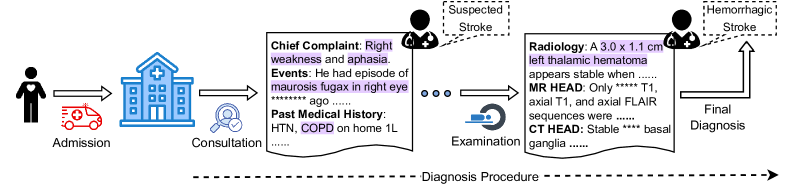
Large language models (LLMs) have recently showcased remarkable capabilities, spanning a wide range of tasks and applications, including those in the medical domain. Models like GPT-4 excel in medical question answering but may face challenges in the lack of interpretability when handling complex tasks in real clinical settings. We thus introduce the diagnostic reasoning dataset for clinical notes (DiReCT), aiming at evaluating the reasoning ability and interpretability of LLMs compared to human doctors. It contains 511 clinical notes, each meticulously annotated by physicians, detailing the diagnostic reasoning process from observations in a clinical note to the final diagnosis. Additionally, a diagnostic knowledge graph is provided to offer essential knowledge for reasoning, which may not be covered in the training data of existing LLMs. Evaluations of leading LLMs on DiReCT bring out a significant gap between their reasoning ability and that of human doctors, highlighting the critical need for models that can reason effectively in real-world clinical scenarios.
Motivation & Objective
- To address the lack of interpretability in large language models (LLMs) when handling complex, real-world clinical diagnostic tasks.
- To develop a benchmark dataset that captures the full diagnostic reasoning process from clinical notes to final diagnosis, as performed by human physicians.
- To provide a diagnostic knowledge graph based on clinical guidelines to support reasoning with domain-specific knowledge not always present in LLM training data.
- To evaluate the gap between LLM performance and human diagnostic reasoning in multi-evidence, step-by-step clinical reasoning.
- To enable the development of more transparent and reliable LLM-based diagnostic assistants through structured, explainable reasoning.
Proposed method
- The DiReCT dataset contains 511 clinical notes from MIMIC-IV, spanning 25 disease categories across cardiology, gastroenterology, neurology, pulmonology, and endocrinology.
- Each clinical note is annotated by physicians to identify key observations and provide a step-by-step diagnostic reasoning chain leading to the final diagnosis.
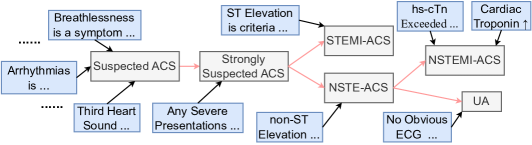
- A diagnostic knowledge graph is constructed from established clinical guidelines to encode disease-specific diagnostic criteria and reasoning pathways.
- An AI-agent baseline is implemented that uses the knowledge graph to decompose diagnosis into a sequence of evidence-based inferences from observations.
- The evaluation framework measures LLM performance on diagnostic reasoning using both direct prediction and chain-of-thought generation, comparing outputs to human-annotated reasoning.
- The dataset is released via PhysioNet, and code is available on GitHub to support reproducibility and further benchmarking.
Experimental results
Research questions
- RQ1How well can state-of-the-art LLMs replicate the step-by-step diagnostic reasoning process of human physicians when given complex clinical notes?
- RQ2To what extent does incorporating a formal diagnostic knowledge graph improve the interpretability and accuracy of LLM-based diagnostic reasoning?
- RQ3What is the performance gap between LLMs and human doctors in reasoning across multi-evidence, real-world clinical scenarios?
- RQ4Can LLMs effectively utilize external knowledge graphs to compensate for gaps in their training data during diagnostic reasoning?
- RQ5How do variations in clinical note writing styles affect the ability of LLMs to identify relevant diagnostic evidence?
Key findings
- Current state-of-the-art LLMs exhibit a significant performance gap compared to human physicians in diagnostic reasoning on complex clinical notes.
- The use of a diagnostic knowledge graph improves reasoning consistency and supports models in accessing guideline-based knowledge not present in their training data.
- Simple AI-agent baselines using the knowledge graph achieve better alignment with human reasoning than zero-shot LLM prompting, indicating the value of structured knowledge.
- The DiReCT dataset reveals that superficial text matching is insufficient for accurate diagnostic reasoning due to variations in clinical note phrasing.
- The dataset exposes the limitations of LLMs in handling multi-evidence entailment and sequential reasoning, even when provided with external knowledge.
- The results underscore the critical need for models that can perform transparent, multi-step diagnostic reasoning grounded in clinical guidelines.
Better researchstarts right now
From reading papers to final review, dramatically reduce your research time.
No credit card · Free plan available
This review was created by AI and reviewed by human editors.