
[Paper Review] Directed Diffusion: Direct Control of Object Placement through Attention Guidance
Directed Diffusion adds coarse positional control over directed objects in text-guided diffusion by editing cross-attention maps using user-provided bounding boxes, without model training.
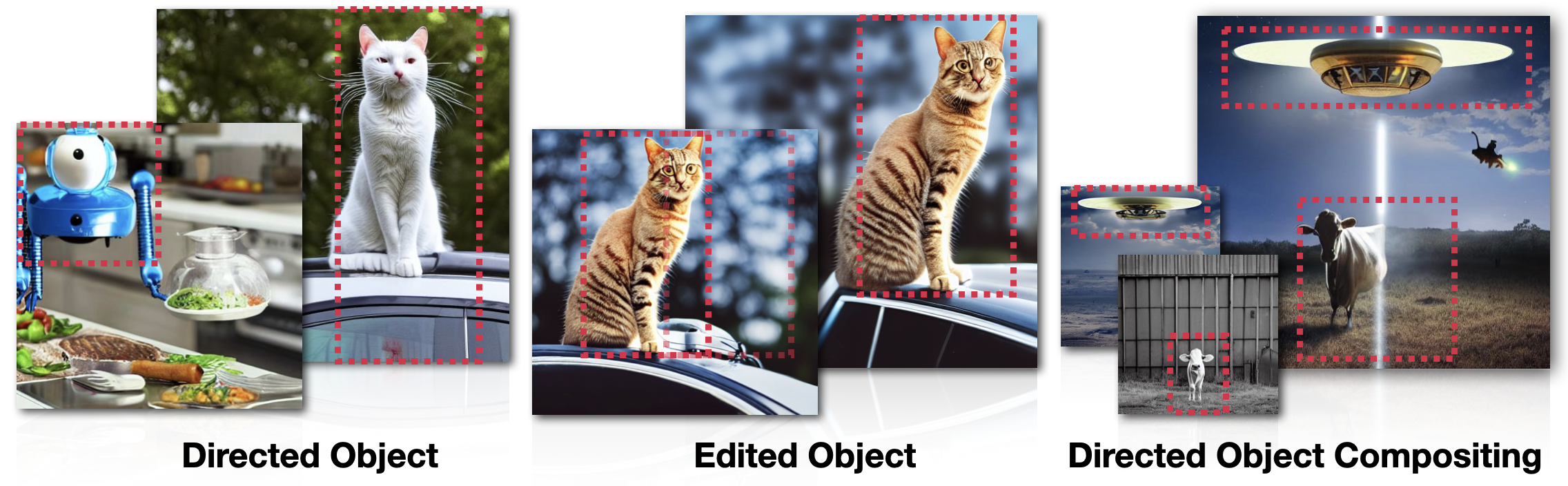
Text-guided diffusion models such as DALLE-2, Imagen, eDiff-I, and Stable Diffusion are able to generate an effectively endless variety of images given only a short text prompt describing the desired image content. In many cases the images are of very high quality. However, these models often struggle to compose scenes containing several key objects such as characters in specified positional relationships. The missing capability to ``direct'' the placement of characters and objects both within and across images is crucial in storytelling, as recognized in the literature on film and animation theory. In this work, we take a particularly straightforward approach to providing the needed direction. Drawing on the observation that the cross-attention maps for prompt words reflect the spatial layout of objects denoted by those words, we introduce an optimization objective that produces ``activation'' at desired positions in these cross-attention maps. The resulting approach is a step toward generalizing the applicability of text-guided diffusion models beyond single images to collections of related images, as in storybooks. Directed Diffusion provides easy high-level positional control over multiple objects, while making use of an existing pre-trained model and maintaining a coherent blend between the positioned objects and the background. Moreover, it requires only a few lines to implement.
Motivation & Objective
- Motivate storytelling and compositionality by enabling explicit object placement in diffusion-generated scenes.
- Provide a simple, training-free method to control multiple objects’ positions within a single or across related images.
- Preserve coherence between placed objects and background through the diffusion process.
- Deliver a lightweight implementation that integrates with pre-trained diffusion models.
- Support open-set, zero-shot placement for characters and objects without bespoke retraining.
Proposed method
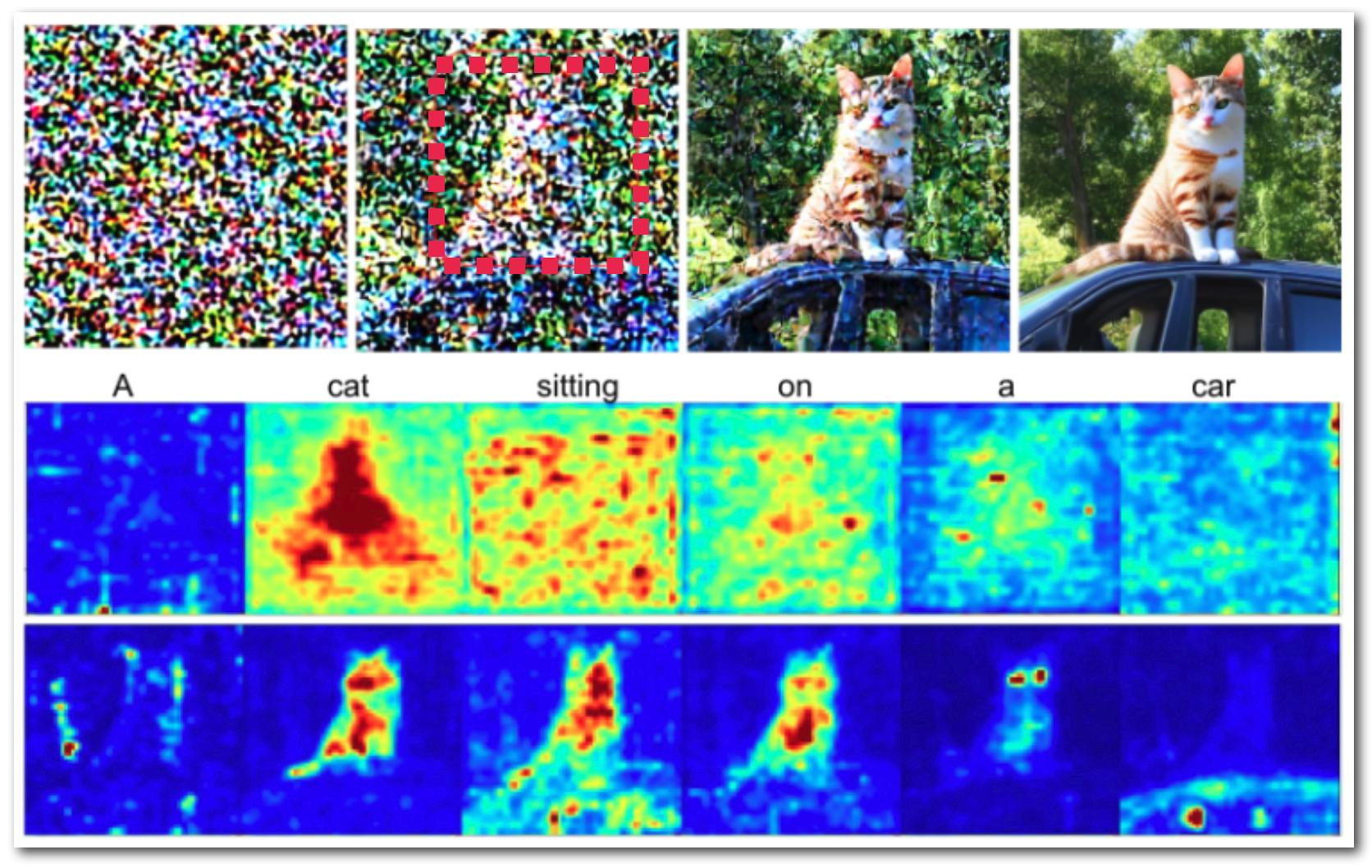
- Leverage cross-attention maps in pre-trained diffusion models to relate prompt words to spatial regions.
- Define a bounding box and directed prompt words to guide object positioning early in the denoising process.
- Introduce an attention editing stage that modulates trailing cross-attention maps with a Gaussian weight inside the bounding box.
- Optimize a small weight vector a to align directed attention maps with Gaussian target maps while preserving the learned text–image association.
- Use a two-stage pipeline: attention editing during initial denoising steps, followed by conventional diffusion denoising with classifier-free guidance.
- Enable placement and interaction control with minimal code changes and no model fine-tuning.
Experimental results
Research questions
- RQ1Can coarse, bounding-box–based guidance steer the placement of specific objects in a pre-trained diffusion model without retraining?
- RQ2How well does attention-guided placement handle multiple directed objects and their interactions with the scene?
- RQ3Does the method maintain contextual coherence (lighting, shadows) between placed objects and the background?
- RQ4How does Directed Diffusion compare to existing open-set placement approaches in terms of ease of use and quality?
Key findings
- The method provides easy, high-level positional control over multiple objects without fine-tuning a pre-trained model.
- Positioned objects integrate coherently with the background and exhibit contextual interactions such as shadows.
- The approach uses a small optimization over a weight vector to align directed cross-attention maps with a Gaussian target within the bounding box.
- The pipeline requires only a few lines of code to implement and preserves the pretrained model’s text–image alignment.
- Compositionality and storytelling capability are enhanced by enabling placement of directed objects and their interactions across scenes or frames.
- In experiments, CLIP-based similarities between prompts and synthesized images are comparable to or better than competing methods (as reported in the paper).
Read this paper
Open the full text in the Nubint reader and ask about any passage as you read.
Read this paper on NubintThis review was generated by AI from the original paper. Please check the paper before citing it.