
[Paper Review] DisDet: Exploring Detectability of Backdoor Attack on Diffusion Models
This paper introduces DisDet, a novel framework for detecting and evading backdoor triggers in diffusion models by leveraging distribution discrepancy between poisoned and benign noise inputs. It proposes a low-cost detection mechanism that achieves 100% detection accuracy and a stealthy trigger design that evades detection with near 100% pass rate while maintaining high attack and benign generation quality across multiple datasets and models.
In the exciting generative AI era, the diffusion model has emerged as a very powerful and widely adopted content generation and editing tool for various data modalities, making the study of their potential security risks very necessary and critical. Very recently, some pioneering works have shown the vulnerability of the diffusion model against backdoor attacks, calling for in-depth analysis and investigation of the security challenges of this popular and fundamental AI technique. In this paper, for the first time, we systematically explore the detectability of the poisoned noise input for the backdoored diffusion models, an important performance metric yet little explored in the existing works. Starting from the perspective of a defender, we first analyze the properties of the trigger pattern in the existing diffusion backdoor attacks, discovering the important role of distribution discrepancy in Trojan detection. Based on this finding, we propose a low-cost trigger detection mechanism that can effectively identify the poisoned input noise. We then take a further step to study the same problem from the attack side, proposing a backdoor attack strategy that can learn the unnoticeable trigger to evade our proposed detection scheme. Empirical evaluations across various diffusion models and datasets demonstrate the effectiveness of the proposed trigger detection and detection-evading attack strategy. For trigger detection, our distribution discrepancy-based solution can achieve a 100\% detection rate for the Trojan triggers used in the existing works. For evading trigger detection, our proposed stealthy trigger design approach performs end-to-end learning to make the distribution of poisoned noise input approach that of benign noise, enabling nearly 100\% detection pass rate with very high attack and benign performance for the backdoored diffusion models.
Motivation & Objective
- To systematically investigate the detectability of backdoor triggers in diffusion models, a critical yet underexplored metric in existing research.
- To develop a low-cost, effective trigger detection mechanism based on distribution discrepancy of noise inputs for defending against backdoor attacks.
- To design a stealthy backdoor trigger that evades detection by minimizing distribution discrepancy with benign noise while preserving high attack and benign generation performance.
- To evaluate the proposed detection and evasion strategies across diverse diffusion models and datasets, ensuring robustness and generalization.
Proposed method
- Proposes a distribution discrepancy-based detection mechanism that compares the statistical distribution of input noise to identify poisoned inputs, using a differentiable histogram approximation for gradient-based optimization.
- Introduces a PDD (Pairwise Distribution Discrepancy) loss function to minimize the distribution gap between poisoned and clean noise inputs during trigger learning.
- Employs a differentiable histogram function $ h_d(\cdot) $ as a surrogate for the non-differentiable distribution discrepancy measure, enabling end-to-end training of the trigger.
- Incorporates a Noise Consistency (NC) loss to improve the model's ability to predict noise in poisoned inputs, enhancing image quality and generation fidelity.
- Performs end-to-end training of the trigger pattern using both PDD and NC losses, optimizing for stealthiness and performance simultaneously.
- Uses the CIFAR-10, CelebA, and ImageNet datasets to evaluate detection and evasion performance across multiple diffusion model architectures.
Experimental results
Research questions
- RQ1Can distribution discrepancy in input noise serve as a reliable marker for detecting backdoor triggers in diffusion models?
- RQ2How effective is a distribution discrepancy-based detection mechanism in identifying poisoned inputs from existing backdoor attacks?
- RQ3Can a backdoor trigger be designed to minimize distribution discrepancy with benign noise, thereby evading detection?
- RQ4To what extent can stealthy triggers maintain high attack success and benign generation quality while evading detection?
Key findings
- The proposed distribution discrepancy-based detection mechanism achieves a 100% detection rate for all backdoor triggers used in prior works, demonstrating high reliability.
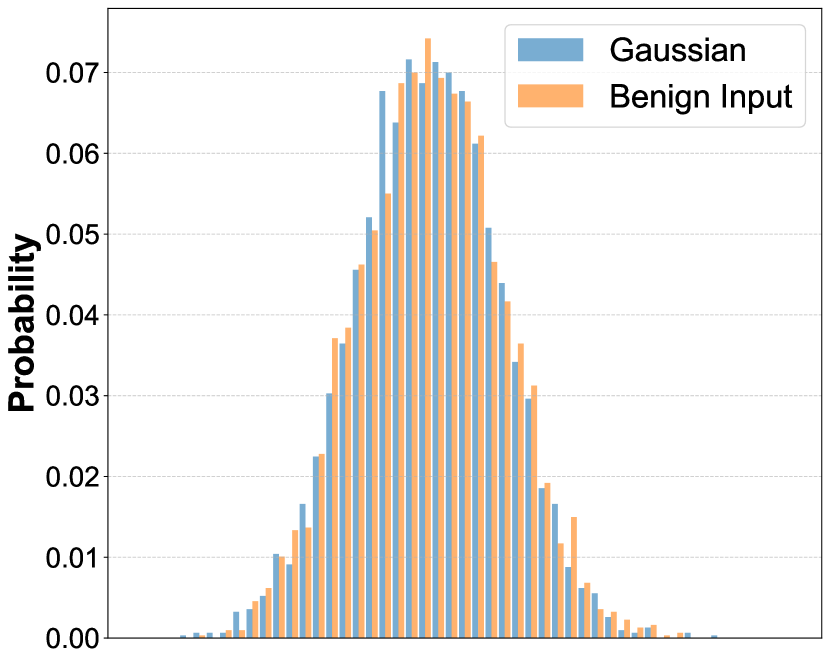
- The PDD-optimized trigger design reduces the PDD score to 0.023 on CIFAR-10, significantly lowering distribution discrepancy and enhancing stealthiness.
- The absolute mean of trigger values increases during training, correlating with improved Gaussian-like distribution and reduced detectability.
- The inclusion of NC loss reduces FID scores by up to 130.8 points compared to baseline, significantly improving image quality in both benign and attack settings.
- The detection pass rate for the stealthy trigger reaches nearly 100%, confirming its effectiveness in evading detection while maintaining high performance.
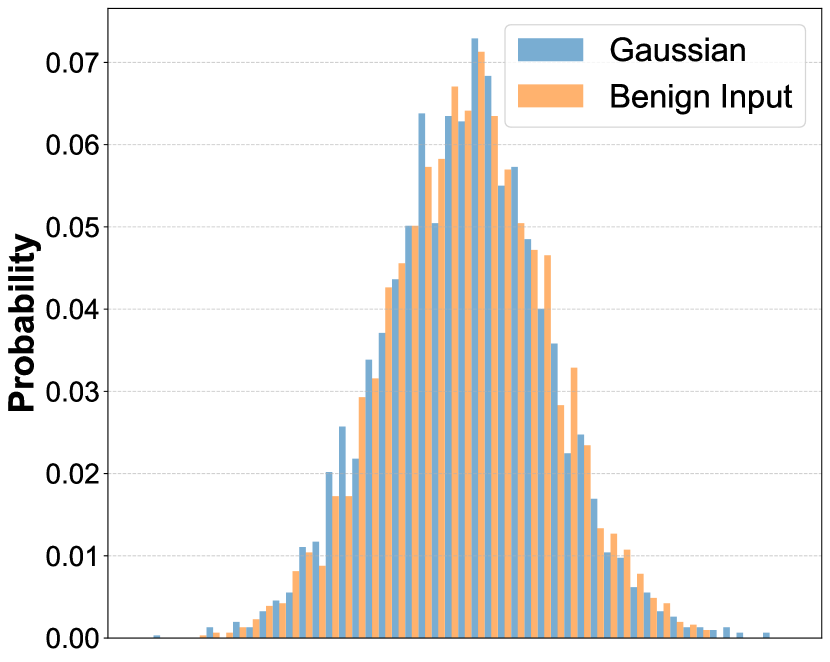
- Visualizations confirm that PDD-optimized triggers produce poisoned inputs indistinguishable from clean Gaussian noise in distribution.
Read this paper
Open the full text in the Nubint reader and ask about any passage as you read.
Read this paper on NubintThis review was generated by AI from the original paper. Please check the paper before citing it.