
[Paper Review] DisDiff: Unsupervised Disentanglement of Diffusion Probabilistic Models
This paper proposes DisDiff, an unsupervised framework that disentangles pre-trained diffusion probabilistic models (DPMs) into factor-specific sub-gradient fields by learning disentangled representations without annotations. It enables interpretable, factor-specific image generation and partial condition sampling via classifier guidance and a novel disentanglement loss, achieving state-of-the-art disentanglement on synthetic and real-world datasets.
Targeting to understand the underlying explainable factors behind observations and modeling the conditional generation process on these factors, we connect disentangled representation learning to Diffusion Probabilistic Models (DPMs) to take advantage of the remarkable modeling ability of DPMs. We propose a new task, disentanglement of (DPMs): given a pre-trained DPM, without any annotations of the factors, the task is to automatically discover the inherent factors behind the observations and disentangle the gradient fields of DPM into sub-gradient fields, each conditioned on the representation of each discovered factor. With disentangled DPMs, those inherent factors can be automatically discovered, explicitly represented, and clearly injected into the diffusion process via the sub-gradient fields. To tackle this task, we devise an unsupervised approach named DisDiff, achieving disentangled representation learning in the framework of DPMs. Extensive experiments on synthetic and real-world datasets demonstrate the effectiveness of DisDiff.
Motivation & Objective
- To address the lack of disentangled representation learning in diffusion probabilistic models (DPMs), which are otherwise highly effective for image generation.
- To enable unsupervised discovery of underlying semantic factors in image data without human-annotated supervision.
- To decompose the DPM's gradient field into sub-gradient fields, each conditioned on a disentangled factor representation, for interpretable and controllable generation.
- To overcome limitations of VAE-based and GAN-based disentanglement, such as the trade-off between disentanglement and generation quality or the need for inversion in GANs.
- To introduce a new inductive bias by enforcing disentanglement constraints across all timesteps in the diffusion process.
Proposed method
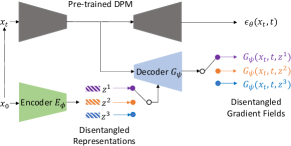
- DisDiff uses an encoder to learn disentangled representations of underlying factors from input images in the diffusion process.
- It employs a decoder to learn factor-specific sub-gradient fields, each conditioned on the representation of a single discovered factor.
- A novel disentangling loss enforces disentanglement by encouraging factor-specific representations while ensuring reconstruction of the input image.
- The method applies classifier guidance and score-based conditioning to inject factor-specific conditions into the diffusion process.
- It uses a weighted loss scheme where the difference in encoder outputs across timesteps acts as a dynamic weighting coefficient to balance disentanglement and reconstruction.
- Learnable orthogonal positional embeddings are used to distinguish between different factors during conditioning, improving disentanglement stability.
Experimental results
Research questions
- RQ1Can a pre-trained DPM be disentangled into factor-specific sub-gradient fields in an unsupervised manner?
- RQ2Can disentangled representations be learned without any human-annotated labels or pre-trained classifiers?
- RQ3Does enforcing disentanglement constraints across all timesteps improve disentanglement quality and generation controllability?
- RQ4Can partial condition sampling—conditioning only on a subset of factors—be effectively achieved using superposed sub-gradient fields?
- RQ5How does DisDiff compare to existing VAE- and GAN-based disentanglement methods in terms of disentanglement quality and generation fidelity?
Key findings
- DisDiff achieves state-of-the-art disentanglement performance on both synthetic (Shapes3D) and real-world (CelebA) datasets without any annotations.
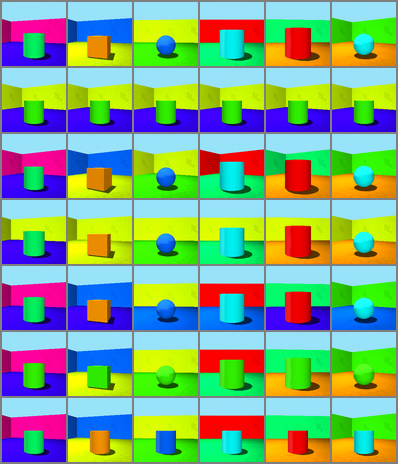
- The method enables partial condition sampling by superimposing only selected sub-gradient fields, allowing control over individual factors such as object color or background.
- Ablation studies show that using the difference in encoder outputs as a weighting coefficient significantly improves disentanglement, outperforming constant or loss-based weighting.
- The use of learnable orthogonal positional embeddings improves disentanglement performance compared to no positional embedding or standard learnable embeddings.
- Cross-attention layers hurt performance slightly, likely due to the limited representational capacity of a single token per factor.
- The number of latent vectors has minimal impact on performance when set above the number of underlying factors, indicating robustness to hyperparameter choice.
Read this paper
Open the full text in the Nubint reader and ask about any passage as you read.
Read this paper on NubintThis review was generated by AI from the original paper. Please check the paper before citing it.