
[Paper Review] Disentangling the Faraday rotation sky
This paper presents the first full-sky map of the line-of-sight-averaged Galactic magnetic field using information field theory to jointly analyze extragalactic Faraday rotation measures, pulsar dispersion measures, and thermal electron tracers (Hα, bremsstrahlung). The method disentangles $B_\parallel$ and electron density $n_{\mathrm{th}}$, yielding a 1.1 μG all-sky RMS field strength and a detailed dispersion measure map consistent with models at high latitudes but affected by disk systematics.
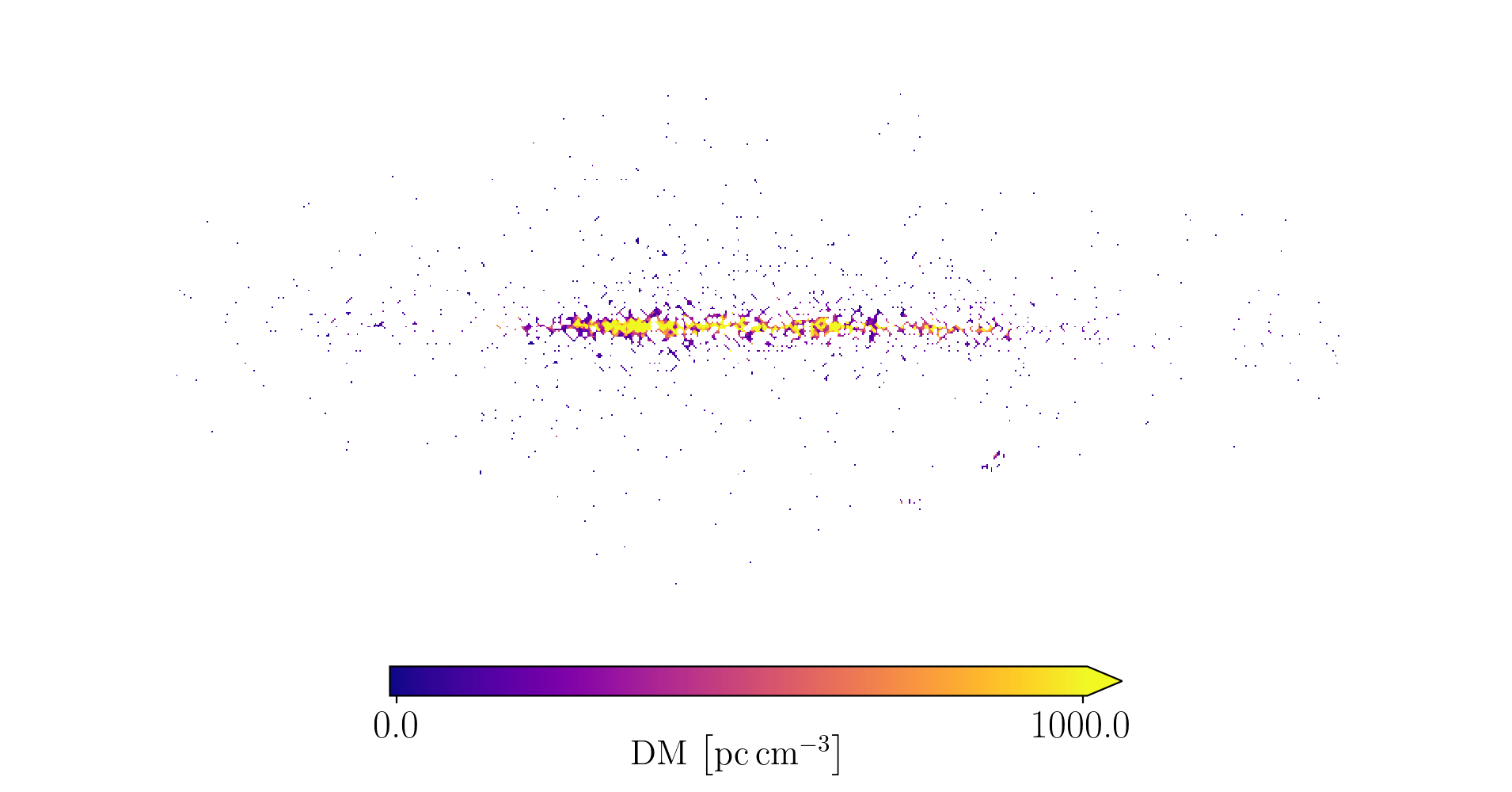
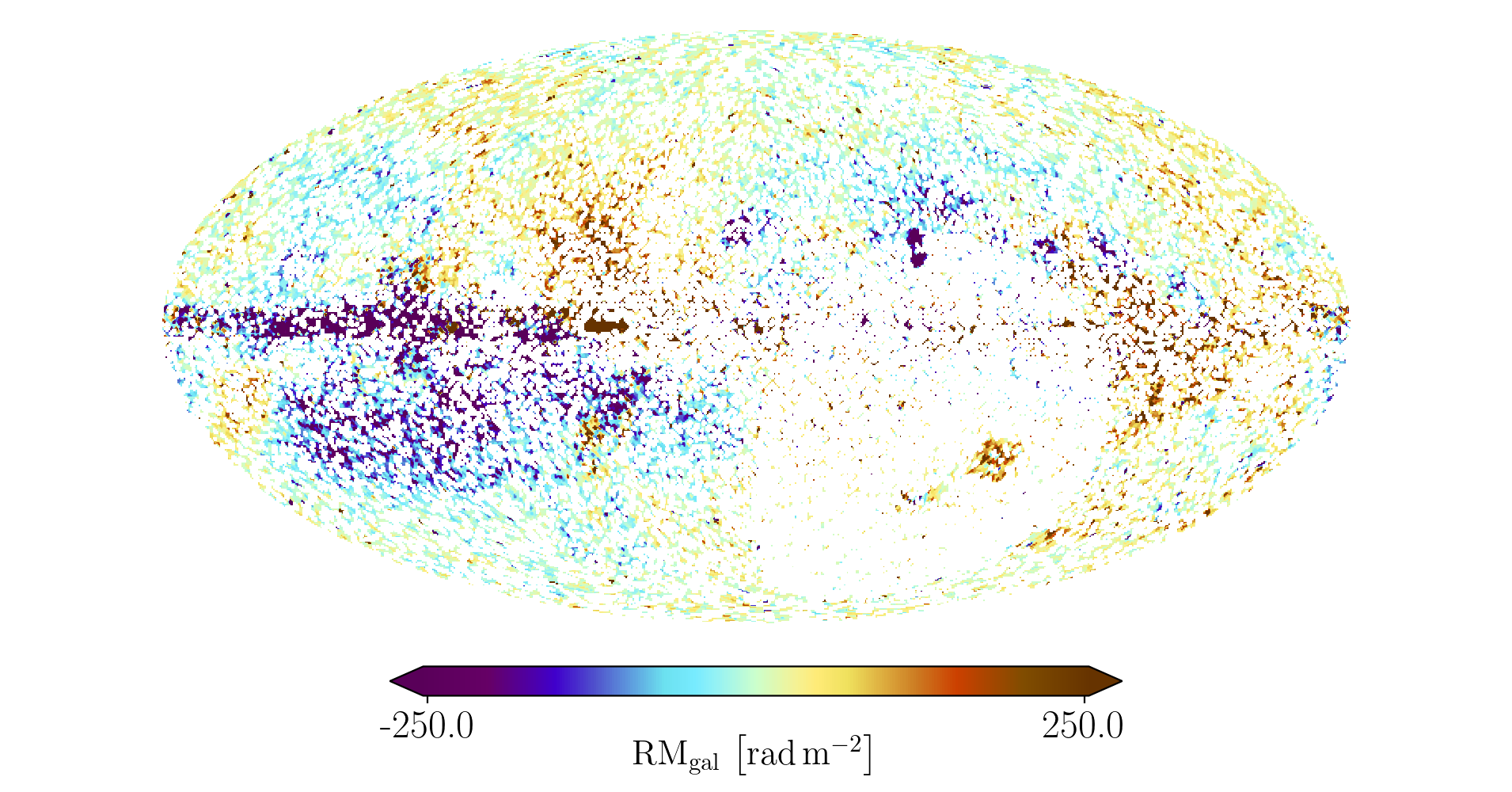
Magnetic fields permeate the diffuse interstellar medium (ISM) of the Milky Way, and are essential to explain the dynamical evolution and current shape of the Galaxy. Magnetic fields reveal themselves via their influence on the surrounding matter, and as such are notoriously hard to measure independently of other tracers. In this work, we attempt to disentangle an all sky map of the line-of-sight parallel component of the Galactic magnetic field from the Faraday effect, utilizing several tracers of the Galactic thermal electron density. Additionally, we aim to produce a Galactic electron dispersion measure map and quantify several tracers of the structure of the ionized medium of the Milky Way. We rely on compiled catalogs of extragalactic Faraday rotation measures and Galactic pulsar dispersion measures, a well as data on bremsstrahlung and the hydrogen $α$ spectral line to trace the ionized medium of the Milky Way. We present the first full sky map of the line-of-sight averaged Galactic magnetic field. Within this map, we find LoS parallel and LoS-averaged magnetic field strengths of up to 4 $μ$G, with an all-sky root-mean-square of 1.1 $μ$G, which is consistent with previous local measurements and global magnetic field models. Additionally, we produce a detailed electron dispersion measure map, which agrees with already existing parametric models at high latitudes, but suffers from systematic effects in the disk. Further analysis of our results with regard to the 3D structure of $n_{th}$ reveals that it follows a Kolmogorov-type turbulence for most of the sky. From the reconstructed dispersion measure and emission measure maps we construct several tracers of variability of $n_{th}$ along the LoS.
Motivation & Objective
- To disentangle the Galactic magnetic field from the Faraday effect by jointly analyzing multiple astrophysical tracers.
- To produce a high-fidelity, all-sky map of the line-of-sight-averaged magnetic field strength $B_\parallel$.
- To construct a detailed electron dispersion measure (DM) map and assess its consistency with existing models.
- To quantify the 3D structure of the thermal electron density $n_{\mathrm{th}}$ and its turbulence properties.
- To define a roadmap for future 3D reconstruction of the Galactic magnetic field and ionized ISM.
Proposed method
- Employs information field theory, a Bayesian inference framework, to handle noisy, incomplete, and high-dimensional data.
- Uses extragalactic Faraday rotation measures (RM), pulsar dispersion measures (DM), and thermal electron tracers (Hα, bremsstrahlung) as input data.
- Applies joint statistical inference to separate $B_\parallel$ and $n_{\mathrm{th}}$ from the entangled Faraday depth $\phi$.
- Derives angular power spectra and conversion factors $\mathrm{L_{DM^{2}/EM}}$ and $\varrho_{\mathrm{EM/DM}}$ to probe electron density structure.
- Constructs a mock 3D model of $n_{\mathrm{th}}$ to interpret observed power-law behavior and systematics.
- Performs detailed cutouts on specific regions (e.g., Sh 2-27, Smith high-velocity cloud) to validate local consistency.
Experimental results
Research questions
- RQ1What is the true all-sky distribution of the line-of-sight-averaged Galactic magnetic field $B_\parallel$?
- RQ2How can we disentangle $B_\parallel$ and $n_{\mathrm{th}}$ from Faraday depth when both are entangled in the data?
- RQ3What is the 3D structure of the thermal electron density $n_{\mathrm{th}}$ in the Milky Way, and does it follow Kolmogorov-type turbulence?
- RQ4How do the inferred dispersion measure and emission measure maps compare with existing parametric models?
- RQ5What systematic biases affect the reconstruction, and how can they be mitigated with future data and modeling?
Key findings
- The first full-sky map of the line-of-sight-averaged Galactic magnetic field is produced, with an all-sky root-mean-square strength of 1.1 μG.
- Magnetic field strengths reach up to 4 μG in localized regions, consistent with local measurements and global models.
- The dispersion measure map agrees with existing parametric models at high Galactic latitudes but shows systematic effects in the Galactic disk due to sparse pulsar sampling.
- The angular power spectrum of the DM sky exhibits a Kolmogorov-type turbulence behavior, consistent with the 'Big power law in the sky'.
- The conversion factor $\mathrm{L_{DM^{2}/EM}}$ indicates the effective path length contributing to DM and EM, with values consistent with literature in uniform medium approximations.
- The factor $\varrho_{\mathrm{EM/DM}}$ provides an estimate of the average thermal electron density along the line of sight, matching expected values for the Milky Way.
Read this paper
Open the full text in the Nubint reader and ask about any passage as you read.
Read this paper on NubintThis review was generated by AI from the original paper. Please check the paper before citing it.