
[Paper Review] Disruptive Autoencoders: Leveraging Low-level features for 3D Medical Image Pre-training
This paper proposes Disruptive Autoencoders (DAE), a novel self-supervised pre-training framework for 3D medical images that enhances low-level feature learning through a combination of local masking—masking across channel embeddings rather than tokens—alongside low-level perturbations like noise and downsampling. The method achieves state-of-the-art performance on multiple 3D medical image segmentation benchmarks, including topping the public test leaderboard of the BTCV multi-organ segmentation challenge.
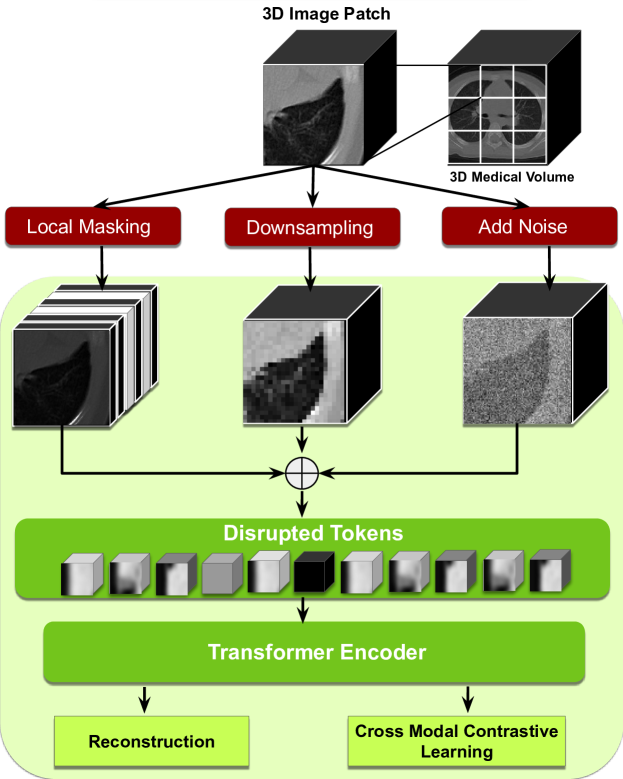
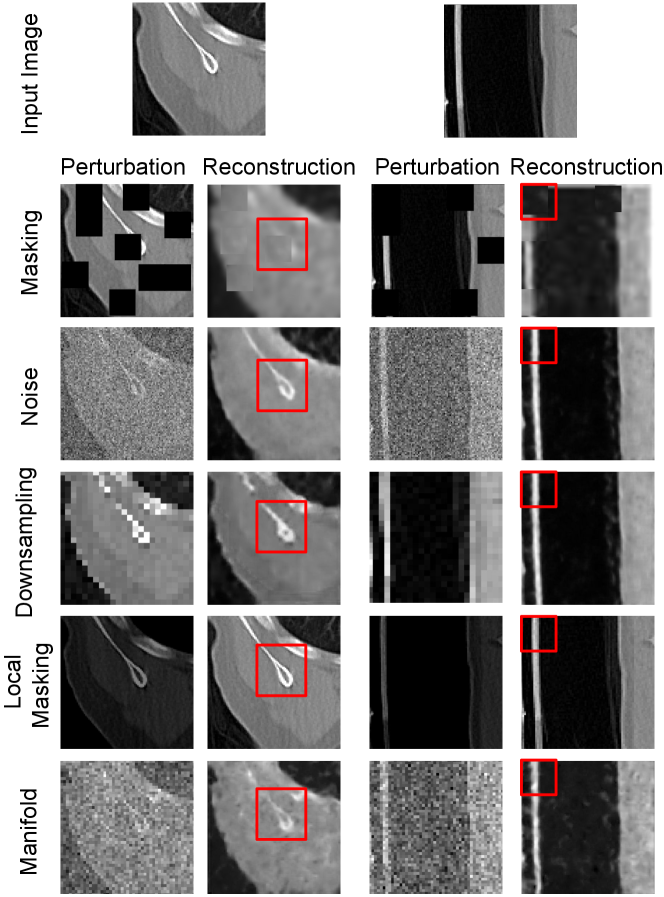
Harnessing the power of pre-training on large-scale datasets like ImageNet forms a fundamental building block for the progress of representation learning-driven solutions in computer vision. Medical images are inherently different from natural images as they are acquired in the form of many modalities (CT, MR, PET, Ultrasound etc.) and contain granulated information like tissue, lesion, organs etc. These characteristics of medical images require special attention towards learning features representative of local context. In this work, we focus on designing an effective pre-training framework for 3D radiology images. First, we propose a new masking strategy called local masking where the masking is performed across channel embeddings instead of tokens to improve the learning of local feature representations. We combine this with classical low-level perturbations like adding noise and downsampling to further enable low-level representation learning. To this end, we introduce Disruptive Autoencoders, a pre-training framework that attempts to reconstruct the original image from disruptions created by a combination of local masking and low-level perturbations. Additionally, we also devise a cross-modal contrastive loss (CMCL) to accommodate the pre-training of multiple modalities in a single framework. We curate a large-scale dataset to enable pre-training of 3D medical radiology images (MRI and CT). The proposed pre-training framework is tested across multiple downstream tasks and achieves state-of-the-art performance. Notably, our proposed method tops the public test leaderboard of BTCV multi-organ segmentation challenge.
Motivation & Objective
- To address the challenge of learning robust low-level representations in 3D medical images, which are critical for fine-grained tasks like organ and lesion segmentation.
- To overcome the limitations of vanilla Masked Autoencoders (MAEs) in reconstructing fine anatomical structures in 3D radiology images.
- To design a pre-training framework that effectively leverages multiple medical imaging modalities (e.g., MRI, CT) in a unified, contrastive learning-aware manner.
- To curate and utilize a large-scale, multi-modal 3D medical image dataset to enable effective pre-training.
- To demonstrate that stronger low-level feature learning leads to improved downstream performance in medical image segmentation.
Proposed method
- Proposes a novel local masking strategy that masks across channel embeddings rather than spatial tokens, enhancing the model's ability to learn local, fine-grained features.
- Introduces disruptive perturbations—additive noise and downsampling—applied before tokenization to further stimulate low-level representation learning.
- Combines these disruptions with a transformer-based encoder and convolutional decoder to reconstruct the original 3D image from the corrupted latent representation.
- Introduces a Cross-Modal Contrastive Loss (CMCL) to align features across different imaging modalities (e.g., MRI, CT) during pre-training, enabling modality-aware representation learning.
- Employs a large-scale, curated dataset of 3D MRI and CT volumes to pre-train the model on diverse anatomical and acquisition variations.
- Uses self-supervised pre-training followed by fine-tuning on downstream segmentation tasks, with evaluation on standard benchmarks like BTCV and PROMISE12.
Experimental results
Research questions
- RQ1Can a pre-training framework that emphasizes low-level feature learning through targeted disruptions improve 3D medical image representation learning?
- RQ2Does local masking—masking across channel embeddings rather than spatial tokens—lead to better reconstruction and downstream performance than standard token masking?
- RQ3How do combined low-level perturbations (noise, downsampling) and local masking compare to individual disruptions in pre-training effectiveness?
- RQ4To what extent does cross-modal contrastive learning improve multi-modal pre-training in 3D medical images?
- RQ5Does pre-training with stronger low-level features lead to better generalization, especially under low-data regimes?
Key findings
- Disruptive Autoencoders achieve state-of-the-art performance on the public test leaderboard of the BTCV multi-organ segmentation challenge, outperforming prior methods including MAE and Swin-UNETR.
- The method achieves a Dice score of 0.8472 on the BTCV dataset, surpassing even the combination of three pretext tasks in Swin-UNETR.
- On the PROMISE12 dataset, DAE outperforms both random initialization and MAE across all data regimes, with significant gains on 20% and 50% training data, demonstrating strong data efficiency.
- Abllation studies confirm that the combination of local masking and low-level perturbations yields the best performance, with local masking alone outperforming noise and downsampling individually.
- CKA analysis shows that early network layers retain more low-level features from pre-trained to fine-tuned models, confirming that low-level representations are more stable and critical for downstream performance.
- The inclusion of Cross-Modal Contrastive Loss (CMCL) improves fine-tuning performance, indicating that modality-aware pre-training enhances generalization across imaging modalities.
Read this paper
Open the full text in the Nubint reader and ask about any passage as you read.
Read this paper on NubintThis review was generated by AI from the original paper. Please check the paper before citing it.