
[Paper Review] Distance-distributed design for Gaussian process surrogates
This paper proposes a novel distance-distributed design for Gaussian process (GP) surrogates that optimizes pairwise distance distributions to improve hyperparameter estimation, particularly lengthscales. By reverse-engineering the favorable distance structures of random designs, the method achieves superior predictive accuracy and sequential optimization performance compared to conventional space-filling designs like maximin and Latin hypercube sampling.
A common challenge in computer experiments and related fields is to efficiently explore the input space using a small number of samples, i.e., the experimental design problem. Much of the recent focus in the computer experiment literature, where modeling is often via Gaussian process (GP) surrogates, has been on space-filling designs, via maximin distance, Latin hypercube, etc. However, it is easy to demonstrate empirically that such designs disappoint when the model hyperparameterization is unknown, and must be estimated from data observed at the chosen design sites. This is true even when the performance metric is prediction-based, or when the target of interest is inherently or eventually sequential in nature, such as in blackbox (Bayesian) optimization. Here we expose such inefficiencies, showing that in many cases purely random design is superior to higher-powered alternatives. We then propose a family of new schemes by reverse engineering the qualities of the random designs which give the best estimates of GP lengthscales. Specifically, we study the distribution of pairwise distances between design elements, and develop a numerical scheme to optimize those distances for a given sample size and dimension. We illustrate how our distance-based designs, and their hybrids with more conventional space-filling schemes, outperform in both static (one-shot design) and sequential settings.
Motivation & Objective
- To address the inefficiency of conventional space-filling designs—such as maximin and Latin hypercube sampling—in estimating GP hyperparameters, especially lengthscales.
- To investigate why random uniform designs often outperform these space-filling alternatives in hyperparameter estimation despite lacking explicit space-filling properties.
- To develop a new class of experimental designs that explicitly target favorable pairwise distance distributions to enhance GP hyperparameter inference.
- To demonstrate the superiority of these distance-distributed designs in both static one-shot and sequential design settings, particularly for Bayesian optimization and prediction.
- To provide a computationally feasible optimization framework for generating designs with desired distance distributions, using the Beta family as a flexible parametric model.
Proposed method
- Reverse-engineers the pairwise distance distributions of random uniform designs that yield accurate GP lengthscale estimates.
- Parametrizes the target distance distribution using the Beta distribution family, defined by shape parameters α and β, to model unimodal, well-behaved distance profiles.
- Optimizes the Beta parameters (α, β) via numerical search to minimize prediction error and improve hyperparameter estimation accuracy under a given design size n and dimension d.
- Introduces a hybrid design strategy that combines distance-distributed designs with traditional space-filling schemes (e.g., LHS) to balance global coverage and hyperparameter estimation quality.
- Employs a random swapping algorithm to refine designs and improve convergence to optimal distance distributions.
- Validates the method using synthetic and real-world computer experiment benchmarks, comparing performance against maximin, LHS, and random designs in both static and sequential settings.
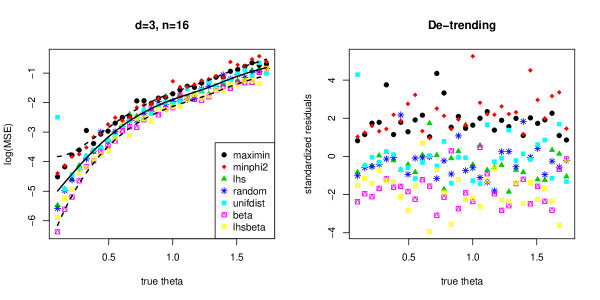
Experimental results
Research questions
- RQ1Why do random uniform designs often outperform maximin and Latin hypercube designs in estimating GP lengthscales despite lacking explicit space-filling properties?
- RQ2Can a systematic design strategy be developed that explicitly targets favorable pairwise distance distributions to improve GP hyperparameter estimation?
- RQ3How do distance-distributed designs compare to conventional space-filling designs in terms of predictive accuracy and performance in sequential Bayesian optimization?
- RQ4What parametric family of distance distributions (e.g., Beta) best supports accurate and stable GP hyperparameter inference across different design sizes and input dimensions?
- RQ5Can hybrid designs combining distance-distributed and space-filling properties achieve both good global coverage and robust hyperparameter estimation?
Key findings
- Random uniform designs consistently outperform maximin and Latin hypercube designs in estimating GP lengthscales, particularly in low-sample regimes.
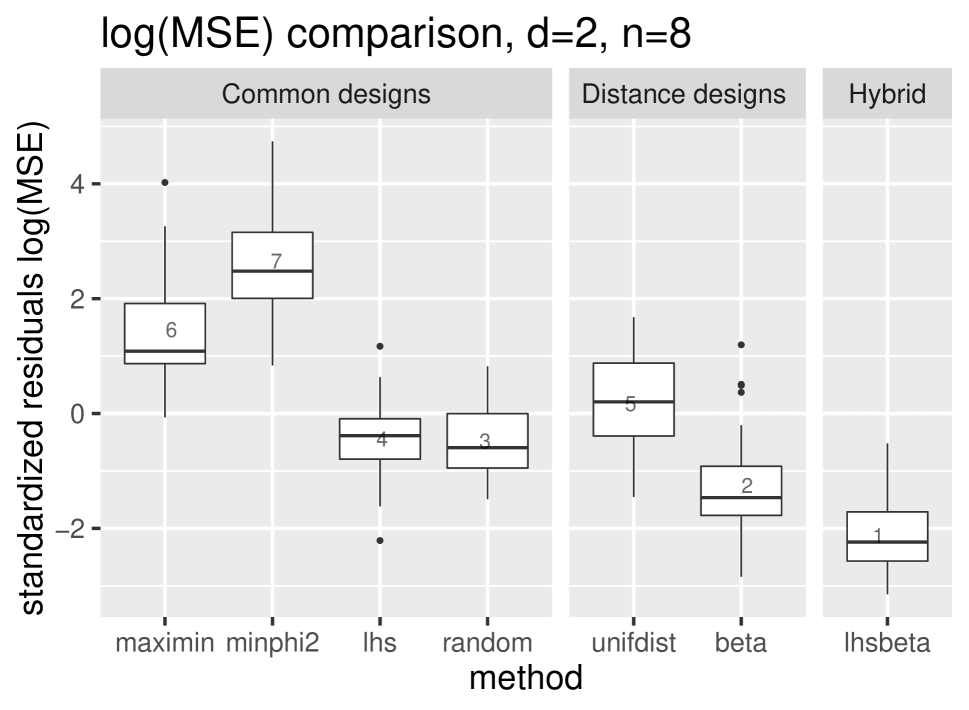
- The proposed distance-distributed designs, optimized via the Beta family, achieve significantly lower prediction error than maximin and LHS designs in both static and sequential settings.
- Hybrid designs that combine distance-distributed and LHS components show improved performance over pure LHS or maximin designs, especially in high-dimensional problems.
- The method successfully mitigates the poor hyperparameter estimation caused by multi-modal or irregular pairwise distance distributions in traditional space-filling designs.
- Optimal distance distributions are unimodal and concentrated around intermediate distances, which aligns with the favorable properties of random designs.
- The approach is robust across different kernel families and can be extended to separable or nugget-inflated GP models, though with added complexity in optimization.
Read this paper
Open the full text in the Nubint reader and ask about any passage as you read.
Read this paper on NubintThis review was generated by AI from the original paper. Please check the paper before citing it.