
[Paper Review] DistilHuBERT: Speech Representation Learning by Layer-wise Distillation of Hidden-unit BERT
This paper proposes DistilHuBERT, a knowledge distillation framework that compresses HuBERT by training a smaller student model to predict intermediate hidden representations from multiple layers of the teacher model. The method reduces model size by 75% and speeds up inference by 73%, while retaining most performance across ten speech tasks, even with limited data.
Self-supervised speech representation learning methods like wav2vec 2.0 and Hidden-unit BERT (HuBERT) leverage unlabeled speech data for pre-training and offer good representations for numerous speech processing tasks. Despite the success of these methods, they require large memory and high pre-training costs, making them inaccessible for researchers in academia and small companies. Therefore, this paper introduces DistilHuBERT, a novel multi-task learning framework to distill hidden representations from a HuBERT model directly. This method reduces HuBERT's size by 75% and 73% faster while retaining most performance in ten different tasks. Moreover, DistilHuBERT required little training time and data, opening the possibilities of pre-training personal and on-device SSL models for speech.
Motivation & Objective
- Address the high memory and computational cost of large self-supervised speech models like HuBERT, which limits their use in academia and small companies.
- Overcome the limitations of standard knowledge distillation in speech SSL, where distilling only the final output layer fails to capture rich, layered representations.
- Develop a multi-task learning framework that enables a small student model to learn from multiple intermediate hidden layers of a pre-trained HuBERT teacher.
- Enable efficient pre-training of compact, on-device, and personalizable speech representation models with minimal data and training time.
Proposed method
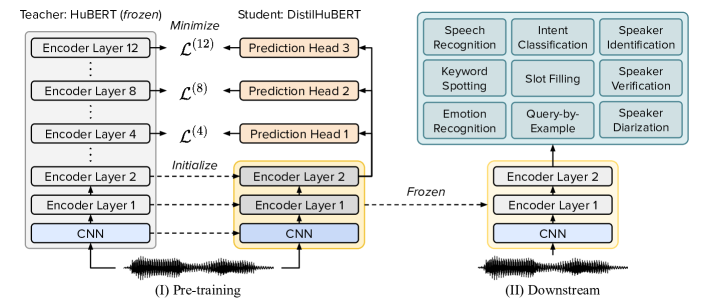
- Propose a multi-task knowledge distillation framework where a student model predicts the hidden representations of specific intermediate layers (4th, 8th, 12th) from the teacher HuBERT model.
- Use three separate prediction heads attached to the student’s transformer encoder to minimize mean squared error loss between predicted and target hidden representations.
- Train the student model end-to-end using a combined loss function: $\mathcal{L} = \mathcal{L}^{(4)} + \mathcal{L}^{(8)} + \mathcal{L}^{(12)}$, encouraging the student to learn rich, layered representations.
- After pre-training, remove the prediction heads, freeze the student model, and use its distilled representations for downstream tasks.
- Initialize the student model with the teacher’s parameters to improve convergence and representation quality during distillation.
- Apply the distillation framework to a small, lightweight student model consisting of a CNN feature extractor and a compact transformer encoder.
Experimental results
Research questions
- RQ1Can layer-wise knowledge distillation from intermediate hidden states improve the performance of a smaller student model compared to distilling only the final output?
- RQ2How effective is the proposed multi-task distillation framework in compressing HuBERT while preserving performance across diverse speech tasks?
- RQ3To what extent can DistilHuBERT be trained effectively with limited or out-of-domain pre-training data?
- RQ4Which specific HuBERT layers contribute most to downstream task performance, and how does multi-layer distillation balance representation learning across semantics, speaker identity, and phonetic content?
Key findings
- DistilHuBERT reduces HuBERT’s model size by 75% and speeds up inference by 73%, achieving a significant efficiency gain without major performance drop.
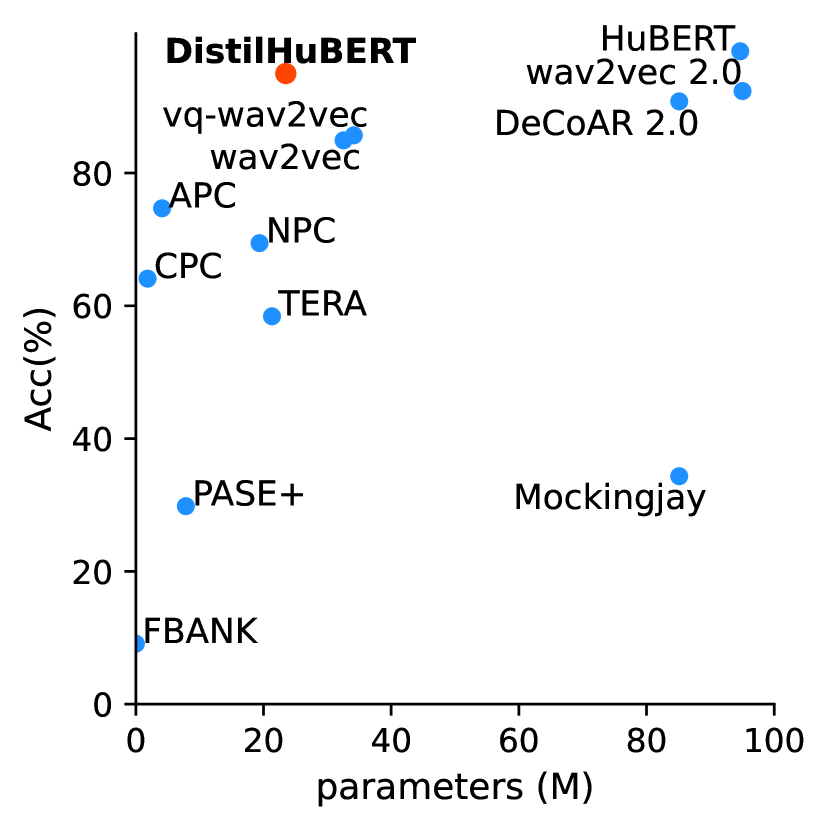
- On the SUPERB benchmark, DistilHuBERT achieves 94.99% accuracy on Intent Classification (IC), 73.54% on Speaker Identification (SID), and 13.34% WER on Automatic Speech Recognition (ASR), closely matching HuBERT’s performance.
- Training with only 100 hours of LibriSpeech data yields 93.17% IC accuracy and 69.46% SID accuracy, demonstrating strong generalization with minimal data.
- DistilHuBERT outperforms other distillation-based methods and many strong baselines, even when trained on smaller or out-of-domain datasets like WSJ and AISHELL-1.
- The 8th and 12th layers of HuBERT were found to be most informative for ASR and IC, while the 4th layer contributed more to speaker identity, justifying the multi-layer selection strategy.
- The model’s distilled representations are robust to data distribution shifts, with AISHELL-1 showing strong SID performance due to speaker identity independence from language.
Read this paper
Open the full text in the Nubint reader and ask about any passage as you read.
Read this paper on NubintThis review was generated by AI from the original paper. Please check the paper before citing it.