
[Paper Review] Distilled Feature Fields Enable Few-Shot Language-Guided Manipulation
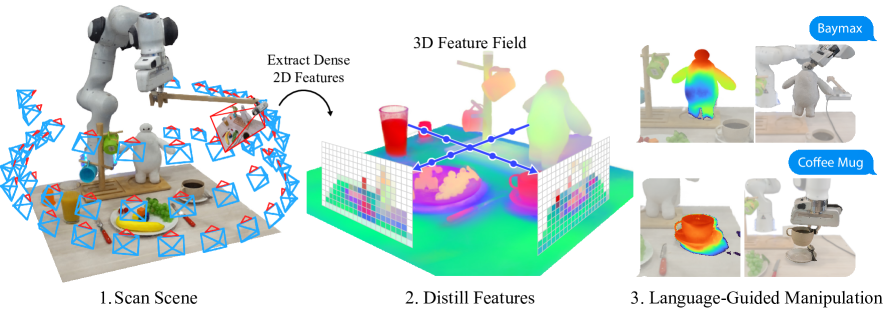
The paper proposes Distilled Feature Fields (DFFs) to fuse 2D vision-language priors with 3D geometry via NeRFs, enabling few-shot and language-guided 6-DOF robotic manipulation without fine-tuning. It demonstrates open-set object grasping and language-driven tasks using CLIP/DINO features distilled into a 3D feature field.
Self-supervised and language-supervised image models contain rich knowledge of the world that is important for generalization. Many robotic tasks, however, require a detailed understanding of 3D geometry, which is often lacking in 2D image features. This work bridges this 2D-to-3D gap for robotic manipulation by leveraging distilled feature fields to combine accurate 3D geometry with rich semantics from 2D foundation models. We present a few-shot learning method for 6-DOF grasping and placing that harnesses these strong spatial and semantic priors to achieve in-the-wild generalization to unseen objects. Using features distilled from a vision-language model, CLIP, we present a way to designate novel objects for manipulation via free-text natural language, and demonstrate its ability to generalize to unseen expressions and novel categories of objects.
Motivation & Objective
- Bridge 2D semantic priors from vision-language models with 3D geometry for robust robotic manipulation in cluttered, open-set environments.
- Enable few-shot grasping and placing by leveraging distilled 3D feature fields derived from pre-trained 2D models.
- Allow open-text language guidance to select and manipulate novel objects without task-specific fine-tuning.
Proposed method
- Construct a Distilled Feature Field (DFF) by distilling dense 2D features from a vision foundation model into a 3D NeRF-style volume.
- Use MaskCLIP to obtain dense patch-level features aligned with CLIP's language space for 3D distillation.
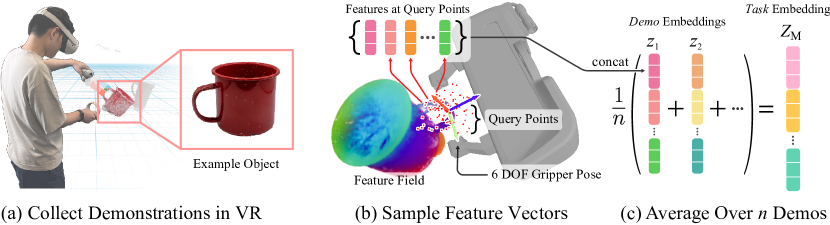
- Represent 6-DOF grasp/placement poses by sampling a set of query points in the gripper frame and aggregating alpha-weighted features from the scene’s feature field.
- Infer candidate grasps by cosine similarity between a task embedding Z_M (averaged over demonstrations) and feature-field queried at transformed points, followed by pose optimization and collision filtering.
- Incorporate language guidance by retrieving demonstrations closest to the language query via CLIP embeddings and adding a language-guidance term to the pose objective, enabling open-text manipulation without retraining.
Experimental results
Research questions
- RQ1Can Distilled Feature Fields fuse 2D vision-language priors with 3D geometry to enable open-ended, few-shot manipulation in cluttered scenes?
- RQ2To what extent can language descriptions guide manipulation to generalize to unseen object categories and expressions?
- RQ3What is the performance of 6-DOF grasping/placing when using DFFs distilled from DINO and CLIP features compared to baselines?
- RQ4How effective is a zero-shot language-conditioned manipulation pipeline without fine-tuning on new object categories?
Key findings
- DFFs enable open-ended scene understanding for 6-DOF grasping and placing in unseen object scenarios.
- Fusion of DINO ViT and CLIP-based features provides complementary geometric and semantic priors, improving manipulation success over baselines that rely on density, color, or intermediate NeRF features.
- Language-guided manipulation using CLIP-aligned feature fields allows selecting and manipulating objects via free-text queries, enabling generalization to out-of-distribution and novel categories.
- The system demonstrates successful grasps and placements across several tasks and objects in cluttered environments, though some failures stem from grasp rotation accuracy and CLIP's limitations in capturing relational/ordinal language details.
Read this paper
Open the full text in the Nubint reader and ask about any passage as you read.
Read this paper on NubintThis review was generated by AI from the original paper. Please check the paper before citing it.