
[Paper Review] DistServe: Disaggregating Prefill and Decoding for Goodput-optimized Large Language Model Serving
DistServe disaggregates prefill and decoding across separate GPUs, co-optimizes their resources, and optimizes placement to achieve higher per-GPU goodput under TTFT and TPOT SLOs, outperforming state-of-the-art systems.
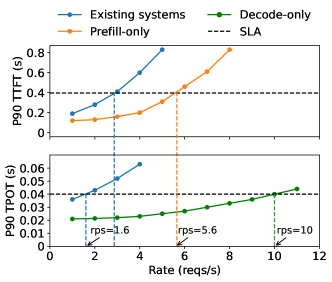
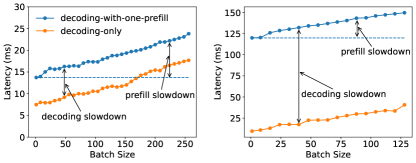
DistServe improves the performance of large language models (LLMs) serving by disaggregating the prefill and decoding computation. Existing LLM serving systems colocate the two phases and batch the computation of prefill and decoding across all users and requests. We find that this strategy not only leads to strong prefill-decoding interferences but also couples the resource allocation and parallelism plans for both phases. LLM applications often emphasize individual latency for each phase: time to first token (TTFT) for the prefill phase and time per output token (TPOT) of each request for the decoding phase. In the presence of stringent latency requirements, existing systems have to prioritize one latency over the other, or over-provision compute resources to meet both. DistServe assigns prefill and decoding computation to different GPUs, hence eliminating prefill-decoding interferences. Given the application's TTFT and TPOT requirements, DistServe co-optimizes the resource allocation and parallelism strategy tailored for each phase. DistServe also places the two phases according to the serving cluster's bandwidth to minimize the communication caused by disaggregation. As a result, DistServe significantly improves LLM serving performance in terms of the maximum rate that can be served within both TTFT and TPOT constraints on each GPU. Our evaluations show that on various popular LLMs, applications, and latency requirements, DistServe can serve 7.4x more requests or 12.6x tighter SLO, compared to state-of-the-art systems, while staying within latency constraints for > 90% of requests.
Motivation & Objective
- Motivate the need to optimize LLM serving with tight TTFT and TPOT latency requirements.
- Identify prefill-decoding interference and resource coupling as key bottlenecks in colocated serving.
- Propose disaggregation of prefill and decoding to enable phase-specific optimization.
- Develop placement and scheduling algorithms to maximize per-GPU goodput under real workloads.
- Evaluate DistServe against existing systems across multiple models and latency targets.
Proposed method
- Disaggregate prefill and decoding phases onto separate GPUs to remove interference.
- Co-optimize resource allocation and parallelism for each phase based on TTFT and TPOT requirements.
- Develop placement algorithms (high node-affinity and low node-affinity) to maximize per-GPU goodput and meet traffic rate with replication.
- Introduce an online scheduling layer with a pull-based KV cache transmission to reduce memory pressure and pipeline bubbles.
- Use workload-aware simulation to estimate SLO attainment and guide configuration searches.
- Provide replication strategies to scale the optimized per-phase configurations to higher traffic.
Experimental results
Research questions
- RQ1Can disaggregating prefill and decoding phases improve per-GPU goodput under TTFT and TPOT constraints?
- RQ2What placement and parallelism configurations maximize goodput for each phase given cluster topology and bandwidth?
- RQ3How does DistServe perform across different LLM sizes, applications, and latency targets compared with state-of-the-art systems?
- RQ4What are the practical challenges (e.g., KV cache transfer, non-uniform prompts) and how can they be mitigated in deployment?
- RQ5Is online replanning needed to adapt to workload changes and how effective is it?
Key findings
- DistServe achieves up to 4.48× more requests under latency constraints compared to state-of-the-art systems.
- DistServe enables up to 10.2× tighter SLOs while staying within latency targets for >90% of requests.
- Disaggregating prefill and decoding eliminates prefill–decoding interference and allows phase-specific parallelism.
- Placement algorithms and replication scale per-phase goodput to meet traffic rates efficiently.
- KV-cache transmission is managed via a pull-based mechanism to reduce memory pressure and pipeline bubbles.
- Performance gains hold across multiple LLMs, applications, and latency requirements.
Read this paper
Open the full text in the Nubint reader and ask about any passage as you read.
Read this paper on NubintThis review was generated by AI from the original paper. Please check the paper before citing it.