
[Paper Review] Diverse Embedding Expansion Network and Low-Light Cross-Modality Benchmark for Visible-Infrared Person Re-identification
Introduces DEEN, an embedding-space augmentation network with a diverse embedding expansion module and multistage feature aggregation to reduce VIS-IR modality gaps, plus the LLCM low-light VIReID dataset. Demonstrates state-of-the-art VIReID performance on SYSU-MM01, RegDB, and LLCM.
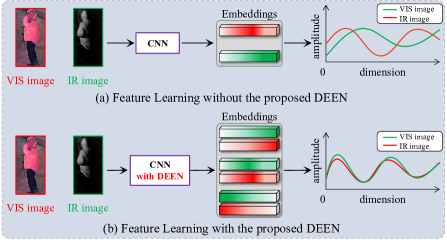
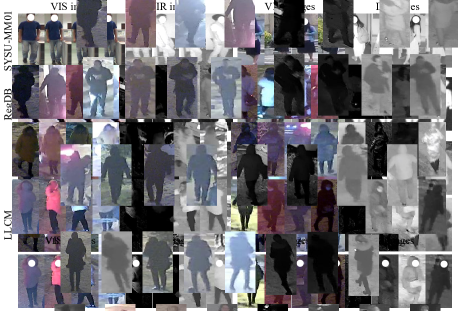
For the visible-infrared person re-identification (VIReID) task, one of the major challenges is the modality gaps between visible (VIS) and infrared (IR) images. However, the training samples are usually limited, while the modality gaps are too large, which leads that the existing methods cannot effectively mine diverse cross-modality clues. To handle this limitation, we propose a novel augmentation network in the embedding space, called diverse embedding expansion network (DEEN). The proposed DEEN can effectively generate diverse embeddings to learn the informative feature representations and reduce the modality discrepancy between the VIS and IR images. Moreover, the VIReID model may be seriously affected by drastic illumination changes, while all the existing VIReID datasets are captured under sufficient illumination without significant light changes. Thus, we provide a low-light cross-modality (LLCM) dataset, which contains 46,767 bounding boxes of 1,064 identities captured by 9 RGB/IR cameras. Extensive experiments on the SYSU-MM01, RegDB and LLCM datasets show the superiority of the proposed DEEN over several other state-of-the-art methods. The code and dataset are released at: https://github.com/ZYK100/LLCM
Motivation & Objective
- Motivate VIReID under challenging cross-modality gaps between visible and infrared images with limited training data.
- Propose Diverse Embedding Expansion (DEE) to generate diverse embeddings and learn informative cross-modality representations.
- Introduce Center-Guided Pair Mining (CPM) loss to encourage diversity while aligning VIS and IR embeddings.
- Develop a Multistage Feature Aggregation (MFA) block to mine channel-wise and spatial features across backbone stages.
- Provide a challenging low-light cross-modality VIReID dataset (LLCM) to evaluate robustness to illumination changes.
Proposed method
- Propose DEEN, an end-to-end network using a two-stream ResNet-50 backbone.
- Implement DEE, a multi-branch dilated-convolution module that generates multiple embeddings per input.
- Use a CPM loss to encourage diversity among generated embeddings and to pull VIS-generated embeddings toward IR counterparts (and vice versa).
- Impose an orthogonality constraint among DEE branches to encourage learning diverse representations.
- Incorporate an MFA block to fuse multi-stage features, enabling richer channel-wise and spatial representations.
- Optimize with a combination of cross-entropy, triplet, CPM, and orthogonal losses under a unified objective.
Experimental results
Research questions
- RQ1Can embedding-space augmentation via DEE produce diverse cross-modality clues to bridge VIS-IR gaps in VIReID?
- RQ2Does the CPM loss effectively steer generated embeddings to be both diverse and modality-aligned?
- RQ3Will MFA-enhanced multi-stage aggregation improve cross-modality feature discrimination?
- RQ4How does DEEN perform under low-light cross-modality conditions compared to existing VIReID methods?
- RQ5What is the impact of the LLCM dataset on evaluating VIReID robustness to illumination changes?
Key findings
- DEEN achieves state-of-the-art results on SYSU-MM01 and RegDB, notably R-1=74.7, mAP=71.8 in All-Search on SYSU-MM01 and VIS→IR R-1=91.1, mAP=85.1 on RegDB.
- On RegDB, DEEN attains VIS→IR R-1=91.1 and IR→VIS R-1=89.5 with mAPs of 85.1 and 83.4, respectively.
- On the LLCM dataset, DEEN surpasses representative baselines with IR→VIS R-1=54.9, mAP=62.9 and VIS→IR R-1=62.9, mAP=74.7.
- Ablations show that DEE alone provides limited gains, but when combined with CPM and MFA, the model achieves substantial improvements (DEEN = 54.9 R-1, 62.9 mAP on LLCM; 74.7 R-1, 71.8 mAP on SYSU-MM01).
- The MFA block outperforms a Non-local baseline in both Rank-1 and mAP, confirming its effectiveness for cross-stage feature fusion.
- DEEN exhibits robustness to illumination changes and improves intra-class compactness while reducing inter-class and cross-modality gaps.
Read this paper
Open the full text in the Nubint reader and ask about any passage as you read.
Read this paper on NubintThis review was generated by AI from the original paper. Please check the paper before citing it.