
[Paper Review] DiverseMotion: Towards Diverse Human Motion Generation via Discrete Diffusion
DiverseMotion proposes a novel Motion Discrete Diffusion (MDD) framework that achieves state-of-the-art balance between motion quality and diversity in text-to-motion generation. By introducing the large-scale Wild Motion-Caption (WMC) dataset with 8,888 motion clips and 141k diverse captions, and employing a Hierarchical Semantic Aggregation (HSA) module to capture fine-grained text semantics, the method significantly improves motion diversity while maintaining high generation quality on HumanML3D and KIT-ML benchmarks.
We present DiverseMotion, a new approach for synthesizing high-quality human motions conditioned on textual descriptions while preserving motion diversity.Despite the recent significant process in text-based human motion generation,existing methods often prioritize fitting training motions at the expense of action diversity. Consequently, striking a balance between motion quality and diversity remains an unresolved challenge. This problem is compounded by two key factors: 1) the lack of diversity in motion-caption pairs in existing benchmarks and 2) the unilateral and biased semantic understanding of the text prompt, focusing primarily on the verb component while neglecting the nuanced distinctions indicated by other words.In response to the first issue, we construct a large-scale Wild Motion-Caption dataset (WMC) to extend the restricted action boundary of existing well-annotated datasets, enabling the learning of diverse motions through a more extensive range of actions. To this end, a motion BLIP is trained upon a pretrained vision-language model, then we automatically generate diverse motion captions for the collected motion sequences. As a result, we finally build a dataset comprising 8,888 motions coupled with 141k text.To comprehensively understand the text command, we propose a Hierarchical Semantic Aggregation (HSA) module to capture the fine-grained semantics.Finally,we involve the above two designs into an effective Motion Discrete Diffusion (MDD) framework to strike a balance between motion quality and diversity. Extensive experiments on HumanML3D and KIT-ML show that our DiverseMotion achieves the state-of-the-art motion quality and competitive motion diversity. Dataset, code, and pretrained models will be released to reproduce all of our results.
Motivation & Objective
- To address the lack of diversity in existing text-to-motion generation models, which often produce repetitive, template-like motions despite high quality.
- To overcome the limited action coverage in current motion benchmarks, which restricts the model's ability to learn diverse motion patterns.
- To improve semantic understanding of text prompts by capturing nuanced distinctions beyond just the action verb, especially in complex or descriptive phrases.
- To develop a scalable, automated pipeline for constructing diverse, high-quality motion-caption datasets using pre-trained vision-language models.
- To achieve a balanced trade-off between motion quality (measured by FID) and motion diversity (measured by MM-Dist) in text-conditioned motion generation.
Proposed method
- The authors construct the Wild Motion-Caption (WMC) dataset by fine-tuning a motion BLIP on existing motion-text pairs to automatically generate 141k diverse captions for 8,888 motion sequences.
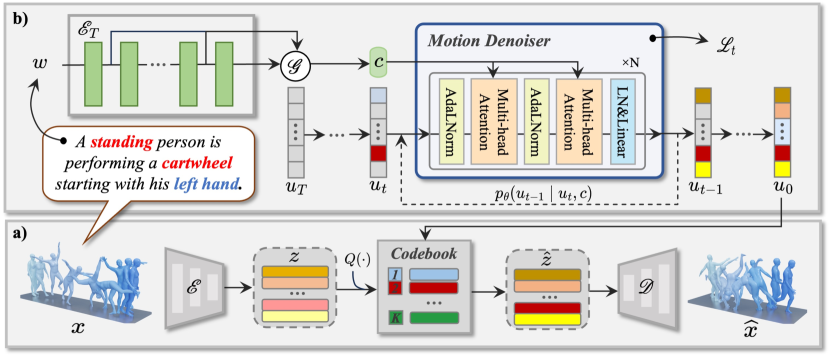
- A Hierarchical Semantic Aggregation (HSA) module is proposed to fuse multi-level text embeddings from a CLIP-based text encoder, enhancing semantic representation by integrating low-level details with high-level semantics.
- The Motion Discrete Diffusion (MDD) framework is built upon a VQ-VAE-based motion tokenizer and a discrete diffusion model, where motion sequences are modeled as discrete tokens for efficient generation.
- Classifier-free guidance is used during inference to control the trade-off between motion-text alignment and generative diversity via a scale hyperparameter.
- The MDD framework conditions the diffusion process on the HSA-encoded text embeddings, enabling precise and diverse motion generation.
- The model is trained and evaluated on HumanML3D and KIT-ML, with extensive ablation studies on HSA and diffusion step configurations.
Experimental results
Research questions
- RQ1Can a large-scale, diverse motion-caption dataset significantly improve the diversity of generated human motions in text-to-motion generation?
- RQ2How does hierarchical text encoding enhance the model's ability to understand nuanced differences in natural language prompts beyond the action verb?
- RQ3To what extent can discrete diffusion modeling with classifier-free guidance balance motion quality and diversity in text-conditioned generation?
- RQ4Does the proposed HSA module improve performance on long or complex text prompts compared to standard text encoding?
- RQ5What is the optimal number of diffusion steps for achieving the best trade-off between motion quality and diversity?
Key findings
- DiverseMotion achieves a new state-of-the-art FID of 0.070 on the HumanML3D benchmark, representing a 48% improvement over the baseline and a 40% improvement over prior SOTA methods.
- The model achieves a Top-1 accuracy of 0.496 and a Top-3 accuracy of 0.783 on HumanML3D, demonstrating strong motion-text alignment and generative diversity.
- The HSA module improves FID by 48% compared to the baseline using standard CLIP token embeddings, with even larger gains on longer, more complex prompts (MM-Dist-L improvement of 0.057).
- Ablation shows that 100 diffusion steps yield the best balance between quality and diversity, with performance degrading at both lower (30 steps) and higher (120 steps) settings.
- Classifier-free guidance with scale s=100 enables a favorable trade-off, where text-motion consistency exceeds real motion (Top-1: 0.496 vs. real 0.511), while maintaining high diversity.
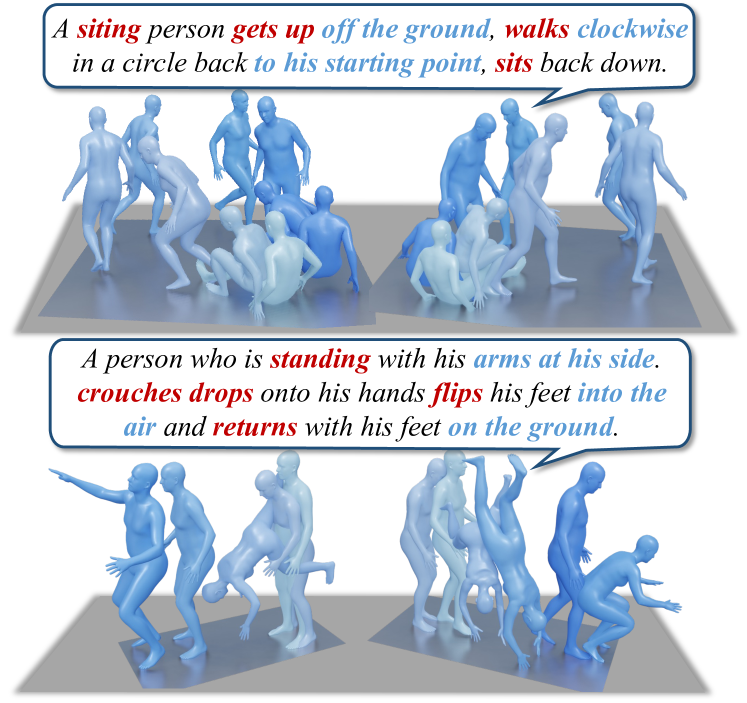
- Qualitative results show that DiverseMotion generates multiple plausible, distinct motions for the same prompt, unlike prior SOTA methods that produce highly similar outputs.
Read this paper
Open the full text in the Nubint reader and ask about any passage as you read.
Read this paper on NubintThis review was generated by AI from the original paper. Please check the paper before citing it.