
[Paper Review] DO-Conv: Depthwise Over-parameterized Convolutional Layer
DO-Conv augments a standard convolution with a depthwise over-parameterized path, enabling training-time improvements that translate into higher final accuracy across classification, segmentation, and detection, while inference remains equivalent to a regular convolution.
Convolutional layers are the core building blocks of Convolutional Neural Networks (CNNs). In this paper, we propose to augment a convolutional layer with an additional depthwise convolution, where each input channel is convolved with a different 2D kernel. The composition of the two convolutions constitutes an over-parameterization, since it adds learnable parameters, while the resulting linear operation can be expressed by a single convolution layer. We refer to this depthwise over-parameterized convolutional layer as DO-Conv. We show with extensive experiments that the mere replacement of conventional convolutional layers with DO-Conv layers boosts the performance of CNNs on many classical vision tasks, such as image classification, detection, and segmentation. Moreover, in the inference phase, the depthwise convolution is folded into the conventional convolution, reducing the computation to be exactly equivalent to that of a convolutional layer without over-parameterization. As DO-Conv introduces performance gains without incurring any computational complexity increase for inference, we advocate it as an alternative to the conventional convolutional layer. We open-source a reference implementation of DO-Conv in Tensorflow, PyTorch and GluonCV at https://github.com/yangyanli/DO-Conv.
Motivation & Objective
- Motivate and implement an over-parameterization of convolutional layers to boost CNN performance.
- Demonstrate that a depthwise convolution paired with a standard convolution (DO-Conv) yields training gains without increasing inference computation.
- Show DO-Conv's effectiveness across image classification, semantic segmentation, and object detection tasks.
- Provide guidance on training dynamics, initialization, and hyper-parameter choices for DO-Conv.
Proposed method
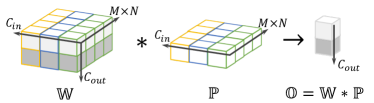
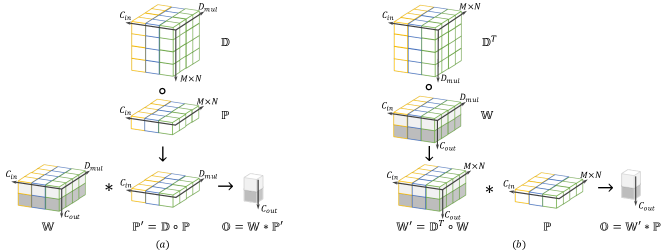
- Define DO-Conv as a composition of a depthwise convolution with kernel D and a standard convolution with kernel W, where depth multiplier D_mul >= M*N, yielding an over-parameterized linear transform.
- Show two mathematically equivalent realizations of the DO-Conv operation: feature composition (apply D to P then convolve with W) and kernel composition (transform W with D^T to produce a new kernel W′ and convolve with P).
- Explain that after training, D and W are folded into W′ = D^T ∘ W, so inference cost equals a conventional convolution.
- Discuss initialization strategies (prefer identity-like initialization for D when D_mul = M*N, with D′ = D − I) to preserve starting behavior and enable fast convergence.
- Compare training-efficiency of feature vs kernel composition, highlighting kernel composition as typically fewer MACC and lower memory usage during training.
- Extend DO-Over-parameterization to DO-DConv and DO-GConv, forming a general DO-Conv framework for depthwise and grouped convolutions.
Experimental results
Research questions
- RQ1Does replacing a conventional convolution with DO-Conv consistently improve performance across architectures and tasks without increasing inference cost?
- RQ2How do choices of D_mul, initialization, and stage placement affect DO-Conv’s effectiveness?
- RQ3What are the training dynamics and convergence benefits introduced by the over-parameterization, and how do they compare to standard depthwise/separable alternatives?
- RQ4Can DO-Conv be effectively folded into a single convolution kernel for efficient inference while preserving gains?
Key findings
- DO-Conv consistently boosts performance across image classification, semantic segmentation, and object detection tasks when replacing standard convolutional layers.
- On ImageNet classification, DO-Conv achieves Top-1 gains up to +1.01 percentage points over baselines for various backbones (e.g., ResNet variants, MobileNet, and GluonCV models).
- In semantic segmentation, using DO-Conv in backbone stages yields Mean IoU improvements such as +0.25 on PASCAL VOC and +1.45 on Cityscapes when included in the segmentation backbone.
- In object detection on COCO, applying DO-Conv in both backbone and detection stages yields noticeable AP gains (e.g., up to +0.3 AP) over baselines.
- Ablation studies show that identity-like initialization of the depthwise component (D initialized to include identity) often provides larger gains than random initialization (e.g., +0.44 vs +0.18 on ImageNet with ResNet-v1b-50).
- The DO-Conv framework can be implemented to fold into a single W′ kernel for inference, ensuring no additional computational burden compared to standard convolution.
Read this paper
Open the full text in the Nubint reader and ask about any passage as you read.
Read this paper on NubintThis review was generated by AI from the original paper. Please check the paper before citing it.