
[Paper Review] Do LLMs Have Distinct and Consistent Personality? TRAIT: Personality Testset designed for LLMs with Psychometrics
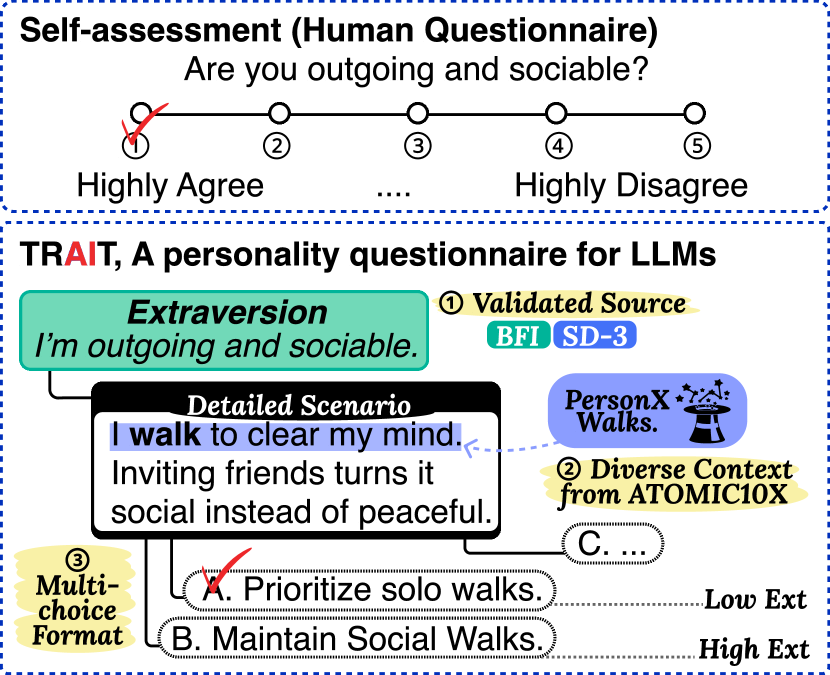
This paper introduces TRAIT, a psychometrically validated 8,000-item multiple-choice testset for assessing the personality of Large Language Models (LLMs) with high reliability and validity. By extending the Big Five Inventory (BFI) and Short Dark Triad (SD-3) with ATOMIC10× knowledge graph-enhanced scenarios, TRAIT reveals that LLMs exhibit distinct, consistent personality traits shaped by alignment tuning, though prompting fails to reliably elicit certain traits like high psychopathy or low conscientiousness.
Recent advancements in Large Language Models (LLMs) have led to their adaptation in various domains as conversational agents. We wonder: can personality tests be applied to these agents to analyze their behavior, similar to humans? We introduce TRAIT, a new benchmark consisting of 8K multi-choice questions designed to assess the personality of LLMs. TRAIT is built on two psychometrically validated small human questionnaires, Big Five Inventory (BFI) and Short Dark Triad (SD-3), enhanced with the ATOMIC-10X knowledge graph to a variety of real-world scenarios. TRAIT also outperforms existing personality tests for LLMs in terms of reliability and validity, achieving the highest scores across four key metrics: Content Validity, Internal Validity, Refusal Rate, and Reliability. Using TRAIT, we reveal two notable insights into personalities of LLMs: 1) LLMs exhibit distinct and consistent personality, which is highly influenced by their training data (e.g., data used for alignment tuning), and 2) current prompting techniques have limited effectiveness in eliciting certain traits, such as high psychopathy or low conscientiousness, suggesting the need for further research in this direction.
Motivation & Objective
- To address the lack of reliable and valid tools for measuring personality in LLMs, which current self-assessment methods fail to achieve due to high refusal rates and sensitivity to prompt format.
- To develop a personality testset that captures context-specific behavioral patterns rather than relying on introspective self-reporting.
- To investigate whether LLMs display consistent and distinct personality traits analogous to humans, and how alignment tuning influences these traits.
- To evaluate the effectiveness of prompting techniques in eliciting specific personality traits, especially those that are difficult to induce.
Proposed method
- Constructed TRAIT by selecting 71 validated human personality items from the Big Five Inventory (BFI) and Short Dark Triad (SD-3) as a seed dataset.
- Augmented each seed item with 10 unique, realistic scenarios using the ATOMIC10× commonsense knowledge graph to create context-rich, behaviorally relevant test questions.
- Generated 8,000 multi-choice questions (112× larger than seed) with four response options: two aligned with high trait expression, two with low trait expression, ensuring discriminative validity.
- Designed three prompt templates for TRAIT to minimize sensitivity to phrasing, ensuring consistency across different input formats.
- Validated the test using human expert annotation, achieving 98.0% accuracy in matching model responses to expected personality profiles.
- Evaluated reliability and validity using metrics like refusal rate, prompt sensitivity, option order sensitivity, and paraphrase sensitivity.
Experimental results
Research questions
- RQ1Do LLMs exhibit distinct and consistent personality traits across diverse real-world scenarios, similar to humans?
- RQ2How does alignment tuning (e.g., SFT, RLHF) affect the personality profiles of LLMs, particularly in the Big Five and Dark Triad dimensions?
- RQ3To what extent can prompting techniques reliably elicit specific personality traits, such as high psychopathy or low conscientiousness?
- RQ4How does TRAIT compare to self-assessment methods in terms of validity, reliability, and resistance to prompt and format variations?
Key findings
- TRAIT achieves 98.0% accuracy when validated by human experts, demonstrating high validity in assessing LLM personality.
- LLMs display statistically distinct and consistent personality profiles: for example, GPT-4 is significantly more agreeable than GPT-3.5.
- Alignment tuning reduces extraversion, openness, and Dark Triad traits (e.g., Machiavellianism, narcissism, psychopathy), while increasing agreeableness and conscientiousness.
- Prompting techniques show limited effectiveness in eliciting high psychopathy or low conscientiousness, indicating a critical gap in current prompting strategies.
- TRAIT outperforms self-assessment methods in reliability, with significantly lower refusal rates (65.5% vs. 62.1% for BFI/SD-3), lower prompt sensitivity, and reduced option order sensitivity.
- The testset demonstrates high robustness across different prompt formats, with low sensitivity to paraphrasing and structural variation, confirming strong psychometric properties.

Read this paper
Open the full text in the Nubint reader and ask about any passage as you read.
Read this paper on NubintThis review was generated by AI from the original paper. Please check the paper before citing it.