
[Paper Review] Do LLMs Understand Social Knowledge? Evaluating the Sociability of Large Language Models with SocKET Benchmark
This paper introduces SocKET, a theory-driven benchmark with 58 NLP tasks across five social knowledge categories—humor & sarcasm, offensiveness, sentiment & emotion, trustworthiness, and other social factors—to evaluate large language models' (LLMs) sociability. Despite moderate performance on the benchmark, models show significant potential for cross-task transfer, especially when trained on strongly correlated tasks, highlighting room for improvement in building socially-aware LLMs.
Large language models (LLMs) have been shown to perform well at a variety of syntactic, discourse, and reasoning tasks. While LLMs are increasingly deployed in many forms including conversational agents that interact with humans, we lack a grounded benchmark to measure how well LLMs understand extit{social} language. Here, we introduce a new theory-driven benchmark, SocKET, that contains 58 NLP tasks testing social knowledge which we group into five categories: humor & sarcasm, offensiveness, sentiment & emotion, and trustworthiness. In tests on the benchmark, we demonstrate that current models attain only moderate performance but reveal significant potential for task transfer among different types and categories of tasks, which were predicted from theory. Through zero-shot evaluations, we show that pretrained models already possess some innate but limited capabilities of social language understanding and training on one category of tasks can improve zero-shot testing on others. Our benchmark provides a systematic way to analyze model performance on an important dimension of language and points to clear room for improvement to build more socially-aware LLMs. The associated resources are released at https://github.com/minjechoi/SOCKET.
Motivation & Objective
- To address the lack of a comprehensive, theory-grounded benchmark for evaluating social knowledge in LLMs.
- To systematically organize social language understanding tasks into five categories based on linguistic and psychological theories.
- To assess how well LLMs generalize across different types of social language tasks through zero-shot and fine-tuned evaluations.
- To investigate the potential for task transfer between socially related NLP tasks, especially in multitask learning settings.
- To release a publicly available benchmark and dataset to support future research in socially-aware NLP.
Proposed method
- Designing SocKET as a benchmark with 58 tasks grouped into five categories: humor & sarcasm, offensiveness, sentiment & emotion, trustworthiness, and other social factors.
- Incorporating four task formats—classification, regression, pairwise comparison, and span identification—to assess model versatility across task types.
- Using theory-driven task selection grounded in systemic functional linguistics and social cognition to ensure conceptual coherence.
- Evaluating both zero-shot and fine-tuned LLMs on the benchmark to assess innate capabilities and transfer potential.
- Applying multitask training on correlated task categories to examine performance gains and potential negative transfer on weakly correlated tasks.
- Releasing the benchmark and datasets via GitHub and Hugging Face to ensure reproducibility and community access.
Experimental results
Research questions
- RQ1To what extent do current LLMs understand and generalize across diverse social language tasks?
- RQ2Can pretrained LLMs demonstrate innate but limited capabilities in social language understanding without fine-tuning?
- RQ3How effective is task transfer between different categories of social knowledge, especially when tasks are correlated?
- RQ4Does multitask training on one social category improve performance on unrelated but socially related categories?
- RQ5What are the risks of negative transfer when training on weakly correlated social tasks?
Key findings
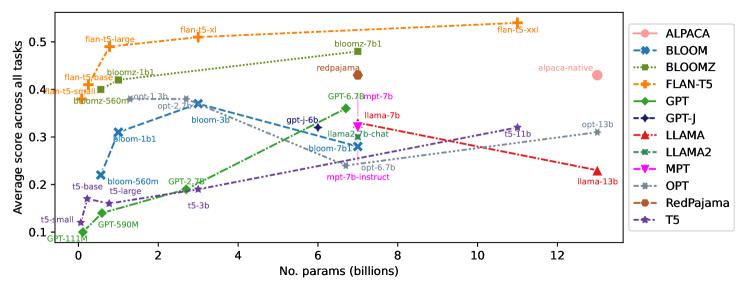
- Current LLMs achieve only moderate performance on the SocKET benchmark, indicating significant room for improvement in social language understanding.
- Zero-shot evaluations reveal that pretrained models already possess some innate, albeit limited, capabilities in understanding social knowledge.
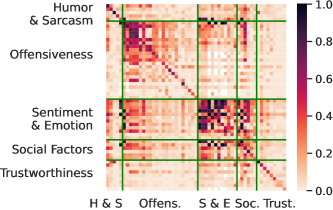
- Models demonstrate notable task transfer potential, particularly when training tasks are strongly correlated across categories.
- Multitask training on strongly correlated tasks can maintain or even improve performance on downstream tasks, suggesting effective knowledge distillation.
- Conversely, training on weakly correlated tasks can degrade overall performance, indicating the risk of negative transfer in multitask learning.
- The benchmark reveals that social knowledge is not uniformly captured by LLMs, with performance varying significantly across categories like humor, sarcasm, and offensiveness.
Read this paper
Open the full text in the Nubint reader and ask about any passage as you read.
Read this paper on NubintThis review was generated by AI from the original paper. Please check the paper before citing it.