
[Paper Review] Do LLMs Understand User Preferences? Evaluating LLMs On User Rating Prediction
The paper evaluates off-the-shelf and fine-tuned LLMs for user rating prediction, comparing zero-shot, few-shot, and fine-tuning performance against traditional recommender baselines on MovieLens and Amazon-Books datasets.
Large Language Models (LLMs) have demonstrated exceptional capabilities in generalizing to new tasks in a zero-shot or few-shot manner. However, the extent to which LLMs can comprehend user preferences based on their previous behavior remains an emerging and still unclear research question. Traditionally, Collaborative Filtering (CF) has been the most effective method for these tasks, predominantly relying on the extensive volume of rating data. In contrast, LLMs typically demand considerably less data while maintaining an exhaustive world knowledge about each item, such as movies or products. In this paper, we conduct a thorough examination of both CF and LLMs within the classic task of user rating prediction, which involves predicting a user's rating for a candidate item based on their past ratings. We investigate various LLMs in different sizes, ranging from 250M to 540B parameters and evaluate their performance in zero-shot, few-shot, and fine-tuning scenarios. We conduct comprehensive analysis to compare between LLMs and strong CF methods, and find that zero-shot LLMs lag behind traditional recommender models that have the access to user interaction data, indicating the importance of user interaction data. However, through fine-tuning, LLMs achieve comparable or even better performance with only a small fraction of the training data, demonstrating their potential through data efficiency.
Motivation & Objective
- Assess whether off-the-shelf LLMs can predict user ratings without task-specific training.
- Compare LLMs to strong traditional recommender baselines under fair evaluation settings.
- Investigate how model size and data efficiency affect LLM-based rating prediction.
- Evaluate the impact of fine-tuning LLMs with human interaction data on performance.
- Explore data-efficient learning regimes for LLMs in recommendation tasks.
Proposed method
- Formulate user rating prediction as predicting a 1–5 rating given user history and item metadata.
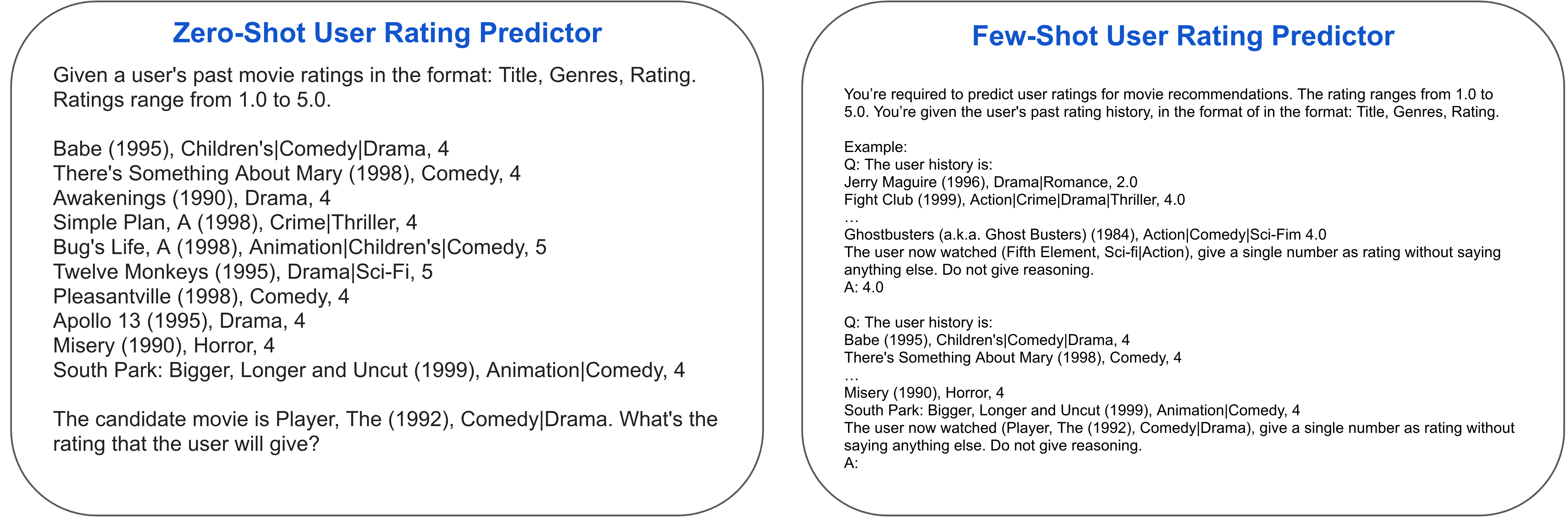
- Use zero-shot and few-shot prompting to elicit ratings from various LLMs across multiple sizes.
- Prompt engineering to ensure numeric rating outputs (e.g., single number, no explanations).
- Fine-tune Flan-T5 family models (Base and XXL) on classification (5-class) or regression objectives for rating prediction.
- Compare zero-shot, few-shot, and fine-tuned LLMs against traditional baselines (MF, MLP, Transformer-MLP) and simple heuristics.
- Evaluate using RMSE, MAE, and AUC on MovieLens-1M and Amazon-Books (5-core) datasets.
Experimental results
Research questions
- RQ1RQ1: Do off-the-shelf LLMs perform well in zero-shot and few-shot rating predictions?
- RQ2RQ2: How do LLMs compare with traditional recommender models in a fair setting?
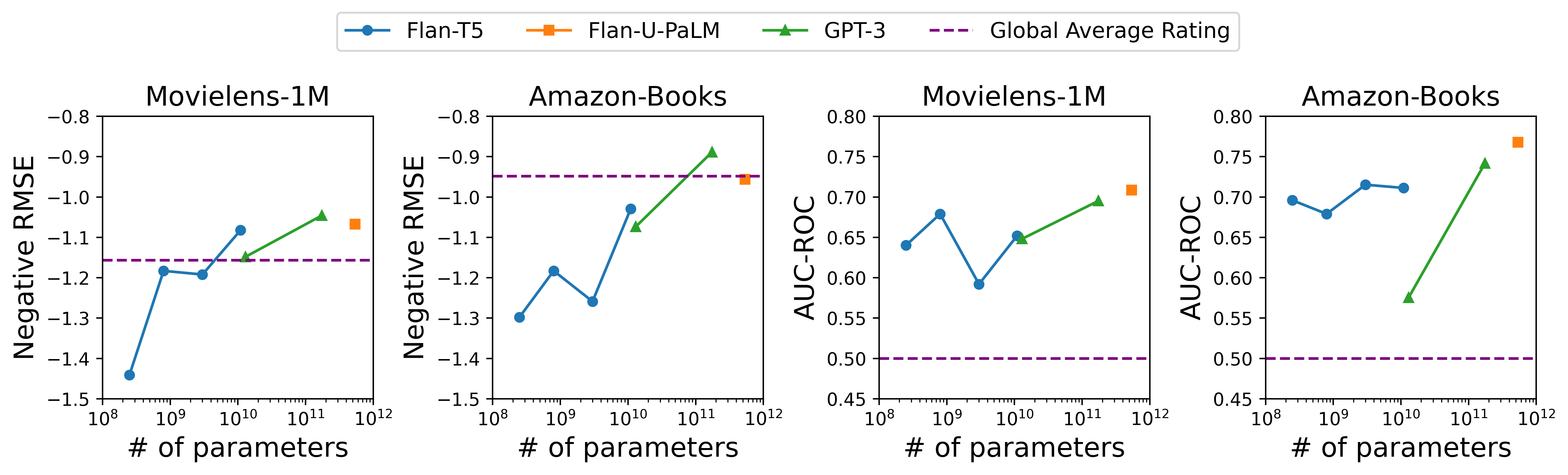
- RQ3RQ3: How does model size influence LLM performance in rating prediction?
- RQ4RQ4: Do LLMs converge faster or require less data than traditional models?
Key findings
- Zero-shot LLMs with sizes >100B parameters can achieve reasonable recommendations in cold-start settings, rivaling some baselines on RMSE and AUC but generally lag behind interaction-data-based methods.
- Zero-shot and few-shot LLMs underperform supervised recommender models that utilize user-item interaction data.
- Fine-tuned LLMs can achieve comparable or better performance than strong baselines with a small fraction of training data, indicating data-efficient potential.
- Fine-tuning Flan-T5-XXL generally yields better MAE and AUC than smaller variants and some baselines, highlighting the benefit of dataset-specific training.
- Data efficiency analyses show LLMs converge with less data for RMSE and especially AUC compared to Transformer-MLP baselines.
Read this paper
Open the full text in the Nubint reader and ask about any passage as you read.
Read this paper on NubintThis review was generated by AI from the original paper. Please check the paper before citing it.