
[Paper Review] Do Membership Inference Attacks Work on Large Language Models?
The study systematically evaluates multiple membership inference attacks on large language models trained on the Pile and finds MIA performance is generally near random across domains and sizes, with some exceptions driven by data overlap, training dynamics, and distribution shifts.
Membership inference attacks (MIAs) attempt to predict whether a particular datapoint is a member of a target model's training data. Despite extensive research on traditional machine learning models, there has been limited work studying MIA on the pre-training data of large language models (LLMs). We perform a large-scale evaluation of MIAs over a suite of language models (LMs) trained on the Pile, ranging from 160M to 12B parameters. We find that MIAs barely outperform random guessing for most settings across varying LLM sizes and domains. Our further analyses reveal that this poor performance can be attributed to (1) the combination of a large dataset and few training iterations, and (2) an inherently fuzzy boundary between members and non-members. We identify specific settings where LLMs have been shown to be vulnerable to membership inference and show that the apparent success in such settings can be attributed to a distribution shift, such as when members and non-members are drawn from the seemingly identical domain but with different temporal ranges. We release our code and data as a unified benchmark package that includes all existing MIAs, supporting future work.
Motivation & Objective
- Assess the effectiveness of existing MIAs on pre-training data of large language models (LLMs) across multiple domains and scales.
- Identify root causes of low MIA effectiveness in LLM pre-training and analyze factors like data size, epochs, and domain overlap.
- Propose a unified benchmark and analytical methods to understand when MIAs may or may not leak information from LLMs.
Proposed method
- Evaluate five MIAs (LOSS, reference-based, zlib entropy, neighborhood, min-k% probability) on Pythia and Pythia-dedup models from 160M to 12B parameters trained on the Pile.
- Use AUC ROC as the primary metric, with supplementary TPR@low-FPR to assess high-confidence performance.
- Analyze effects of model size, deduplication, and reference model choice on attack effectiveness.
- Examine how non-member data overlap (n-gram overlap) with member data affects MIA distinguishability.
- Investigate how temporal shifts in non-members and modifications of member data influence MIA outcomes.
- Provide a unified MIA benchmark package (Mimir) with implementations of attacks for LMs.
Experimental results
Research questions
- RQ1Do membership inference attacks significantly outperform random guessing on large language models pre-trained on the Pile across a range of sizes?
- RQ2What factors (model size, data deduplication, training epochs, reference model choice) influence MIA effectiveness on LLM pre-training data?
- RQ3How does n-gram overlap between member and non-member data affect MIA performance, and can overlap analyses explain observed results?
- RQ4Do temporally shifted non-members or semantically/lexically close perturbed records meaningfully change MIA outcomes?
- RQ5What principled guidelines can help evaluate and interpret MIA benchmarks for generative models?
Key findings
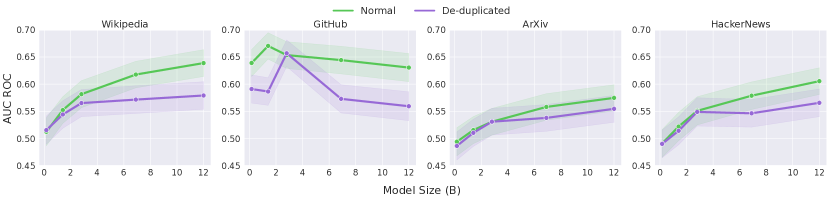
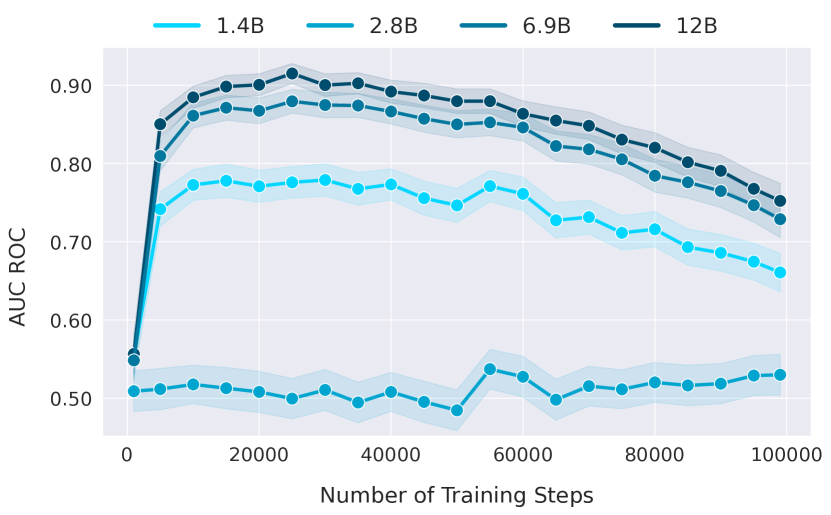
- MIAs generally perform near random (AUC ROC < 0.6) across most domains and model sizes tested (up to 12B parameters).
- Increasing model size yields marginal MIA performance gains, while deduplication tends to decrease MIA effectiveness.
- Reference-based attacks perform best among evaluated MIAs in some settings, but differences across attacks are modest overall.
- High n-gram overlap between members and non-members is common in natural-language domains, reducing MIA distinguishability; lower overlap can improve attack performance.
- Temporally shifted non-members (e.g., newer data) yield higher MIA performance, indicating distribution shifts can inflate apparent leakage.
- Modified (lexically/semantically close) member records can still be misclassified by MIAs, highlighting ambiguity in defining membership for generative models.
Read this paper
Open the full text in the Nubint reader and ask about any passage as you read.
Read this paper on NubintThis review was generated by AI from the original paper. Please check the paper before citing it.