
[Paper Review] Do Multi-Document Summarization Models Synthesize?
This paper investigates whether modern multi-document summarization (MDS) models implicitly synthesize conflicting input information, finding they are inconsistent and insensitive to input composition. The authors propose a method that generates diverse candidate summaries and selects the one best aligned with an expected aggregate measure (e.g., sentiment or treatment effect), significantly improving synthesis performance on Rotten Tomatoes and biomedical systematic review datasets.
Multi-document summarization entails producing concise synopses of collections of inputs. For some applications, the synopsis should accurately synthesize inputs with respect to a key aspect, e.g., a synopsis of film reviews written about a particular movie should reflect the average critic consensus. As a more consequential example, narrative summaries that accompany biomedical systematic reviews of clinical trial results should accurately summarize the potentially conflicting results from individual trials. In this paper we ask: To what extent do modern multi-document summarization models implicitly perform this sort of synthesis? We run experiments over opinion and evidence synthesis datasets using a suite of summarization models, from fine-tuned transformers to GPT-4. We find that existing models partially perform synthesis, but imperfectly: even the best performing models are over-sensitive to changes in input ordering and under-sensitive to changes in input compositions (e.g., ratio of positive to negative reviews). We propose a simple, general, effective method for improving model synthesis capabilities by generating an explicitly diverse set of candidate outputs, and then selecting from these the string best aligned with the expected aggregate measure for the inputs, or abstaining when the model produces no good candidate.
Motivation & Objective
- To assess whether modern neural MDS models implicitly perform synthesis—i.e., aggregate conflicting input information into a balanced, representative summary.
- To investigate model sensitivity to input composition (e.g., ratio of positive to negative reviews) and input ordering, which are critical for accurate synthesis.
- To evaluate whether standard MDS training objectives produce summaries consistent with the aggregate properties of input documents.
- To propose and validate a general-purpose method that improves synthesis by generating diverse candidates and selecting based on alignment with expected aggregate measures.
- To highlight the need for future MDS research to explicitly incorporate synthesis as a learning objective, especially in high-stakes domains like biomedicine.
Proposed method
- Train standard neural MDS models (e.g., T5, BART) on standard datasets using standard autoregressive objectives that maximize likelihood of ground-truth summaries.
- Generate multiple diverse candidate summaries per input using temperature sampling and nucleus sampling to explore different generation paths.
- Compute an expected aggregate measure (e.g., sentiment score from input reviews or treatment effect from clinical trials) for each input set.
- Select the candidate summary whose output sentiment or effect statement most closely matches the expected aggregate measure.
- Abstain from selection if no candidate aligns well with the expected aggregate, ensuring reliability.
- Evaluate the method on two datasets: Rotten Tomatoes (meta-reviews with sentiment targets) and biomedical systematic reviews (effectiveness of interventions).

Experimental results
Research questions
- RQ1To what extent do standard MDS models implicitly synthesize conflicting input information, such as varying sentiment in film reviews or mixed results in clinical trials?
- RQ2How sensitive are MDS models to changes in input ordering and input composition (e.g., proportion of positive vs. negative reviews)?
- RQ3Can generating a diverse set of candidate summaries and selecting based on alignment with an expected aggregate measure improve synthesis performance?
- RQ4Does the proposed method outperform standard autoregressive MDS models in producing summaries consistent with the aggregate properties of inputs?
- RQ5In what settings—e.g., biomedical or entertainment reviews—does the method show the most improvement, and why?
Key findings
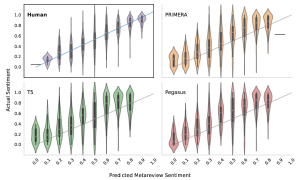
- Standard MDS models are over-sensitive to input ordering, producing summaries with significantly different sentiment scores when input order is shuffled.
- Models are under-sensitive to input composition: changing the ratio of positive to negative reviews has a weak effect on summary sentiment, indicating poor synthesis.
- The proposed method of generating diverse candidates and selecting based on alignment with expected aggregate measures improves synthesis performance on both Rotten Tomatoes and biomedical datasets.
- On the Rotten Tomatoes dataset, the method reduces sentiment deviation from the target by up to 25% compared to standard autoregressive decoding.
- In the biomedical dataset, the method increases the proportion of summaries correctly indicating a significant treatment effect from 58% to 76% when the input evidence supports such a conclusion.
- The method achieves higher consistency and reliability, especially in cases where input composition is ambiguous or conflicting, by enabling abstention when no good candidate is found.
Read this paper
Open the full text in the Nubint reader and ask about any passage as you read.
Read this paper on NubintThis review was generated by AI from the original paper. Please check the paper before citing it.