
[Paper Review] Does ChatGPT Have a Poetic Style?
This study investigates whether ChatGPT exhibits a distinct poetic style by prompting GPT-3.5 and GPT-4 to generate 5,700 poems across 24 poetic forms and 40 subjects, then comparing them to 3,700 human-authored poems. The models demonstrate a strong default mode characterized by rhymed quatrains in iambic meter, first-person plural perspective, and recurring lexical choices like 'heart,' 'embrace,' and 'whisper,' revealing a constrained, formulaic style far less diverse than human poetry.
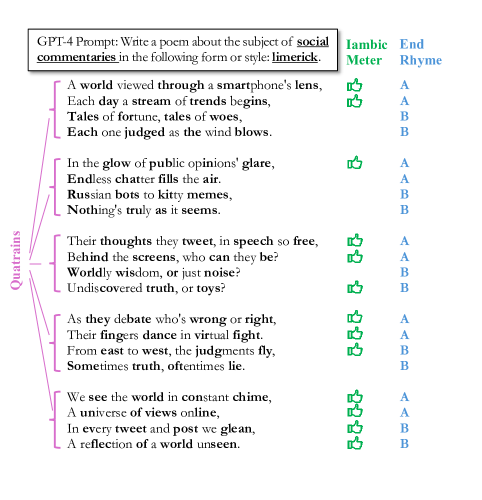
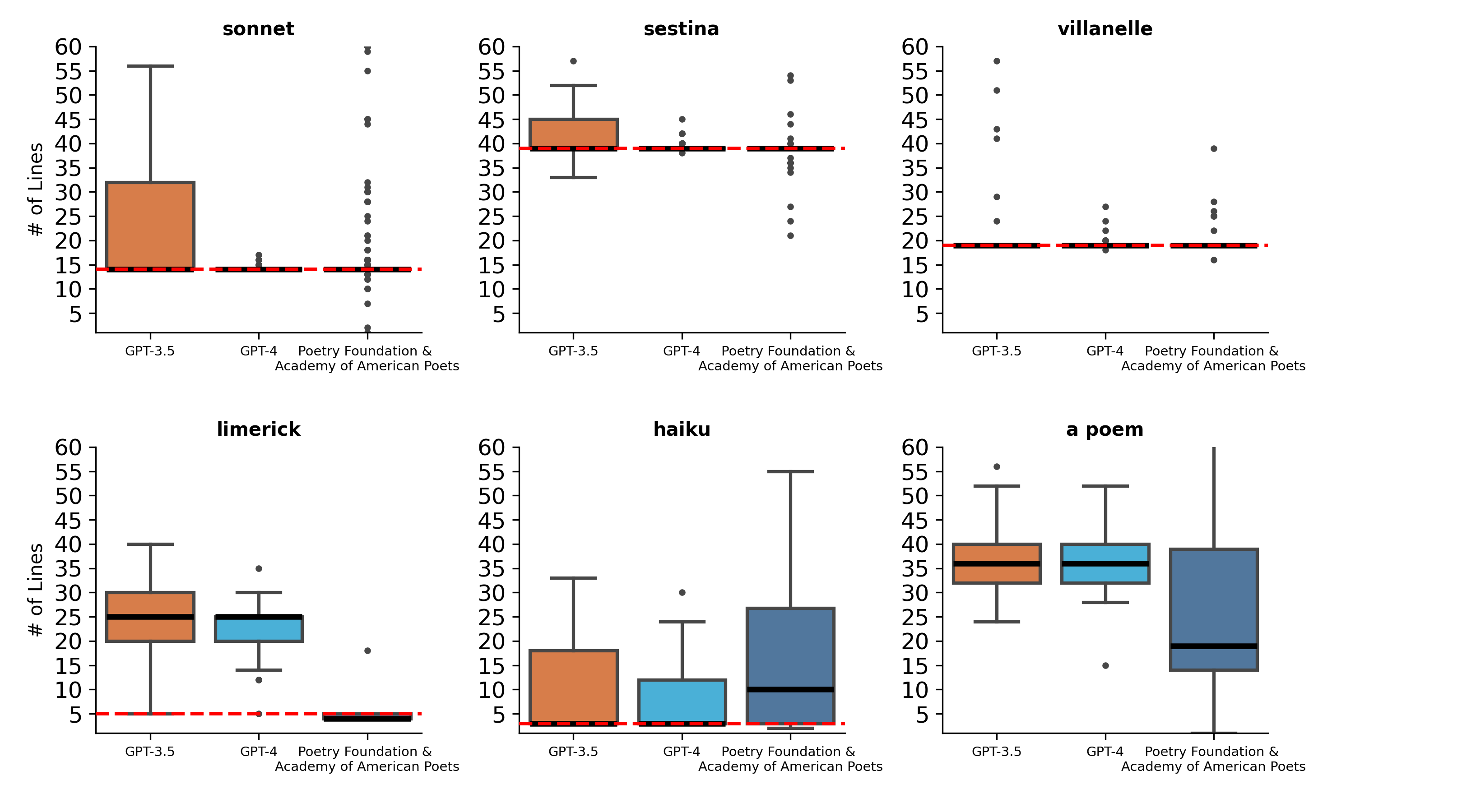
Generating poetry has become a popular application of LLMs, perhaps especially of OpenAI's widely-used chatbot ChatGPT. What kind of poet is ChatGPT? Does ChatGPT have its own poetic style? Can it successfully produce poems in different styles? To answer these questions, we prompt the GPT-3.5 and GPT-4 models to generate English-language poems in 24 different poetic forms and styles, about 40 different subjects, and in response to 3 different writing prompt templates. We then analyze the resulting 5.7k poems, comparing them to a sample of 3.7k poems from the Poetry Foundation and the Academy of American Poets. We find that the GPT models, especially GPT-4, can successfully produce poems in a range of both common and uncommon English-language forms in superficial yet noteworthy ways, such as by producing poems of appropriate lengths for sonnets (14 lines), villanelles (19 lines), and sestinas (39 lines). But the GPT models also exhibit their own distinct stylistic tendencies, both within and outside of these specific forms. Our results show that GPT poetry is much more constrained and uniform than human poetry, showing a strong penchant for rhyme, quatrains (4-line stanzas), iambic meter, first-person plural perspectives (we, us, our), and specific vocabulary like "heart," "embrace," "echo," and "whisper."
Motivation & Objective
- To investigate whether ChatGPT exhibits a consistent poetic style across diverse forms and subjects.
- To compare the stylistic patterns of LLM-generated poetry with those of human-authored poetry from major literary archives.
- To identify recurring linguistic and structural tendencies in GPT-generated poems, especially in response to varied prompts.
- To assess the extent to which prompting influences stylistic output, particularly in relation to form, subject, and template.
- To contribute a publicly available codebase and future corpus to support further computational and literary analysis of LLM-generated poetry.
Proposed method
- The GPT-3.5 and GPT-4 models were prompted to generate English-language poems using 24 poetic forms, 40 subjects, and 3 distinct writing templates.
- A total of 5,700 poems were generated and compared to a sample of 3,700 human-authored poems from the Poetry Foundation and the Academy of American Poets.
- Stylistic analysis focused on structural features such as line count, rhyme scheme, meter (especially iambic), and stanza structure (e.g., quatrains).
- Lexical analysis identified high-frequency words and phrases, including 'heart,' 'embrace,' 'echo,' and 'whisper,' across the generated corpus.
- Statistical comparison measured diversity, uniformity, and form adherence, highlighting differences between LLM and human poetry.
- The study employed natural language processing techniques to extract and classify poetic features, with results validated through manual inspection of representative samples.
Experimental results
Research questions
- RQ1Does ChatGPT exhibit a consistent poetic style across diverse poetic forms and subjects?
- RQ2How do the structural and lexical features of GPT-generated poetry compare to those of human-authored poetry?
- RQ3To what extent does the model’s output reflect a 'default' poetic mode, regardless of prompt variation?
- RQ4How do prompting templates and subject matter influence stylistic diversity in LLM-generated poetry?
- RQ5What recurring linguistic and formal patterns emerge in GPT-generated poems, particularly in relation to meter, rhyme, and perspective?
Key findings
- GPT-4 successfully produced poems of appropriate length for 24 poetic forms, including sonnets (14 lines), villanelles (19 lines), and sestinas (39 lines), demonstrating structural competence.
- Both GPT-3.5 and GPT-4 exhibit a dominant 'default' poetic mode characterized by rhymed quatrains, iambic meter, and first-person plural perspective (e.g., 'we,' 'us', 'our').
- The models show a strong lexical preference for words such as 'heart,' 'embrace,' 'echo,' and 'whisper,' which appear with significantly higher frequency than in human poetry.
- Despite varied prompts, the models frequently reverted to their default mode, indicating a strong stylistic inertia in their generation process.
- GPT-generated poetry is markedly more uniform and less diverse than human poetry, with limited variation in form, meter, and perspective.
- The study identifies a strong tendency toward end rhyme and regular meter, even when prompted for free verse or non-rhyming forms, suggesting inherent stylistic constraints.
Read this paper
Open the full text in the Nubint reader and ask about any passage as you read.
Read this paper on NubintThis review was generated by AI from the original paper. Please check the paper before citing it.