
[Paper Review] Does Localization Inform Editing? Surprising Differences in Causality-Based Localization vs. Knowledge Editing in Language Models
The study shows that where facts are localized in a language model (via Causal Tracing) does not predict which layer to edit to rewrite facts; editing can succeed outside the localized region, and several editing problem variants are explored.
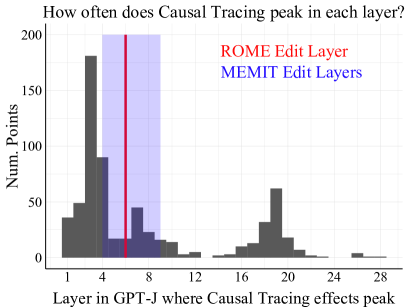
Language models learn a great quantity of factual information during pretraining, and recent work localizes this information to specific model weights like mid-layer MLP weights. In this paper, we find that we can change how a fact is stored in a model by editing weights that are in a different location than where existing methods suggest that the fact is stored. This is surprising because we would expect that localizing facts to specific model parameters would tell us where to manipulate knowledge in models, and this assumption has motivated past work on model editing methods. Specifically, we show that localization conclusions from representation denoising (also known as Causal Tracing) do not provide any insight into which model MLP layer would be best to edit in order to override an existing stored fact with a new one. This finding raises questions about how past work relies on Causal Tracing to select which model layers to edit. Next, we consider several variants of the editing problem, including erasing and amplifying facts. For one of our editing problems, editing performance does relate to localization results from representation denoising, but we find that which layer we edit is a far better predictor of performance. Our results suggest, counterintuitively, that better mechanistic understanding of how pretrained language models work may not always translate to insights about how to best change their behavior. Our code is available at https://github.com/google/belief-localization
Motivation & Objective
- Understand whether causal localization points (via Causal Tracing) predict which model layers to edit to rewrite stored facts.
- Assess the relationship between localization results and editing success across multiple editing methods and datasets.
- Investigate alternative editing problem formulations to connect localization insights with editing performance.
Proposed method
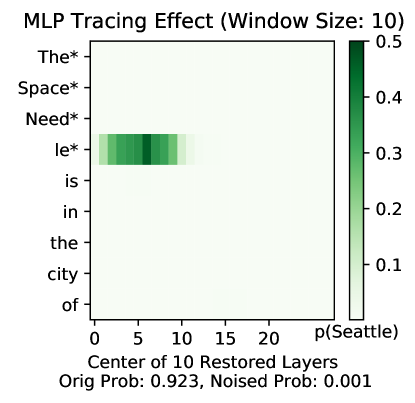
- Use CounterFact data with GPT-J to measure where facts are stored via Causal Tracing across MLP layers.
- Apply editing methods (ROME, MEMIT, constrained finetuning) to inject, erase, amplify, or modify facts at various layers.
- Quantify editing success with normalized rewrite, paraphrase, and neighborhood scores.
- Compare localization signals (tracing effects) to edit outcomes using regression analyses across layers and variants.
- Introduce and test editing problem variants (Error Injection, Tracing Reversal, Fact Erasure, Fact Amplification, Fact Forcing) to probe localization-editing connections.
Experimental results
Research questions
- RQ1Does the layer with strongest tracing effects predict higher edit success when rewriting a fact?
- RQ2How does editing performance vary with edit layer position across different editing methods?
- RQ3Can localization signals meaningfully explain variance in editing success across multiple editing scenarios?
- RQ4Do alternative editing formulations reveal any alignment between localization and editing?
- RQ5Are there robust patterns across models and datasets that connect localization to editing outcomes?
Key findings
- Edit success is essentially uncorrelated with where factual information is stored as measured by Causal Tracing across layers.
- The choice of edit layer explains most of the variance in rewrite success; tracing effects contribute almost no additional explanatory power.
- Editing at early-to-mid layers can successfully overwrite facts even when localization suggests storage elsewhere.
- Fact Forcing shows the strongest, though modest, link between localization signals and editing success among the variants tested.
- Across robustness checks, localization insights did not reliably predict editing performance for most methods and datasets.
Read this paper
Open the full text in the Nubint reader and ask about any passage as you read.
Read this paper on NubintThis review was generated by AI from the original paper. Please check the paper before citing it.