
[Paper Review] Domain Re-Modulation for Few-Shot Generative Domain Adaptation
This paper proposes Domain Re-Modulation (DoRM), a novel generator structure for few-shot generative domain adaptation that freezes the pre-trained source generator and introduces learnable mapping and affine modules (M&A) to enable high-fidelity, diverse, and cross-domain consistent image synthesis. By leveraging linear combinability in StyleGAN's style space, DoRM supports multi-domain and hybrid-domain generation, achieving state-of-the-art performance in 10-shot GDA with improved cross-domain consistency via a similarity-based structure loss.
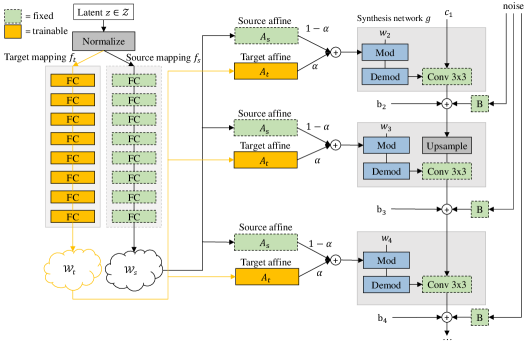
In this study, we delve into the task of few-shot Generative Domain Adaptation (GDA), which involves transferring a pre-trained generator from one domain to a new domain using only a few reference images. Inspired by the way human brains acquire knowledge in new domains, we present an innovative generator structure called Domain Re-Modulation (DoRM). DoRM not only meets the criteria of high quality, large synthesis diversity, and cross-domain consistency, which were achieved by previous research in GDA, but also incorporates memory and domain association, akin to how human brains operate. Specifically, DoRM freezes the source generator and introduces new mapping and affine modules (M&A modules) to capture the attributes of the target domain during GDA. This process resembles the formation of new synapses in human brains. Consequently, a linearly combinable domain shift occurs in the style space. By incorporating multiple new M&A modules, the generator gains the capability to perform high-fidelity multi-domain and hybrid-domain generation. Moreover, to maintain cross-domain consistency more effectively, we introduce a similarity-based structure loss. This loss aligns the auto-correlation map of the target image with its corresponding auto-correlation map of the source image during training. Through extensive experiments, we demonstrate the superior performance of our DoRM and similarity-based structure loss in few-shot GDA, both quantitatively and qualitatively. The code will be available at https://github.com/wuyi2020/DoRM.
Motivation & Objective
- To address the limitations of existing few-shot GAN adaptation methods that retrain the entire generator, which restricts multi-domain and hybrid-domain generation.
- To enable efficient, high-fidelity image synthesis in new domains using only a few reference images.
- To endow the generator with memory and domain association capabilities, mimicking human brain learning mechanisms.
- To improve cross-domain consistency between source and adapted target images through a novel similarity-based structure loss.
Proposed method
- DoRM introduces new mapping and affine modules (M&A) that are trained end-to-end while freezing the pre-trained source generator, enabling domain-specific style modulation.
- The M&A modules are trained to induce a linearly combinable domain shift in the style space, allowing for multi-domain and hybrid-domain generation by activating multiple modules simultaneously.
- A similarity-based structure loss $L_{ss}$ is proposed, aligning the auto-correlation maps of intermediate CLIP features from source and target images to enhance cross-domain consistency.
- The method leverages CLIP's image encoder to extract intermediate tokens and computes auto-correlation maps for loss supervision.
- The generator structure allows for selective activation of M&A modules per target domain, enabling efficient storage and inference.
- The approach is evaluated on both 2D (StyleGAN2) and 3D (EG3D) GANs, demonstrating generalization across architectures.

Experimental results
Research questions
- RQ1Can a few-shot GAN adaptation method achieve high-fidelity, diverse, and consistent image synthesis while supporting multi-domain and hybrid-domain generation?
- RQ2How can a generator retain knowledge from previously learned domains and integrate them for novel hybrid-domain synthesis?
- RQ3Can a learnable, modular adaptation mechanism outperform full-generator fine-tuning in terms of efficiency, consistency, and generalization?
- RQ4To what extent does a similarity-based structure loss improve cross-domain alignment in few-shot GAN adaptation?
- RQ5Can the proposed method generalize across different GAN architectures, including 3D GANs?
Key findings
- In 10-shot GDA, DoRM achieved a CLIP feature cosine similarity of 0.9492 with Sketches and 0.9780 with Babies, outperforming all baselines.
- On hybrid-domain generation (e.g., Sketches-Babies), DoRM achieved a CLIP similarity of 0.8809/0.7271, significantly outperforming methods like Domain Expansion and DynaGAN.
- DoRM demonstrated superior cross-domain consistency, maintaining identity and pose alignment between source and adapted images across diverse target domains.
- The method enabled seamless latent interpolation and editing across multiple adapted domains, confirming gradual and semantically meaningful style transitions.
- In one-shot GDA on EG3D, DoRM successfully generated high-quality images in the Sketch domain while preserving source identity.
- Qualitative results confirmed DoRM’s ability to generate realistic, diverse, and consistent images in both standard and hybrid domains, with no failure cases observed in hybrid generation.
Read this paper
Open the full text in the Nubint reader and ask about any passage as you read.
Read this paper on NubintThis review was generated by AI from the original paper. Please check the paper before citing it.