
[Paper Review] Domain Specialization as the Key to Make Large Language Models Disruptive: A Comprehensive Survey
This survey categorizes and analyzes domain specialization techniques for large language models (LLMs), proposing a taxonomy based on accessibility (black/grey/white box) and outlining application domains, challenges, and future trends.
Large language models (LLMs) have significantly advanced the field of natural language processing (NLP), providing a highly useful, task-agnostic foundation for a wide range of applications. However, directly applying LLMs to solve sophisticated problems in specific domains meets many hurdles, caused by the heterogeneity of domain data, the sophistication of domain knowledge, the uniqueness of domain objectives, and the diversity of the constraints (e.g., various social norms, cultural conformity, religious beliefs, and ethical standards in the domain applications). Domain specification techniques are key to make large language models disruptive in many applications. Specifically, to solve these hurdles, there has been a notable increase in research and practices conducted in recent years on the domain specialization of LLMs. This emerging field of study, with its substantial potential for impact, necessitates a comprehensive and systematic review to better summarize and guide ongoing work in this area. In this article, we present a comprehensive survey on domain specification techniques for large language models, an emerging direction critical for large language model applications. First, we propose a systematic taxonomy that categorizes the LLM domain-specialization techniques based on the accessibility to LLMs and summarizes the framework for all the subcategories as well as their relations and differences to each other. Second, we present an extensive taxonomy of critical application domains that can benefit dramatically from specialized LLMs, discussing their practical significance and open challenges. Last, we offer our insights into the current research status and future trends in this area.
Motivation & Objective
- Motivate the need for domain-specific adaptation of LLMs due to domain heterogeneity, evolving knowledge, and ethical constraints.
- Provide a systematic taxonomy of domain specialization techniques based on accessibility to LLMs (black box, grey box, white box).
- Map domain specialization methods to an extensive set of application domains and discuss practical significance and open challenges.
- Offer insights into current research status and future trends in domain-specific LLM applications.
Proposed method
- Propose a four-stage common framework for domain specialization: Definition, Augmentation, Optimization, Evaluation.
- Taxonomize approaches by accessibility (black/grey/white box) and by training/intervention level (pre-training, fine-tuning, inference-time).
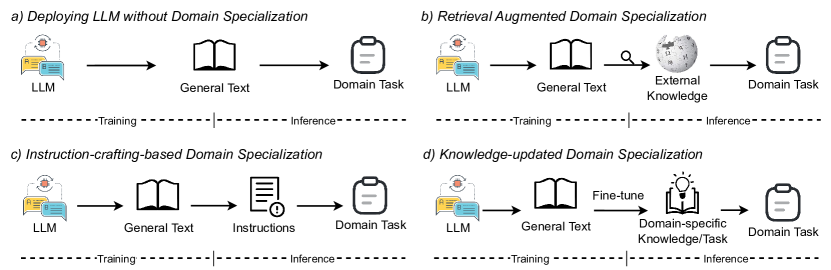
- Describe three core approach classes: external augmentation (Domain Knowledge and Domain Tools), prompt crafting, and model fine-tuning, with relations and trade-offs.
- Illustrate a unified workflow showing how external knowledge, prompts, and parameter updates can be combined for domain-specific tasks.
Experimental results
Research questions
- RQ1What taxonomy best characterizes LLM domain specialization techniques across different accessibility levels?
- RQ2What are the major domain application areas that can benefit from specialized LLMs and what challenges do they pose?
- RQ3How do external augmentation, prompt crafting, and model fine-tuning compare in cost, performance, and generalization for domain adaptation?
- RQ4What future directions and bottlenecks shape the advancement of domain-specialized LLMs?
Key findings
- A systematic taxonomy categorizes domain specialization techniques into external augmentation, prompt crafting, and model fine-tuning, aligned with black/grey/white box accessibility.
- A comprehensive mapping of application domains is provided, highlighting practical significance and open challenges for domain-specialized LLMs.
- The paper discusses trade-offs among approaches, including computational cost, ease of implementation, and generalization, and notes their complementary potential.
- Open challenges identified include seamless integration of external knowledge, scalability to large knowledge bases, and maintaining model up-to-date information.

Read this paper
Open the full text in the Nubint reader and ask about any passage as you read.
Read this paper on NubintThis review was generated by AI from the original paper. Please check the paper before citing it.