
[Paper Review] Domain wall interpretation of the PTA signal confronting black hole overproduction
This paper proposes that the stochastic gravitational wave background (SGWB) detected by Pulsar Timing Arrays (PTA) originates from domain wall (DW) networks annihilating in the early universe, which simultaneously produce primordial black holes (PBHs) via super-horizon DW collapse. Using Bayesian analysis of PTA data with PBH overproduction as a prior, it finds that DWs with correlation lengths L≳0.6t can generate a kilo-Hz SGWB observable by Earth-based interferometers, yielding PBHs with masses ~10 M☉.
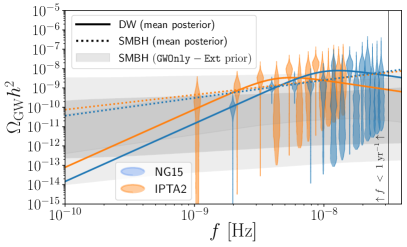
Recently, Pulsar Timing Array (PTA) collaborations have detected a stochastic gravitational wave background (SGWB) at nano-Hz frequencies, with Domain Wall networks (DWs) proposed as potential sources. To be cosmologically viable, they must annihilate before dominating the universe energy budget, thus generating a SGWB. While sub-horizon DWs shrink and decay rapidly, causality requires DWs with super-horizon size to continue growing until they reach the Hubble horizon. Those entering the latest can be heavier than a Hubble patch and collapse into Primordial Black Holes (PBHs). We conduct a Bayesian analysis of the PTA signal, interpreting it as an outcome of SGWB from DW networks, with a prior ensuring no PBH overproduction. Our findings indicate that DWs result in the production of solar-mass PBHs. The binary mergers occurring within these PBHs generate a second SGWB in the kilo-Hz domain which could be observable in on-going or planned Earth-based interferometers.
Motivation & Objective
- To investigate whether domain wall networks can simultaneously explain the PTA's stochastic gravitational wave background (SGWB) and avoid overproducing primordial black holes (PBHs).
- To estimate the PBH abundance from super-horizon domain walls using percolation theory during DW annihilation.
- To perform a Bayesian analysis of PTA datasets (NG15 and IPTA2) incorporating both DW and SMBH binary contributions, with PBH overproduction as a physical prior.
- To determine the observable signatures of such DW networks, particularly a second SGWB in the kilo-Hz band detectable by ground-based interferometers.
Proposed method
- Modeling the energy density and correlation length of domain wall networks using the scaling regime ρ_DW = σ / L, with L ≈ t / A, where A ≈ 0.8 from numerical simulations.
- Applying percolation theory to estimate the fraction of super-horizon DWs that collapse into PBHs during annihilation.
- Using Bayesian inference to compare the DW interpretation of the PTA signal against SMBH binary models, incorporating astrophysical priors from the GWOnly-Ext library.
- Including constraints from PBH overproduction, Big Bang Nucleosynthesis (BBN), and dark radiation (ΔN_eff < 0.4) as prior conditions.
- Calculating the resulting SGWB from PBH binary mergers in the kilo-Hz band, dependent on the DW network correlation length L/t.
- Evaluating the detectability of the secondary SGWB using current and planned Earth-based interferometers (e.g., LIGO, LISA).
Experimental results
Research questions
- RQ1Can domain wall networks explain the PTA’s nano-Hz stochastic gravitational wave background while remaining consistent with primordial black hole overproduction constraints?
- RQ2What fraction of super-horizon domain walls collapse into primordial black holes, and how does this depend on the network’s correlation length?
- RQ3What is the predicted amplitude and frequency spectrum of the secondary gravitational wave background from PBH binary mergers induced by domain wall annihilation?
- RQ4How does the inclusion of PBH overproduction as a prior affect the Bayesian evidence for the domain wall interpretation of the PTA signal?
- RQ5Under what conditions on the domain wall correlation length (L/t) is the resulting kilo-Hz SGWB detectable by current or future Earth-based interferometers?
Key findings
- The Bayesian analysis shows that domain wall networks, when combined with supermassive black hole binaries, provide a plausible explanation for the PTA signal, with posterior means of log₁₀(X) ≈ 0.30 ± 0.01 for SM reheating and 0.22 ± 0.00 for PBH overproduction constraints.
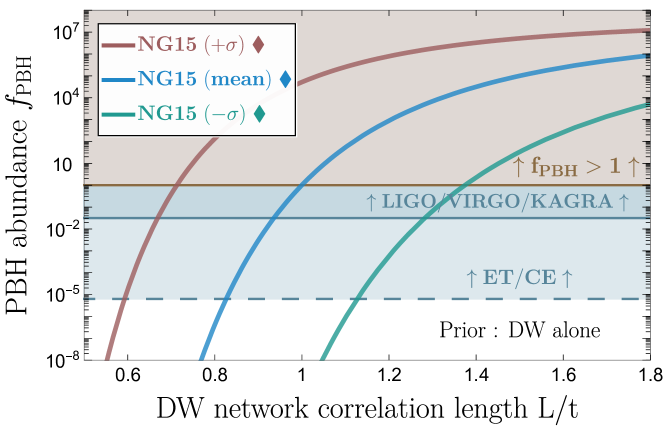
- Domain walls with correlation lengths L/t ≳ 0.6 are required to produce a kilo-Hz SGWB detectable by Earth-based interferometers, with the signal strength decreasing as L/t increases.
- The PBHs formed from collapsing super-horizon domain walls have masses of approximately 10 M☉, consistent with the mass range probed by kilo-Hz GW detectors.
- The analysis finds that PBH overproduction constraints significantly suppress the allowed parameter space for domain wall models, especially for L/t < 0.8.
- For L/t ≳ 0.8, the predicted PBH abundance from DW networks (Eq. 13) remains within observational bounds from CMB and kilo-Hz interferometers, indicating viability.
- The model with SM reheating and PBH overproduction prior yields a Bayesian factor log₁₀(B) ≈ 0.08 ± 0.01 for L/t ∈ [0.8,1.5], indicating weak but non-negligible support for the DW interpretation.
Read this paper
Open the full text in the Nubint reader and ask about any passage as you read.
Read this paper on NubintThis review was generated by AI from the original paper. Please check the paper before citing it.