
[Paper Review] Don't Hallucinate, Abstain: Identifying LLM Knowledge Gaps via Multi-LLM Collaboration
The paper introduces cooperative and competitive multi-LLM collaboration (Cooperate and Compete) to identify knowledge gaps and abstain from answering, achieving up to 19.3% improvement in abstain accuracy over strong baselines across four QA tasks.
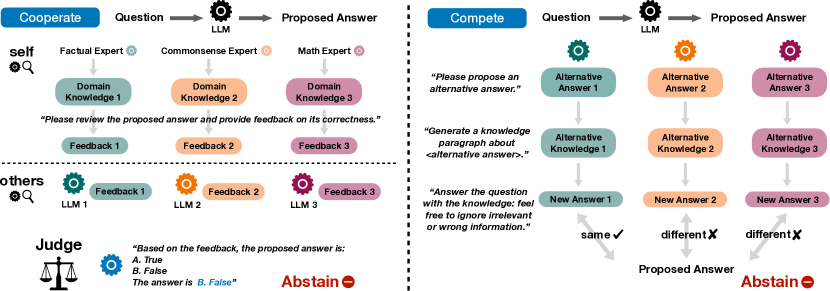
Despite efforts to expand the knowledge of large language models (LLMs), knowledge gaps -- missing or outdated information in LLMs -- might always persist given the evolving nature of knowledge. In this work, we study approaches to identify LLM knowledge gaps and abstain from answering questions when knowledge gaps are present. We first adapt existing approaches to model calibration or adaptation through fine-tuning/prompting and analyze their ability to abstain from generating low-confidence outputs. Motivated by their failures in self-reflection and over-reliance on held-out sets, we propose two novel approaches that are based on model collaboration, i.e., LLMs probing other LLMs for knowledge gaps, either cooperatively or competitively. Extensive experiments with three LLMs on four QA tasks featuring diverse knowledge domains demonstrate that both cooperative and competitive approaches to unveiling LLM knowledge gaps achieve up to 19.3% improvements on abstain accuracy against the strongest baseline. Further analysis reveals that our proposed mechanisms could help identify failure cases in retrieval augmentation and pinpoint knowledge gaps in multi-hop reasoning.
Motivation & Objective
- Motivate abstaining from low-confidence outputs due to evolving knowledge and reliability concerns in LLMs.
- Explore whether data, model, or usage factors should trigger abstention in AbstainQA.
- Systematically evaluate 11 baselines (calibration, training, prompting, self-consistency) for abstention and identify their limitations.
- Propose and validate two novel multi-LLM collaboration approaches (Cooperate and Compete) to robustly detect knowledge gaps.
Proposed method
- Review and adapt 11 existing abstention methods (calibration, training, prompting, self-consistency) to AbstainQA.
- Develop two multi-LLM collaboration strategies: Cooperate (expert LLMs provide feedback and a judge synthesizes abstain decisions) and Compete (conflicting external inputs test reliance on parametric knowledge).
- Evaluate approaches on three LLMs (Mistral-7B, LLaMA2-70B, ChatGPT) across four knowledge-intensive QA tasks.
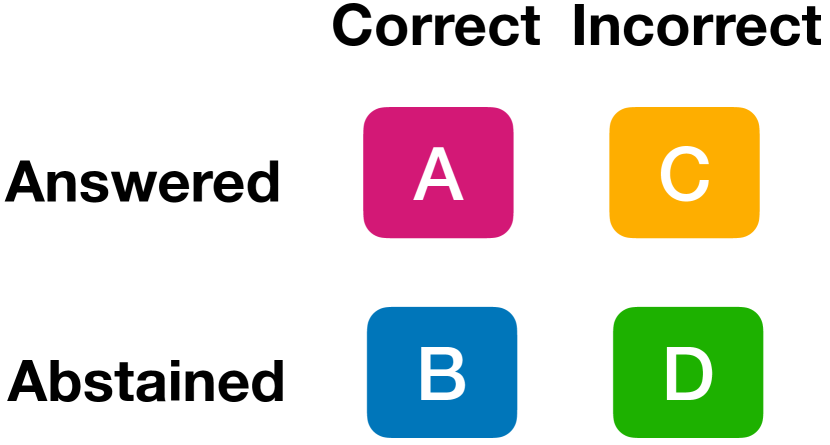
- Assess abstain performance via reliable accuracy, effective reliability, abstain accuracy, and abstain F1 metrics.
- Analyze failure modes in retrieval augmentation and multi-hop reasoning to locate knowledge gaps.
Experimental results
Research questions
- RQ1Can abstention mechanisms detect LLM knowledge gaps without held-out data?
- RQ2Do collaboration-based approaches (Cooperate/Compete) outperform single-model or self-evaluation baselines for abstention?
- RQ3How do different QA tasks and knowledge domains affect abstain effectiveness across LLMs?
- RQ4Can abstain methods help diagnose retrieval failures and multi-hop reasoning gaps?
- RQ5What is the trade-off between abstention rate and reliability across models and tasks?
Key findings
- Cooperate and Compete outperform all baselines in 9 of 12 settings, with up to 19.3% improvement in abstain accuracy.
- Collaboration-based abstention yields strong performance across three LLMs and four QA tasks, reducing incorrect answers while maintaining coverage.
- Prompting-based self-reflection and single-model self-evaluation are less reliable without held-out data; collaboration mitigates this issue.
- Cooperate benefits from stronger base models (e.g., ChatGPT) whereas Compete emphasizes reliability and abstains more in uncertain cases.
- Abstain mechanisms can localize knowledge gaps in multi-hop reasoning and identify retrieval failures when used with retrieval-augmented QA.
Read this paper
Open the full text in the Nubint reader and ask about any passage as you read.
Read this paper on NubintThis review was generated by AI from the original paper. Please check the paper before citing it.