
[Paper Review] DPAdapter: Improving Differentially Private Deep Learning through Noise Tolerance Pre-training
DPAdapter enhances differentially private deep learning by pre-training models for noise tolerance using a modified Sharpness-Aware Minimization (SAM) with a two-batch strategy, significantly improving model robustness and accuracy. It boosts average accuracy from 72.92% to 77.09% under ε=4, serving as a plug-and-play enhancement for existing DPML methods.
Recent developments have underscored the critical role of extit{differential privacy} (DP) in safeguarding individual data for training machine learning models. However, integrating DP oftentimes incurs significant model performance degradation due to the perturbation introduced into the training process, presenting a formidable challenge in the {differentially private machine learning} (DPML) field. To this end, several mitigative efforts have been proposed, typically revolving around formulating new DPML algorithms or relaxing DP definitions to harmonize with distinct contexts. In spite of these initiatives, the diminishment induced by DP on models, particularly large-scale models, remains substantial and thus, necessitates an innovative solution that adeptly circumnavigates the consequential impairment of model utility. In response, we introduce DPAdapter, a pioneering technique designed to amplify the model performance of DPML algorithms by enhancing parameter robustness. The fundamental intuition behind this strategy is that models with robust parameters are inherently more resistant to the noise introduced by DP, thereby retaining better performance despite the perturbations. DPAdapter modifies and enhances the sharpness-aware minimization (SAM) technique, utilizing a two-batch strategy to provide a more accurate perturbation estimate and an efficient gradient descent, thereby improving parameter robustness against noise. Notably, DPAdapter can act as a plug-and-play component and be combined with existing DPML algorithms to further improve their performance. Our experiments show that DPAdapter vastly enhances state-of-the-art DPML algorithms, increasing average accuracy from 72.92\% to 77.09\% with a privacy budget of $ε=4$.
Motivation & Objective
- Address the significant performance degradation caused by differential privacy (DP) noise in deep learning models.
- Overcome the limitations of existing DPML methods that rely on algorithmic modifications or relaxed privacy definitions.
- Leverage parameter robustness as a direct defense mechanism against DP noise to preserve model utility.
- Develop a pre-training technique that enhances model resilience to noise without altering downstream DP training pipelines.
- Enable plug-and-play integration with existing DPML algorithms to universally improve performance across diverse downstream tasks.
Proposed method
- Adapt the Sharpness-Aware Minimization (SAM) framework by introducing a two-batch strategy: a large batch for accurate worst-case perturbation estimation and a small batch for efficient gradient descent.
- Reformulate the SAM objective to prioritize parameter robustness against noise, ensuring that model parameters remain stable under perturbations.
- Pre-train a model on public data with the enhanced SAM variant to minimize sensitivity to noise, thereby improving its resilience during subsequent DP fine-tuning.
- Integrate the pre-trained DPAdapter model as a plug-in component into existing DP-SGD or DP-FedAvg pipelines for downstream private fine-tuning.
- Theoretical analysis demonstrates that the two-batch approach improves parameter robustness by enabling a more accurate estimation of worst-case perturbations.
- The method is designed to be compatible with federated learning settings, where DP noise is applied during model aggregation in DP-FedAvg.
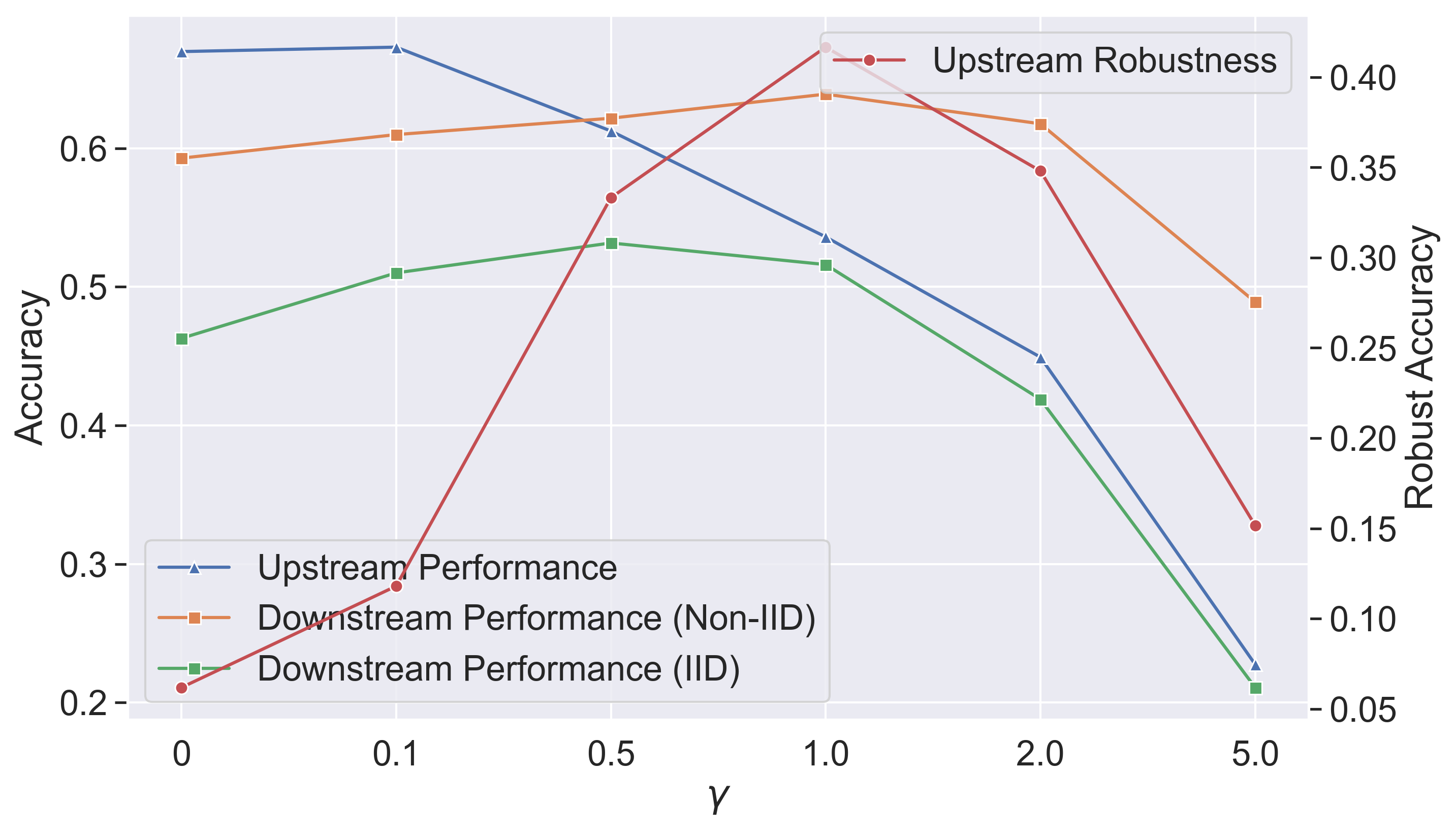
Experimental results
Research questions
- RQ1Can pre-training for parameter robustness significantly reduce the performance degradation caused by differential privacy noise in deep learning models?
- RQ2How does a two-batch refinement of SAM improve the accuracy of differentially private models compared to standard SAM?
- RQ3To what extent can a noise-tolerant pre-trained model enhance downstream performance across diverse private datasets like CIFAR-10, SVHN, and STL-10?
- RQ4Can DPAdapter be effectively integrated into existing DPML frameworks such as DP-SGD and DP-FedAvg without architectural changes?
- RQ5Does parameter robustness, when explicitly optimized during pre-training, serve as a more effective defense mechanism than input robustness or algorithmic redesign?
Key findings
- DPAdapter increases average model accuracy across CIFAR-10, SVHN, and STL-10 from 72.92% to 77.09% under a privacy budget of ε=4.
- The two-batch strategy in DPAdapter enables a more accurate estimation of worst-case perturbations, leading to significantly improved parameter robustness.
- The method achieves consistent performance gains across multiple downstream tasks, demonstrating broad applicability beyond a single dataset.
- DPAdapter acts as a plug-and-play component, enhancing state-of-the-art DPML algorithms without requiring changes to the underlying training pipeline.
- Theoretical analysis confirms that the two-batch design improves robustness by reducing the variance in perturbation estimation, leading to more stable parameter updates.
- The approach is extensible to federated learning, where it can be applied to DP-FedAvg to protect model updates during aggregation.
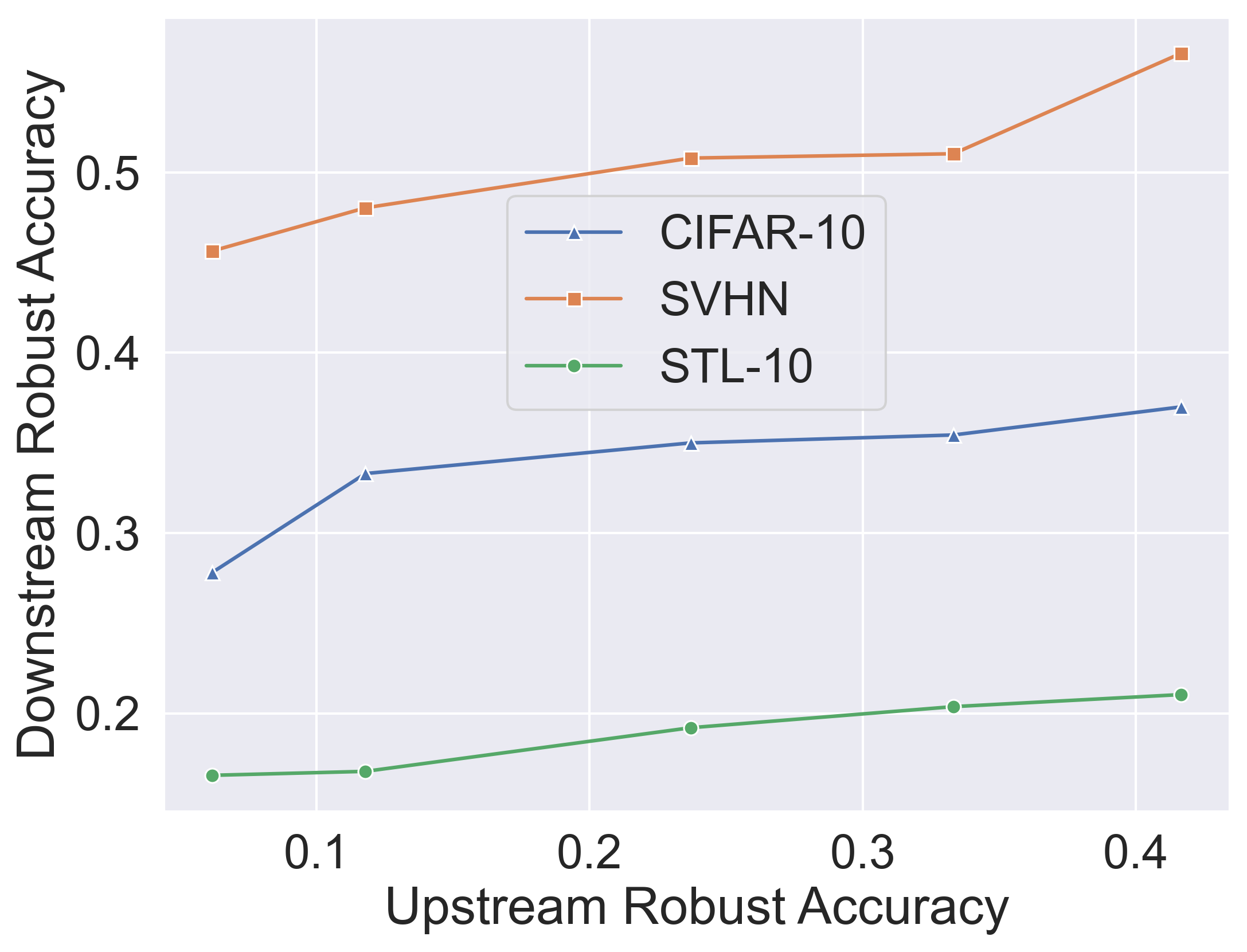
Read this paper
Open the full text in the Nubint reader and ask about any passage as you read.
Read this paper on NubintThis review was generated by AI from the original paper. Please check the paper before citing it.