
[Paper Review] Drastic magnetic-field-induced chiral current order and emergent current-bond-field interplay in kagome metals
This paper proposes a Ginzburg-Landau free energy framework that reveals a trilinear coupling between chiral current order ($\bm{\eta}$), bond order ($\bm{\phi}$), and external magnetic field ($h_z$) in kagome metals AV$_3$Sb$_5$. The emergent $-3m_1 h_z \bm{\eta} \cdot \bm{\phi}$ term explains the drastic magnetic-field-induced enhancement of chiral current order and its interplay with bond order, while also providing a natural explanation for strain-induced increases in the transition temperature $T_{\rm c}$.
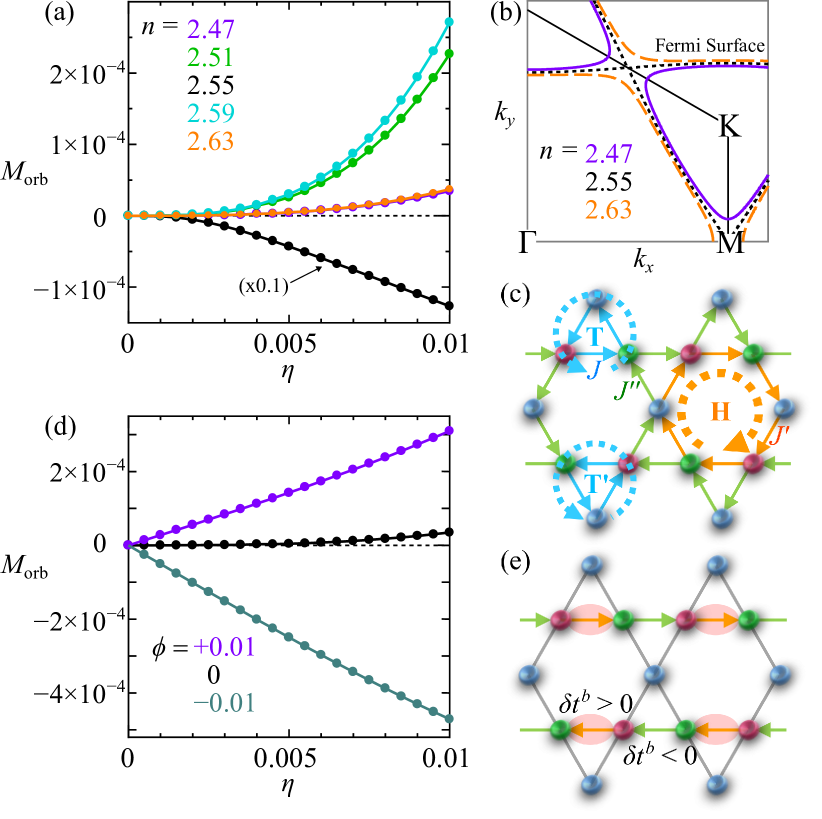
In kagome metals, the chiral current order $η$ with time-reversal-symmetry-breaking is the source of various exotic electronic states, while the method of controlling the current order and its interplay with the star-of-David bond order $ϕ$ are still unsolved. Here, we reveal that tiny uniform orbital magnetization $M[η,ϕ]$ is induced by the chiral current order, and its magnitude is prominently enlarged under the presence of the bond order. Importantly, we derive the magnetic-field ($h$)-induced Ginzburg-Landau free energy expression $ΔF[h,η,ϕ]$, which enables us to elucidate the field-induced current-bond phase transitions in kagome metals. The emergent current-bond-$h$ trilinear coupling term in the free energy, $-3m_1 hηϕ$, naturally explains the characteristic magnetic field sensitive electronic states in kagome metals, such as the field-induced current order and the strong interplay between the bond and current orders. Furthermore, we present a natural explanation for the drastic strain-induced increment of the current order transition temperature T_{TRSB} reported by a recent experiment.
Motivation & Objective
- To understand the origin of drastic magnetic-field-induced chiral current order in kagome metals AV$_3$Sb$_5$.
- To elucidate the interplay between time-reversal-symmetry-breaking chiral current order and star-of-David bond order.
- To derive a microscopic mechanism explaining the field-tuned enhancement of chiral current amplitude and transition temperature $T_{\rm c}$.
- To provide a theoretical explanation for the strain-induced increase in $T_{\rm c}$ observed in recent experiments.
Proposed method
- Derive the magnetic-field-induced Ginzburg-Landau (GL) free energy $\Delta F[h_z, \bm{\eta}, \bm{\phi}] \propto -h_z M_{\rm orb}[\bm{\eta}, \bm{\phi}]$ from a realistic multiorbital tight-binding model.
- Identify the emergent trilinear coupling term $-3m_1 h_z \bm{\eta} \cdot \bm{\phi}$ as the key to field-induced phase transitions.
- Calculate the orbital magnetization $M_{\rm orb}[\bm{\eta}, \bm{\phi}]$ induced by chiral current order, which is significantly enhanced by the presence of bond order.
- Use GL theory to analyze the shift in the current order transition temperature $T_{\rm c}$ under strain or magnetic field, incorporating $\epsilon$- and $\epsilon'$-dependent corrections to GL coefficients.
- Relate the GL coefficients $g_l'$ and $d_l^{(m)}$ to strain and magnetic field via perturbative expansions in $\epsilon'$ and $\epsilon$.
- Validate the model by showing quantitative agreement with experimental observations, including field-tuned chiral transport and strain-induced $T_{\rm c}$ enhancement.

Experimental results
Research questions
- RQ1How does an external magnetic field $h_z$ induce or enhance chiral current order in kagome metals?
- RQ2What is the microscopic origin of the strong interplay between chiral current order and bond order in AV$_3$Sb$_5$?
- RQ3How does the emergent trilinear $h_z$-current-bond coupling term in the GL free energy explain the observed field-induced phase transitions?
- RQ4Why does strain induce a significant increase in the chiral current order transition temperature $T_{\rm c}$?
- RQ5What role does orbital magnetization $M_{\rm orb}$ play in mediating the magnetic-field response of the chiral current order?
Key findings
- The magnetic-field-induced GL free energy contains a trilinear coupling term $-3m_1 h_z \bm{\eta} \cdot \bm{\phi}$, which explains the field-tuned enhancement of chiral current order in AV$_3$Sb$_5$.
- The orbital magnetization $M_{\rm orb}[\bm{\eta}, \bm{\phi}]$ is tiny when only chiral current order is present but is drastically enhanced in the presence of bond order.
- The current order transition temperature $T_{\rm c}$ increases linearly with strain $\epsilon'$, and this strain-induced increment is quantitatively explained by the $\epsilon'$-dependence of GL coefficients $g_l'$ and $d_l^{(m)}$.
- The GL coefficient $D \equiv (2d_5 - d_6)/(2d_1 - d_2)$ is numerically found to be $D \sim 1.36$ for $n=2.56$ and $D \sim 0.29$ for $n=2.48$, confirming the robustness of the mechanism.
- The model reproduces the observed field-induced chiral symmetry breaking, including the alignment of current chirality at $|h_z| \sim 1$ T and the strong amplification of loop current amplitude under small fields.
- In the limit of purely imaginary hopping modulation ($f_{ij}^{(m)} = \pm i g_{ij}^{(m)}$), the theory remains consistent with $D=1$ and $(2g_5 + g_6) = (2g_1 + g_2)$, ensuring general validity.
Read this paper
Open the full text in the Nubint reader and ask about any passage as you read.
Read this paper on NubintThis review was generated by AI from the original paper. Please check the paper before citing it.