
[Paper Review] DRB-GAN: A Dynamic ResBlock Generative Adversarial Network for Artistic Style Transfer
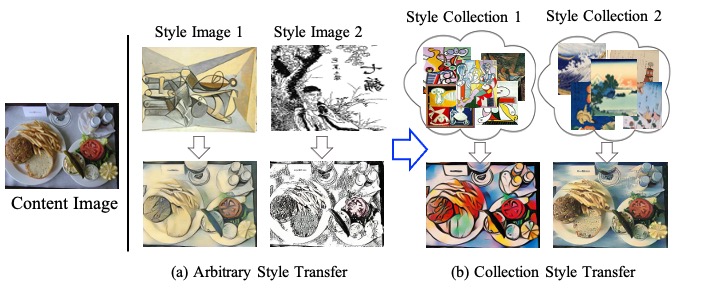
This paper proposes DRB-GAN, a dynamic residual block-based GAN for artistic style transfer that unifies arbitrary and collection-based style transfer in a single model. By modeling style codes as shared parameters in dynamic residual blocks and employing a style class-aware attention mechanism and spatial window Layer-Instance Normalization, DRB-GAN achieves state-of-the-art visual quality and efficiency on both style transfer types.
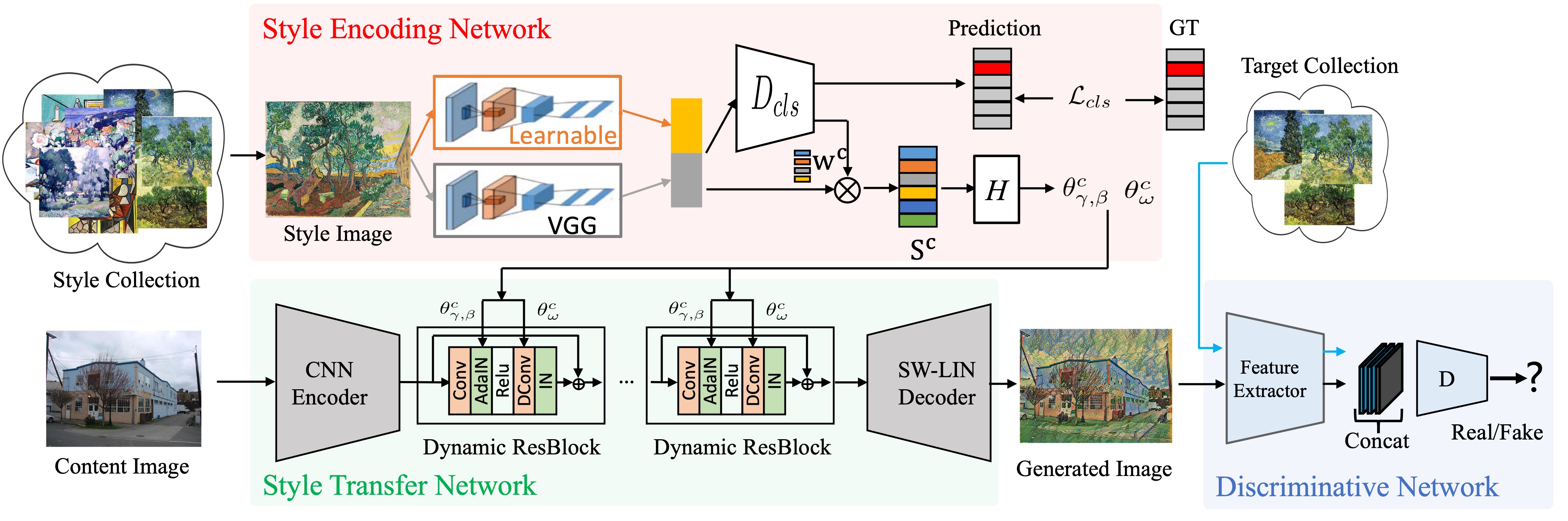
The paper proposes a Dynamic ResBlock Generative Adversarial Network (DRB-GAN) for artistic style transfer. The style code is modeled as the shared parameters for Dynamic ResBlocks connecting both the style encoding network and the style transfer network. In the style encoding network, a style class-aware attention mechanism is used to attend the style feature representation for generating the style codes. In the style transfer network, multiple Dynamic ResBlocks are designed to integrate the style code and the extracted CNN semantic feature and then feed into the spatial window Layer-Instance Normalization (SW-LIN) decoder, which enables high-quality synthetic images with artistic style transfer. Moreover, the style collection conditional discriminator is designed to equip our DRB-GAN model with abilities for both arbitrary style transfer and collection style transfer during the training stage. No matter for arbitrary style transfer or collection style transfer, extensive experiments strongly demonstrate that our proposed DRB-GAN outperforms state-of-the-art methods and exhibits its superior performance in terms of visual quality and efficiency. Our source code is available at \color{magenta}{\url{https://github.com/xuwenju123/DRB-GAN}}.
Motivation & Objective
- Address the limitation of existing methods that treat arbitrary and collection style transfer as separate tasks.
- Improve style transfer quality by modeling style codes as shared parameters in dynamic residual blocks.
- Enhance feature representation learning through a style class-aware attention mechanism in the style encoding network.
- Enable consistent, high-quality stylization across diverse artistic styles and image resolutions.
- Design a style collection conditional discriminator to improve generalization and consistency in both arbitrary and collection style transfer.
Proposed method
- Model style codes as shared parameters for dynamic convolutions and AdaIN layers in multiple Dynamic ResBlocks within the style transfer network.
- Integrate a fixed VGG encoder and a learnable encoder in the style encoding network to extract style-aware features.
- Apply a style class-aware attention mechanism to recalibrate style codes using attention weights derived from style feature representations.
- Use a spatial window Layer-Instance Normalization (SW-LIN) decoder that dynamically combines local channel-wise and layer-wise normalization with learnable parameters.
- Design a style collection conditional discriminator that takes multiple style images from the same artist as reference to enforce feature space consistency.
- Train the model with adversarial loss, perceptual loss, and a classification loss ($\mathcal{L}_{cls}$) to improve style code clustering and generalization.
Experimental results
Research questions
- RQ1Can a unified GAN framework effectively perform both arbitrary and collection-based artistic style transfer?
- RQ2How does modeling style codes as shared parameters in dynamic residual blocks improve style transfer performance?
- RQ3To what extent does the style class-aware attention mechanism enhance the discriminative power of learned style codes?
- RQ4How does the SW-LIN decoder contribute to artifact reduction and high-resolution stylization?
- RQ5What is the impact of the style collection conditional discriminator on consistency and generalization in style transfer?
Key findings
- DRB-GAN achieves state-of-the-art performance in both arbitrary and collection-based style transfer, with a perceptual score of 0.383 and deception score of 0.573.
- The ablation study shows that removing the VGG encoder leads to a significant drop in style score (from 0.383 to 0.273), indicating its importance in capturing style details.
- The model without the $\mathcal{L}_{cls}$ loss degrades in style consistency, with a style score of 0.273, confirming the benefit of class-aware attention for style code clustering.
- The SW-LIN decoder outperforms instance and layer normalization alone, avoiding artifacts and preserving high-resolution details.
- DRB-GAN generalizes well to unseen styles, as shown in qualitative results where stylized outputs match target styles even for previously unseen artists.
- The model maintains consistent performance across different input resolutions, demonstrating robustness and scalability.
Read this paper
Open the full text in the Nubint reader and ask about any passage as you read.
Read this paper on NubintThis review was generated by AI from the original paper. Please check the paper before citing it.