
[Paper Review] DreamAvatar: Text-and-Shape Guided 3D Human Avatar Generation via Diffusion Models
DreamAvatar generates high-quality 3D human avatars from text prompts and SMPL-based shape/pose inputs, using dual observation spaces and diffusion-based self-supervision to produce pose-faithful geometry and texture.
We present DreamAvatar, a text-and-shape guided framework for generating high-quality 3D human avatars with controllable poses. While encouraging results have been reported by recent methods on text-guided 3D common object generation, generating high-quality human avatars remains an open challenge due to the complexity of the human body's shape, pose, and appearance. We propose DreamAvatar to tackle this challenge, which utilizes a trainable NeRF for predicting density and color for 3D points and pretrained text-to-image diffusion models for providing 2D self-supervision. Specifically, we leverage the SMPL model to provide shape and pose guidance for the generation. We introduce a dual-observation-space design that involves the joint optimization of a canonical space and a posed space that are related by a learnable deformation field. This facilitates the generation of more complete textures and geometry faithful to the target pose. We also jointly optimize the losses computed from the full body and from the zoomed-in 3D head to alleviate the common multi-face ''Janus'' problem and improve facial details in the generated avatars. Extensive evaluations demonstrate that DreamAvatar significantly outperforms existing methods, establishing a new state-of-the-art for text-and-shape guided 3D human avatar generation.
Motivation & Objective
- Motivate robust 3D human avatar generation under text guidance while preserving realistic shape and pose.
- Leverage SMPL as a shape prior to guide geometry and pose during diffusion-based optimization.
- Introduce a dual-observation-space (canonical and posed) linked by a learnable deformation field for faithful textures and geometry.
- Mitigate the multi-face Janus problem and enhance facial details by joint full-body and zoomed-in head optimization.
- Enable text-driven editing and shape variation (via SMPL parameters) to produce diverse avatars.
Proposed method
- Use a trainable NeRF to represent density and color for 3D points.
- Apply variational score distillation (VSD) with pretrained diffusion models for 2D self-supervision.
- Incorporate SMPL-derived density fields to initialize and constrain geometry (canonical and posed spaces).
- Introduce a deformation field to map between canonical and posed spaces, enabling dual-observation-space optimization.
- Jointly optimize full-body and zoomed-in head losses to improve facial details and reduce Janus artifacts.
- Utilize ControlNet-based head supervision with a back-view token to stabilize head features.
Experimental results
Research questions
- RQ1How can text-guided diffusion be used to reliably generate coherent 3D human avatars with realistic geometry and texture?
- RQ2Does incorporating SMPL shape/pose priors improve pose consistency and geometry fidelity in 3D avatar generation?
- RQ3Can a dual-observation-space design yield more complete textures and pose-faithful geometry than single-space approaches?
- RQ4Does joint optimization of full-body and head regions mitigate facial detail issues and topological artifacts?
- RQ5How well can text prompts be edited to alter avatar appearance and how do shape parameters affect generated results?
Key findings
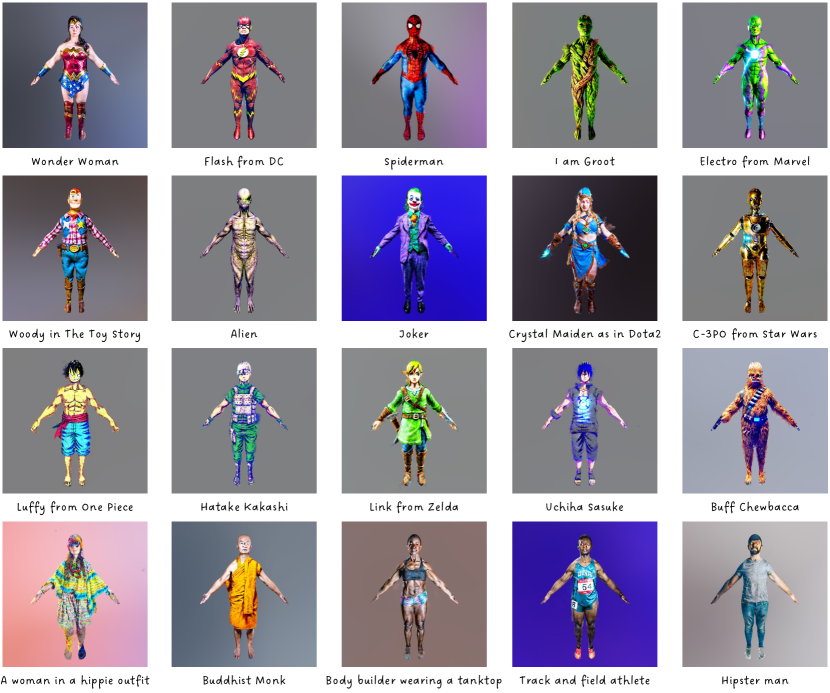
- DreamAvatar outperforms existing text-and-shape guided 3D avatar methods in geometry and texture quality in qualitative evaluations and user studies.
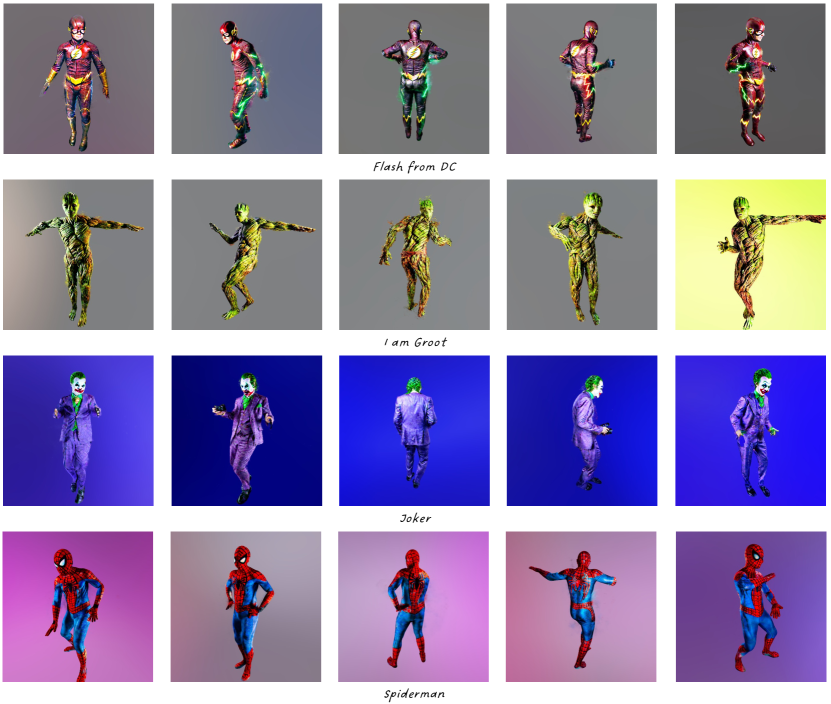
- The dual-observation-space design enables textures to be more complete and geometry to be more faithful to target poses.
- Incorporating SMPL-derived density fields stabilizes geometry and prevents unrealistic shapes.
- Joint head and full-body optimization improves facial details and reduces the Janus problem.
- Text manipulation and SMPL-based shape edits enable controllable and diverse avatar generation across styles and poses.
Read this paper
Open the full text in the Nubint reader and ask about any passage as you read.
Read this paper on NubintThis review was generated by AI from the original paper. Please check the paper before citing it.