
[Paper Review] DreamSparse: Escaping from Plato's Cave with 2D Frozen Diffusion Model Given Sparse Views
DreamSparse enables high-quality, geometry- and identity-consistent novel view synthesis from sparse views (2) using a frozen 2D diffusion model by injecting 3D geometry priors via a geometry module and spatial guidance, with noise perturbation enhancing identity preservation. It outperforms baselines in both training and open-set settings without fine-tuning.
Synthesizing novel view images from a few views is a challenging but practical problem. Existing methods often struggle with producing high-quality results or necessitate per-object optimization in such few-view settings due to the insufficient information provided. In this work, we explore leveraging the strong 2D priors in pre-trained diffusion models for synthesizing novel view images. 2D diffusion models, nevertheless, lack 3D awareness, leading to distorted image synthesis and compromising the identity. To address these problems, we propose DreamSparse, a framework that enables the frozen pre-trained diffusion model to generate geometry and identity-consistent novel view image. Specifically, DreamSparse incorporates a geometry module designed to capture 3D features from sparse views as a 3D prior. Subsequently, a spatial guidance model is introduced to convert these 3D feature maps into spatial information for the generative process. This information is then used to guide the pre-trained diffusion model, enabling it to generate geometrically consistent images without tuning it. Leveraging the strong image priors in the pre-trained diffusion models, DreamSparse is capable of synthesizing high-quality novel views for both object and scene-level images and generalising to open-set images. Experimental results demonstrate that our framework can effectively synthesize novel view images from sparse views and outperforms baselines in both trained and open-set category images. More results can be found on our project page: https://sites.google.com/view/dreamsparse-webpage.
Motivation & Objective
- To address the challenge of synthesizing high-quality novel view images from only two sparse views with known camera poses.
- To overcome the lack of 3D awareness in pre-trained 2D diffusion models, which leads to geometric distortion and identity inconsistency.
- To enable generalization to open-set categories without per-object fine-tuning by leveraging strong 2D image priors.
- To inject 3D geometric and spatial information into a frozen diffusion model without parameter updates.
- To improve identity consistency in synthesized views through a noise perturbation strategy using color estimates from the geometry module.
Proposed method
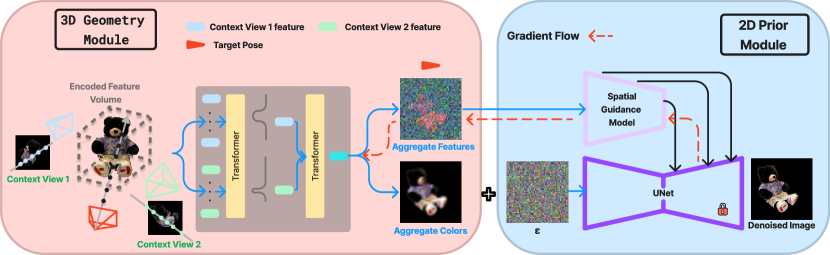
- A geometry module aggregates multi-view features to infer 3D features for the novel view, serving as a 3D prior.
- A spatial guidance model converts 3D feature maps into spatial control signals to steer the diffusion process in the latent space.
- The spatial guidance is applied as cross-attention conditioning in the UNet decoder of the frozen diffusion model, enabling geometry-aware generation without tuning.
- A noise perturbation method adds noise to the blurry color estimate from the geometry model instead of random noise, preserving color and illumination information.
- The pre-trained diffusion model is used in a text-to-image generation setup with text prompts, maintaining frozen weights throughout.
- The framework leverages strong image priors from large-scale text-to-image datasets via the frozen diffusion model to generalize to unseen categories.
Experimental results
Research questions
- RQ1Can a frozen 2D diffusion model generate geometry-consistent novel view images from only two sparse views?
- RQ2How can 3D geometric priors be effectively injected into a pre-trained 2D diffusion model without fine-tuning?
- RQ3Can spatial guidance derived from 3D features improve geometric consistency in novel view synthesis?
- RQ4How can identity and texture consistency be preserved in synthesized views when using a 2D diffusion model?
- RQ5Does noise perturbation using a color estimate improve synthesis quality compared to random noise?
Key findings
- DreamSparse outperforms existing baselines in both training-set and open-set object-level novel view synthesis, demonstrating strong generalization.
- The spatial guidance model enables the frozen diffusion model to generate images with geometry aligned to the ground truth, as shown by PCA visualization of spatial features.
- A spatial guidance weight of λ=2 achieves the best trade-off between geometric consistency and image sharpness, with λ=0 resulting in complete failure of geometry alignment.
- Noise perturbation using the color estimate from the geometry model yields significantly better results than random noise, reducing color and illumination distortions.
- The method generalizes to scene-level novel view synthesis and text-controlled style transfer, showing broader applicability beyond object-centric tasks.
- Despite limitations in handling complex or non-standard geometries, the framework achieves state-of-the-art performance in sparse-view novel view synthesis without per-object optimization.

Read this paper
Open the full text in the Nubint reader and ask about any passage as you read.
Read this paper on NubintThis review was generated by AI from the original paper. Please check the paper before citing it.