
[Paper Review] DrivAerNet++: A Large-Scale Multimodal Car Dataset with Computational Fluid Dynamics Simulations and Deep Learning Benchmarks
DrivAerNet++ is a large-scale multimodal car dataset with 8,000 high-fidelity CFD-simulated designs, multiple data modalities, and ML benchmarks for drag prediction.
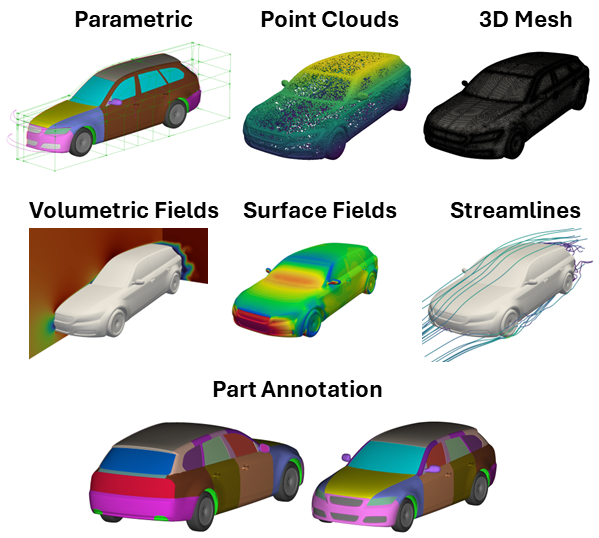
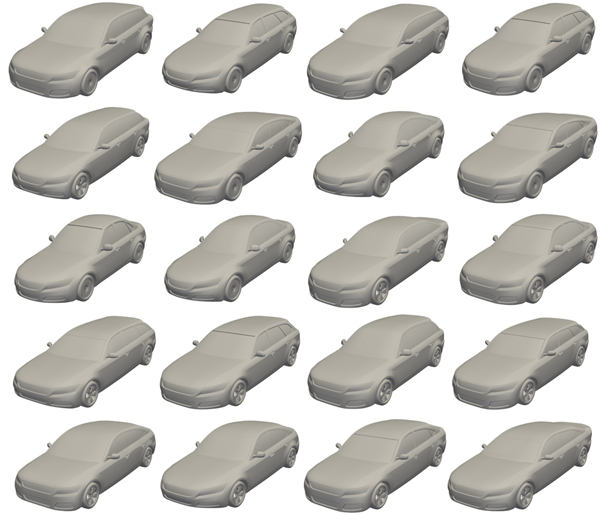
We present DrivAerNet++, the largest and most comprehensive multimodal dataset for aerodynamic car design. DrivAerNet++ comprises 8,000 diverse car designs modeled with high-fidelity computational fluid dynamics (CFD) simulations. The dataset includes diverse car configurations such as fastback, notchback, and estateback, with different underbody and wheel designs to represent both internal combustion engines and electric vehicles. Each entry in the dataset features detailed 3D meshes, parametric models, aerodynamic coefficients, and extensive flow and surface field data, along with segmented parts for car classification and point cloud data. This dataset supports a wide array of machine learning applications including data-driven design optimization, generative modeling, surrogate model training, CFD simulation acceleration, and geometric classification. With more than 39 TB of publicly available engineering data, DrivAerNet++ fills a significant gap in available resources, providing high-quality, diverse data to enhance model training, promote generalization, and accelerate automotive design processes. Along with rigorous dataset validation, we also provide ML benchmarking results on the task of aerodynamic drag prediction, showcasing the breadth of applications supported by our dataset. This dataset is set to significantly impact automotive design and broader engineering disciplines by fostering innovation and improving the fidelity of aerodynamic evaluations. Dataset and code available at: https://github.com/Mohamedelrefaie/DrivAerNet.
Motivation & Objective
- Provide a large, diverse, high-fidelity multimodal dataset of car designs for data-driven aerodynamic design research.
- Enable ML benchmarking across geometry-based and parametric models for drag prediction and other aerodynamic metrics.
- Demonstrate dataset utility through surrogate modeling benchmarks and cross-category generalization analyses.
- Offer data modalities including 3D meshes, point clouds, CFD fields, parametric data, and annotations to support diverse ML tasks.
Proposed method
- Procedural generation of 8,000 car designs by morphing DrivAer-based parametric models using 26 parameters across underbody, wheels, rear, and other components.
- High-fidelity CFD meshing with SnappyHexMesh producing ~24M cells per case and OpenFOAM v11 steady-state k-omega SST simulations.
- Comprehensive data modalities: 3D STL meshes, ANSA parametric models, tabular parameters, CFD fields, surface fields, and annotated labels.
- Benchmarking of surrogate models for aerodynamic drag using 3D geometric deep learning (PointNet, GCNN, RegDGCNN) and tabular AutoML/ML models (XGBoost, LightGBM, RF).
- Evaluation metrics include MSE, MAE, Max AE, and R^2 to compare model accuracy and generalization across designs.
Experimental results
Research questions
- RQ1Can a large-scale multimodal car dataset enable robust surrogate modeling of aerodynamic drag across diverse car configurations?
- RQ2How do geometry-based and parametric ML approaches compare in predicting drag across single-category versus multi-category car designs?
- RQ3To what extent does dataset diversity affect cross-category generalization of drag prediction models?
- RQ4What are the trade-offs between model accuracy and computation time for 3D mesh vs. parametric-data-based drag prediction?
Key findings
- DrivAerNet++ comprises 8,000 car designs with 24M mesh cells per case, totaling 39 TB of data.
- Geometric deep learning models show varying performance: RegDGCNN achieves the best MSE/MAE/Max AE/R^2 on DrivAerNet (Table 2) with MSE 8.01e-5, MAE 6.91e-3, Max AE 8.80e-3, R^2 0.901.
- On DrivAerNet++ (all cars), RegDGCNN attains MSE 14.2e-5, MAE 9.31e-3, Max AE 12.79e-3, R^2 0.641, indicating performance drop when generalizing across diverse designs.
- AutoML/parametric models show improved cross-dataset performance with dataset size; XGBoost R^2 rises from ~0.35 to ~0.55 when increasing training data from 640 to 3,200 samples.
- The study highlights a significant generalization challenge: models trained on a single car category achieve lower R^2 when tested on all-car designs (0.82-0.90 to ~0.60).
- The dataset supports multiple tasks beyond drag surrogate modeling, including CFD acceleration, shape/part classification, and 3D reconstruction.
Read this paper
Open the full text in the Nubint reader and ask about any passage as you read.
Read this paper on NubintThis review was generated by AI from the original paper. Please check the paper before citing it.