
[Paper Review] DriveMLM: Aligning Multi-Modal Large Language Models with Behavioral Planning States for Autonomous Driving
DriveMLM introduces a multi-modal LLM planner aligned with a modular autonomous driving behavioral planner, enabling closed-loop driving in CARLA and providing explanations for decisions, outperforming Apollo on Town05 Long.
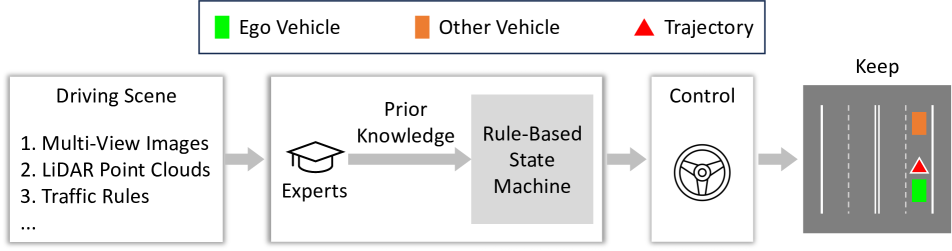
Large language models (LLMs) have opened up new possibilities for intelligent agents, endowing them with human-like thinking and cognitive abilities. In this work, we delve into the potential of large language models (LLMs) in autonomous driving (AD). We introduce DriveMLM, an LLM-based AD framework that can perform close-loop autonomous driving in realistic simulators. To this end, (1) we bridge the gap between the language decisions and the vehicle control commands by standardizing the decision states according to the off-the-shelf motion planning module. (2) We employ a multimodal LLM (MLLM) to model the behavior planning module of a module AD system, which uses driving rules, user commands, and inputs from various sensors (e.g., camera, lidar) as input and makes driving decisions and provide explanations; This model can plug-and-play in existing AD systems such as Autopilot and Apollo for close-loop driving. (3) We design an effective data engine to collect a dataset that includes decision state and corresponding explanation annotation for model training and evaluation. We conduct extensive experiments and show that replacing the decision-making modules of the Autopilot and Apollo with DriveMLM resulted in significant improvements of 3.2 and 4.7 points on the CARLA Town05 Long respectively, demonstrating the effectiveness of our model. We hope this work can serve as a baseline for autonomous driving with LLMs.
Motivation & Objective
- Bridge the gap between language-based decisions and vehicle control by aligning LLM outputs with behavioral planning states.
- Develop a multi-modal LLM planner that ingests multi-view images, LiDAR, rules, and instructions to predict driving decisions and explanations.
- Create an efficient data engine to collect driving data with decision states and explanations for training and evaluation.
- Demonstrate closed-loop driving in realistic simulators and compare with Apollo on standard benchmarks.
Proposed method
- Behavioral planning states alignment to map LLM outputs to executable speed and path decisions in the Apollo-style planner.
- MLLM planner combining a multi-modal tokenizer (temporal QFormer for images, SPT+QFormer for LiDAR, and text embeddings) with an LLM decoder to output decision states and explanations.
- Temporal QFormer design to efficiently process temporal multi-view imagery without linear token growth.
- Data engine that generates 280 hours of CARLA data with decision states and explanations, using expert driving and GPT-3.5 for annotation augmentation.
- Training setup using LLaMA-7B with ViT-g/14 visual encoder, 32 queries for image tokens, GD-MAE for LiDAR, AdamW optimizer, learning rate 5e-5, 2 epochs, batch size 256.
- Evaluation metrics including Driving Score (DS), Route Completion (RC), Infraction Score (IS), Miles Per Intervention (MPI), and NLP-based metrics (BLEU-4, CIDEr, METEOR) for explanations.
Experimental results
Research questions
- RQ1Can an LLM-based planner be aligned with traditional behavioral planning decision states to enable closed-loop autonomous driving?
- RQ2Does a multi-modal LLM planner improve decision accuracy and driving safety compared with rule-based FSM baselines?
- RQ3Are driving decisions and their explanations interpretable and controllable through language-conditioned prompts?
- RQ4How does sensor modality (images, LiDAR) and temporal processing affect decision accuracy and explainability?
Key findings
- DriveMLM achieves 76.1 Driving Score on CARLA Town05 Long, surpassing Apollo by 4.7 DS points.
- DriveMLM attains 98.1 Route Completion and 0.78 Infraction Score, with MPI 0.96, indicating fewer human takeovers.
- Decision-prediction accuracy and decision-type F1-scores are higher for DriveMLM than Apollo and prior LLM baselines.
- DriveMLM provides high-quality explanations with BLEU-4 0.89, CIDEr 0.91, and METEOR 0.61.
- Ablation shows that Multi-View imagery with Temporal QFormer yields best performance (Path F1 and Speed F1 improved; accuracy increased by ~18.2%).
- DriveMLM demonstrates zero-shot reasoning in nuScenes and flexible instruction influence (e.g., yielding for ambulances or traffic-rule adjustments).
Read this paper
Open the full text in the Nubint reader and ask about any passage as you read.
Read this paper on NubintThis review was generated by AI from the original paper. Please check the paper before citing it.