
[Paper Review] DSTCGCN: Learning Dynamic Spatial-Temporal Cross Dependencies for Traffic Forecasting
This paper proposes DSTCGCN, a dynamic spatial-temporal cross graph convolution network that jointly models time-varying spatial and temporal dependencies in traffic forecasting using an FFT-based attentive selector and a dynamic cross graph construction module. It achieves state-of-the-art performance on six real-world datasets by learning adaptive, sparse, and directed cross dependencies without relying on static priors.
Traffic forecasting is essential to intelligent transportation systems, which is challenging due to the complicated spatial and temporal dependencies within a road network. Existing works usually learn spatial and temporal dependencies separately, ignoring the dependencies crossing spatial and temporal dimensions. In this paper, we propose DSTCGCN, a dynamic spatial-temporal cross graph convolution network to learn dynamic spatial and temporal dependencies jointly via graphs for traffic forecasting. Specifically, we introduce a fast Fourier transform (FFT) based attentive selector to choose relevant time steps for each time step based on time-varying traffic data. Given the selected time steps, we introduce a dynamic cross graph construction module, consisting of the spatial graph construction, temporal connection graph construction, and fusion modules, to learn dynamic spatial-temporal cross dependencies without pre-defined priors. Extensive experiments on six real-world datasets demonstrate that DSTCGCN achieves the state-of-the-art performance.
Motivation & Objective
- To address the limitation of existing STGNNs in modeling dynamic, time-varying spatial-temporal cross dependencies in traffic networks.
- To overcome the reliance on static graphs (e.g., distance or similarity matrices) that fail to capture evolving spatial and temporal relationships.
- To develop a method that jointly models dynamic spatial and temporal dependencies through a learnable, sparse, and directed graph fusion mechanism.
- To reduce computational complexity while maintaining high forecasting accuracy by selecting only relevant time steps via an attention mechanism.
- To demonstrate the effectiveness of dynamic cross dependencies in improving traffic forecasting performance across diverse real-world datasets.
Proposed method
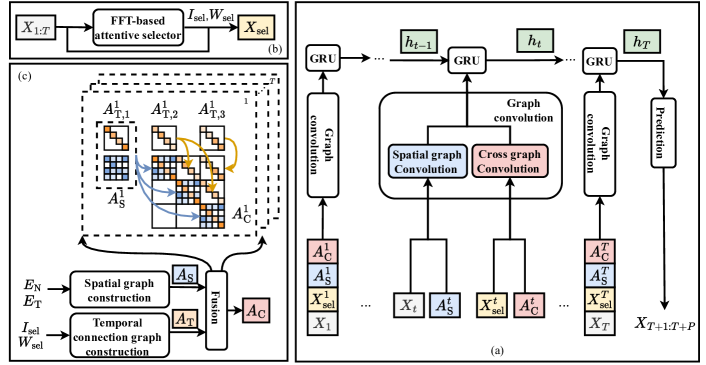
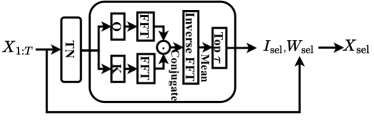
- An FFT-based attentive selector dynamically identifies the most relevant historical time steps for each time step based on time-varying traffic data, reducing the number of temporal neighbors and computational load.
- A dynamic cross graph construction module fuses time-varying spatial graphs and temporal connection graphs in a directed and sparse manner to model cross dependencies.
- The spatial graph is constructed based on learned dynamic correlations between sensors, capturing non-geometric, hidden spatial relationships beyond fixed distances.
- The temporal connection graph models time-varying dependencies between time steps, with attention weights computed via FFT to prioritize relevant historical periods.
- A fusion module combines spatial and temporal components through a learnable, sparse graph convolution mechanism that preserves dynamic, cross-dimensional dependencies.
- The model is trained end-to-end using standard regression loss on traffic flow and speed prediction tasks, with no pre-defined static priors.
Experimental results
Research questions
- RQ1Can an attention mechanism based on fast Fourier transform effectively identify dynamic, relevant time steps for traffic forecasting?
- RQ2Can a dynamic cross graph construction module learn time-varying spatial-temporal dependencies without relying on static graph priors?
- RQ3Does jointly modeling dynamic spatial and temporal cross dependencies lead to improved forecasting accuracy compared to models using static or separate dependencies?
- RQ4How does DSTCGCN balance computational efficiency and predictive performance in large-scale traffic networks?
- RQ5Can the model capture hidden, non-geometric spatial correlations that are not reflected in distance-based graphs?
Key findings
- DSTCGCN achieves state-of-the-art performance on six real-world traffic forecasting datasets, outperforming existing SOTA methods in both MAE and RMSE metrics.
- On PEMS07, DSTCGCN achieves an MAE of 20.37, which is lower than ASTGCN (24.01), STSGCN (25.51), and TraverseNet (21.99), while using fewer parameters.
- The model has only 900,858 parameters and a training time of 3.83 minutes per epoch on PEMS07, making it significantly more efficient than TraverseNet (6.01 min/epoch) and STSGCN (5.52 min/epoch).
- Case studies on METR-LA show that the learned dynamic spatial matrices capture both geometric and hidden spatial correlations, with evolving dependencies over time.
- The FFT-based attention mechanism successfully identifies time steps with high relevance (e.g., time steps 3, 11, 4 in one period), demonstrating dynamic temporal dependency modeling.
- The dynamic cross graph construction module reduces overfitting risks by maintaining sparsity and avoiding full connectivity across time and space.
Better researchstarts right now
From reading papers to final review, dramatically reduce your research time.
No credit card · Free plan available
This review was created by AI and reviewed by human editors.